


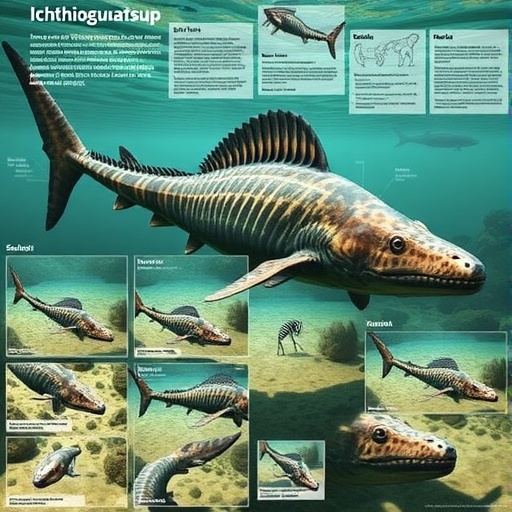
An international team of paleontologists from Switzerland and Germany has unveiled a remarkable discovery that pushes forward our understanding of marine reptile diversity in the Early Jurassic period. Spearheaded by Gaël Spicher of the JURASSICA Museum in Porrentruy, Switzerland, their study meticulously describes a novel species within the genus Eurhinosaurus, based on exquisitely preserved fossil material curated at the Urwelt-Museum Oberfranken in Bayreuth, Germany. The findings were published in the open-access journal Fossil Record, hosted by the Museum für Naturkunde Berlin, marking a significant advancement in the field of Mesozoic marine paleobiology.
The newly identified species has been christened Eurhinosaurus mistelgauensis, a nomenclature derived from the Mistelgau clay pit locality in Upper Franconia, Bavaria. This site has long been recognized as a treasure trove of fossilized Jurassic fauna, offering a window into ancient marine ecosystems. By naming the species after this locality, the researchers emphasize the scientific prominence of the Mistelgau clay pit, which has yielded numerous key specimens critical for reconstructing early Jurassic marine biodiversity and paleoecology.
The Mistelgau clay pit has been subject to systematic excavations since 1998, primarily led by the Urwelt-Museum Oberfranken. These comprehensive efforts have retrieved fossil specimens representative of diverse marine taxa, preserved within the unique sedimentary context of the site. Notably, one specimen of Eurhinosaurus mistelgauensis was extracted from what is colloquially known as a “belemnite battleground,” a geological stratum characterized by dense accumulations of belemnite rostra and other cephalopod remains, indicative of specific paleoenvironmental conditions conducive to high preservation potential.
Ichthyosaurs, the marine reptiles to which Eurhinosaurus belongs, thrived during the Mesozoic era, exhibiting morphological adaptations strongly convergent with modern pelagic predators such as dolphins and tunas. These adaptations include streamlined bodies and powerful tails optimized for swift aquatic locomotion. Eurhinosaurus in particular is renowned for its distinctive rostral morphology; the upper jaw is pronouncedly elongated relative to the lower jaw, resulting in a striking overbite reminiscent of extant swordfish, an example of convergent evolution among predatory vertebrates.
Crucially, Eurhinosaurus mistelgauensis deviates from previously described species in several notable anatomical traits. The robustness of its ribs stands out as a defining characteristic, suggesting possible divergences in respiratory mechanics or locomotor dynamics compared to its congeners. Furthermore, unique morphological features were identified in the craniovertebral joint—the articulation region linking the skull to the cervical vertebrae. These features may reflect specialized kinematic capabilities or feeding strategies that further differentiate this species within the Eurhinosaur clade.
The discovery of Eurhinosaurus mistelgauensis substantiates the paleontological value of the Urwelt-Museum Oberfranken’s fossil repository, underscoring its importance as a scientific resource for paleoecological and evolutionary investigations. Dr. Serjoscha Evers, director of the museum, reflects on the broader implications, noting that the Mistelgau site provides an exceptional glimpse into Jurassic marine life during a geological epoch that is otherwise poorly documented on a global scale. Each fossil find from this locality enriches the composite understanding of marine biotic diversity, trophic structures, and environmental dynamics during this pivotal period.
Ongoing and future analyses of the Mistelgau ichthyosaur specimens promise to expand knowledge not only about interspecific variation but also about the life histories and ecological interactions of these extinct marine reptiles. Among the pending research avenues are detailed investigations into pathologies and healed injuries documented on the bones, which may reveal patterns of predation, intraspecific combat, or environmental hazards experienced by these animals. Such paleoecological insights are crucial for reconstructing the dynamics of Jurassic marine ecosystems with greater fidelity.
The new species’ morphological peculiarities also invite comparative biomechanical modeling to elucidate functional implications of its skeletal design. For instance, the robustness of the ribs and structural differences in the craniovertebral joint might correlate with deviations in swimming efficiency or head mobility during prey capture. This aligns well with bio-inspired approaches increasingly adopted in paleontology, combining quantitative anatomical data with fluid dynamic simulations to infer locomotor performance in extinct taxa.
Moreover, Eurhinosaurus mistelgauensis enriches the phylogenetic framework of ichthyosaurs, providing another data point for reconstructing evolutionary relationships within the group. Its distinct traits may help clarify patterns of morphological innovation and divergence among eurhinosaurs during the Toarcian age of the Early Jurassic. Phylogenetic analyses incorporating this new taxon can refine our understanding of lineage diversification, biogeographic dispersal, and adaptive radiations in marine reptile evolution.
The Mistelgau locality itself remains an invaluable natural laboratory for paleobiological research. The sedimentology and taphonomy interplay in the belemnite battleground offer clues about depositional environments, paleoceanographic conditions, and faunal community assemblages. Integrative studies combining geochemical proxy analyses and paleontological data from this site have the potential to shed light on Jurassic climate fluctuations, marine circulation patterns, and ocean chemistry perturbations—and their influence on marine biodiversity.
The collaborative nature of this study, bridging Swiss and German expertise, highlights the effectiveness of cross-institutional partnerships in advancing paleontological discoveries. Joint efforts have facilitated comprehensive fossil excavation, preparation, and multi-disciplinary analysis necessary to describe new species with scientific rigor. The publication in an open-access venue further ensures that these important findings are accessible globally, stimulating continued research and public engagement with the ancient past.
In summary, the identification of Eurhinosaurus mistelgauensis from the Lower Jurassic Mistelgau clay pit represents a significant milestone in the study of ichthyosaur diversity and Jurassic marine paleoecology. Its distinctive anatomical adaptations provide fresh perspectives on eurhinosaur morphology, functional biology, and evolutionary pathways. The ongoing research stemming from this discovery promises to deepen insight into the life, environment, and evolutionary narrative of one of the Mesozoic’s most fascinating marine reptile groups.
News Publication Date: 25-Sep-2025
Web References:
DOI Link to Article
References:
Spicher GE, Miedema F, Heijne J, Klein N (2025) A new Eurhinosaurus (Ichthyosauria) species from the Lower Jurassic (Toarcian) of Mistelgau (Bavaria, Southern Germany). Fossil Record 28(2): 249-291.
Cite Scienmag News
Violet Maxwell. (September 26, 2025). New Upper Franconian Ichthyosaur Species Discovered in Mistelgau. Scienmag. https://scienmag.com/new-upper-franconian-ichthyosaur-species-discovered-in-mistelgau/
Violet Maxwell. "New Upper Franconian Ichthyosaur Species Discovered in Mistelgau." Scienmag, 26 September 2025, https://scienmag.com/new-upper-franconian-ichthyosaur-species-discovered-in-mistelgau/. Accessed 4 September 2026.
Violet Maxwell. "New Upper Franconian Ichthyosaur Species Discovered in Mistelgau." Scienmag. September 26, 2025. https://scienmag.com/new-upper-franconian-ichthyosaur-species-discovered-in-mistelgau/


