

Saturday, May 23, 2026
Science
No Result
View All Result
  • Login
  • HOME
  • SCIENCE NEWS
  • CONTACT US
  • HOME
  • SCIENCE NEWS
  • CONTACT US
No Result
View All Result
Scienmag
No Result
View All Result
Home Science News Technology and Engineering

New UDA framework enhances precision in medical image segmentation

August 13, 2024
in Technology and Engineering
Reading Time: 2 mins read
0
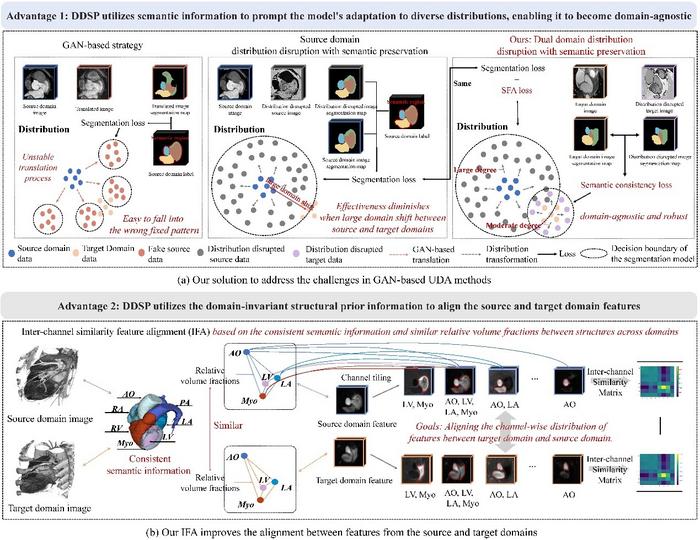
The advantages of the DDSP framework
67
SHARES
606
VIEWS
Share on FacebookShare on Twitter
ADVERTISEMENT

Recently, a research team led by Prof. QIN Wenjian from the Shenzhen Institute of Advanced Technology (SIAT) of the Chinese Academy of Sciences (CAS) developed an unsupervised domain adaptation (UDA) approach, the dual domain distribution disruption with semantics preservation (DDSP) framework, achieving high-precision cross-modality segmentation without dependency on target modality labels.

The advantages of the DDSP framework

Credit: Prof. QIN Wenjian

Recently, a research team led by Prof. QIN Wenjian from the Shenzhen Institute of Advanced Technology (SIAT) of the Chinese Academy of Sciences (CAS) developed an unsupervised domain adaptation (UDA) approach, the dual domain distribution disruption with semantics preservation (DDSP) framework, achieving high-precision cross-modality segmentation without dependency on target modality labels.

The findings were published in Medical Image Analysis on Jul. 14.

Medical imaging stands as a cornerstone of modern diagnostics. However, variability in imaging modalities and the scarcity of target labels pose significant challenges to precise segmentation.

To solve this problem, the researchers proposed the DDSP framework, a paradigm shift in UDA, offering a novel solution that diverges from the complexities of generative adversarial networks (GANs). This approach champions a model inherently adaptive and agnostic to domain variations, thereby simplifying the process and enhancing reliability.

“DDSP embodies the essence of simplicity and efficiency,” said Prof. QIN. “It transcends the intricacies of GAN-based methods by leveraging a distribution disruption module to increase the diversity of image distributions around the source domains, while being constrained by semantic information to facilitate adaptation to distinct distributions.”

Furthermore, the researchers enhanced the framework by incorporating an inter-channel similarity feature alignment. They skillfully utilized the consistent semantic information and anatomical uniformity present across diverse imaging modalities, thereby boosting the framework’s flexibility and precision in recognizing features.

Finally, the researchers validated the proposed method on three public medical imaging datasets, with results showing that DDSP outperformed current UDA techniques. Importantly, its efficacy is comparable to that of fully-supervised models, indicating its potential to facilitate high-quality medical image analysis without extensive target labeling requirements.

The proposed method has great potential to address the challenges of domain adaptation in medical image segmentation tasks, providing a promising avenue for future research in the field.


Journal

Medical Image Analysis

DOI

10.1016/j.media.2024.103275

Method of Research

Commentary/editorial

Subject of Research

Not applicable

Article Title

Dual domain distribution disruption with semantics preservation: Unsupervised domain adaptation for medical image segmentation

Article Publication Date

14-Jul-2024

Share27Tweet17
Previous Post

Innovating sustainable hydrogen production via seawater electrolysis: Self-reconstructed stable and active surface on carbonized wood electrodes

Next Post

Amelioration of habitat since the early Holocene contributed to the origin of agriculture in the farming-pastoral zone of northern China

Related Posts

Vancomycin Dosing Boosts Pediatric Sepsis Treatment Outcomes — Technology and Engineering
Technology and Engineering

Vancomycin Dosing Boosts Pediatric Sepsis Treatment Outcomes

May 23, 2026
Explainable AI Predicts Pediatric Sepsis Early Using Labs — Technology and Engineering
Technology and Engineering

Explainable AI Predicts Pediatric Sepsis Early Using Labs

May 22, 2026
Stress Exposure Linked to Discomfort in Preterm Infants — Technology and Engineering
Technology and Engineering

Stress Exposure Linked to Discomfort in Preterm Infants

May 22, 2026
Granule-Based Nonlinear Fuzzy System Diagnoses Chemical Faults — Technology and Engineering
Technology and Engineering

Granule-Based Nonlinear Fuzzy System Diagnoses Chemical Faults

May 22, 2026
Brain-Inspired Navigation Revolutionizes Robot Mobility — Technology and Engineering
Technology and Engineering

Brain-Inspired Navigation Revolutionizes Robot Mobility

May 22, 2026
Megalibraries Take the Lead in Autonomous Discovery, Surpassing Self-Driving Labs — Technology and Engineering
Technology and Engineering

Megalibraries Take the Lead in Autonomous Discovery, Surpassing Self-Driving Labs

May 22, 2026
Next Post
Landscape of Yumin Site

Amelioration of habitat since the early Holocene contributed to the origin of agriculture in the farming-pastoral zone of northern China

  • Mothers who receive childcare support from maternal grandparents show more parental warmth, finds NTU Singapore study

    Mothers who receive childcare support from maternal grandparents show more parental warmth, finds NTU Singapore study

    27648 shares
    Share 11056 Tweet 6910
  • University of Seville Breaks 120-Year-Old Mystery, Revises a Key Einstein Concept

    1051 shares
    Share 420 Tweet 263
  • Bee body mass, pathogens and local climate influence heat tolerance

    679 shares
    Share 272 Tweet 170
  • Researchers record first-ever images and data of a shark experiencing a boat strike

    543 shares
    Share 217 Tweet 136
  • Groundbreaking Clinical Trial Reveals Lubiprostone Enhances Kidney Function

    528 shares
    Share 211 Tweet 132
Science

Embark on a thrilling journey of discovery with Scienmag.com—your ultimate source for cutting-edge breakthroughs. Immerse yourself in a world where curiosity knows no limits and tomorrow’s possibilities become today’s reality!

RECENT NEWS

  • Glutamatergic NTS Pathway Links Heart Injury, Anxiety
  • Blood Multiomics Uncover Lipid-Mitochondria Link in Cirrhosis
  • Rising Sightings of Blue and Fin Whales in the South East Atlantic
  • Vancomycin Dosing Boosts Pediatric Sepsis Treatment Outcomes

Categories

  • Agriculture
  • Anthropology
  • Archaeology
  • Athmospheric
  • Biology
  • Biotechnology
  • Blog
  • Bussines
  • Cancer
  • Chemistry
  • Climate
  • Earth Science
  • Editorial Policy
  • Marine
  • Mathematics
  • Medicine
  • Pediatry
  • Policy
  • Psychology & Psychiatry
  • Science Education
  • Social Science
  • Space
  • Technology and Engineering

Subscribe to Blog via Email

Enter your email address to subscribe to this blog and receive notifications of new posts by email.

Join 5,146 other subscribers

© 2025 Scienmag - Science Magazine

Welcome Back!

Login to your account below

Forgotten Password?

Retrieve your password

Please enter your username or email address to reset your password.

Log In
No Result
View All Result
  • HOME
  • SCIENCE NEWS
  • CONTACT US

© 2025 Scienmag - Science Magazine

Discover more from Science

Subscribe now to keep reading and get access to the full archive.

Continue reading
