


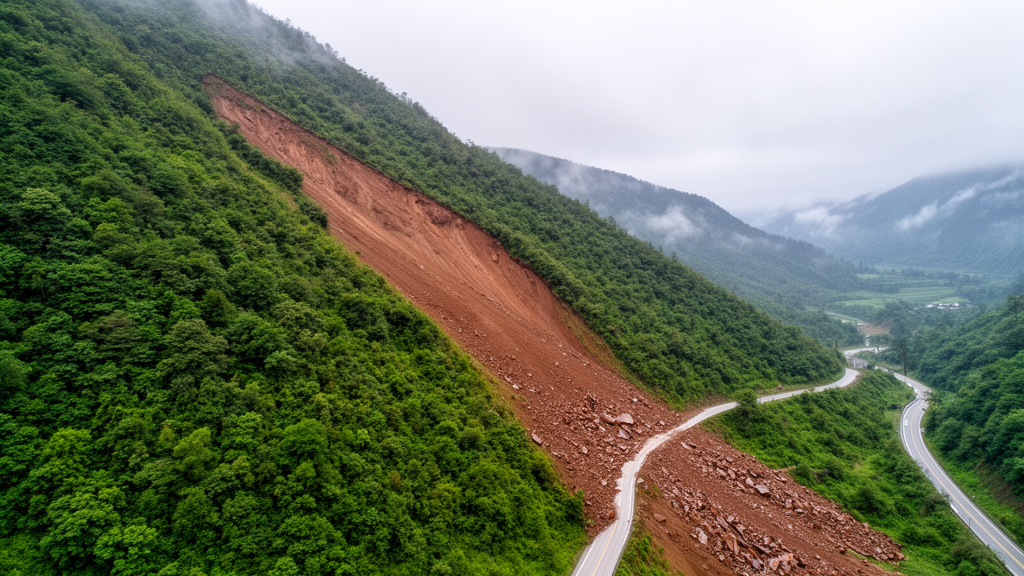
Landslides rarely announce themselves. In satellite and aerial imagery, a fresh failure can look almost identical to a road cut, a riverbank, a quarry face, or a patch of bare soil drying in the sun. For regional screening teams, that ambiguity is not a curiosity but a workload problem: every false detection becomes a location that an analyst must review, while every missed scar disappears from the inspection queue entirely. A team of computer scientists at Yangtze University in Jingzhou, China, has now built a detection system designed specifically for this sparse, confusing setting, and their results suggest that where a neural network focuses its attention during training matters as much as how big the network is.
Changhao Lin, Sai Liang, Hongjie Qin, Qinsonghao Zheng, and Jianghai Shen developed the Sparse Landslide Detection Transformer, or SLD-DETR, by adapting version 4 of the Real-Time Detection Transformer, a modern detector family that borrows semantic knowledge from a large vision foundation model during training without enlarging the deployed network. Their work, published in Frontiers in Earth Science, tackles two connected information bottlenecks that plague generic detectors when applied to landslide imagery. First, extensive background regions dominate semantic supervision, so the network learns more from hectares of bare terrain than from the few cells containing an actual scar. Second, small landslides lose spatial detail during repeated downsampling, and the decoder cannot recover evidence that has already vanished from the feature hierarchy.
The solution is a coordinated focus-preserve-expose design built from three modules. Scale-guided focused distillation, or SGFD, changes how the student detector aligns with a frozen DINOv3 teacher. Instead of averaging the teacher-student discrepancy uniformly across the feature map, SGFD converts each annotated landslide box into a scale-aware elliptical Gaussian region whose amplitude grows as the box becomes smaller. Overlapping instances are combined by a pointwise maximum to prevent gradient multiplication, and a fixed floor of 0.25 retains weak background supervision so that even negative images remain informative. The result is a semantic-alignment gradient redistributed toward annotated regions while keeping surrounding terrain context available.
High-resolution scale-aware supervision, or HRSS, operates earlier in the backbone at stride 4, the finest feature level. A lightweight auxiliary head predicts a dense heatmap compared against a soft target derived from the ground-truth boxes, using a focal-style loss that emphasizes poorly predicted cells and weights target-associated pixels more heavily than background. Because the objective is assignment-free, relevant feature cells receive supervision regardless of whether they become matched queries under the detector’s one-to-one Hungarian matching. The head contains roughly 0.04 million training parameters and is discarded before evaluation, adding nothing to the deployed model.
Stride-4 decoder memory, or S2-Mem, is the only module that remains at inference. The baseline decoder begins its memory at stride 8, so any local evidence confined to the stride-4 feature is inaccessible to query selection and deformable cross-attention. S2-Mem projects the stride-4 backbone feature directly into an additional decoder memory level while bypassing the hybrid encoder entirely, and it sets the base anchor prior at 0.025 so that the original coarser-scale priors remain unchanged. Each query retains continuous, content-adaptive control over where to sample and how much attention mass to assign to the fine level. The module adds approximately 0.06 million parameters, bringing the deployed model from 9.16 to 9.22 million parameters.
Evaluation was designed to reflect how detections are actually reviewed. The team audited the Multi-Scale Landslide Dataset and discovered that the original release suffered substantial source-scene leakage: 78.1 percent of released test files and 77.6 percent of validation files shared training scenes, with 36.0 percent of base scenes crossing nominal subset boundaries. They stripped augmentation suffixes from filenames, recovered base-scene identifiers, and repartitioned the full image pool at a 6:2:2 ratio with each source scene and all its derivatives assigned exclusively to one subset. The held-out test split contains 292 landslides in 655 images, including 401 negative images. All experiments used five independent training seeds, and confidence thresholds were calibrated on validation to a false-positive rate of no more than 0.10 false positives per image, then frozen for testing.
On the held-out test split, SLD-DETR achieved a mean average precision across IoU thresholds 0.50 to 0.95 of 58.07 plus or minus 1.10 percent, compared with 53.90 plus or minus 0.96 percent for the RT-DETRv4-S baseline, and 63.43 plus or minus 1.23 percent mAP@75 against 58.34 plus or minus 2.65 percent. At the validation-calibrated operating points, the test miss rate was 15.82 plus or minus 2.18 percent for SLD-DETR versus 18.63 plus or minus 0.99 percent for the baseline, with equal positive-image false positives per image of 0.2575 and slightly lower negative-image FPPI for the new model. A supplementary run of unmodified RT-DETRv4-S under the original released split peaked at 69.06 percent mAP@50:95, a 15.16-percentage-point difference consistent with optimistic evaluation under source overlap.
Ablation experiments revealed that training order matters. The matched control F0, which repeats the same restoration and late-stage procedure with SGFD inactive, yields only a negligible gain over the joint S2-Mem and HRSS configuration, so restoration alone does not explain the improvement. Activating SGFD under the matched procedure increases mAP@50:95 by 3.56 percentage points, mAP@75 by 4.16 points, and mAR@100 by 1.53 points, while reducing miss rate by 2.40 points. Comparing the final stage-wise model with joint training from epoch 0 yields a 2.33-point mAP@50:95 gain, though mean average recall is slightly lower, a schedule-dependent trade-off rather than uniform improvement. A controlled ConvNeXt-V2-Atto backbone substitution falls short of the final model, suggesting the gain is not explained by backbone choice alone.
Zero-shot transfer to the new-landslide subset of the Sichuan-Tibet Transportation Corridor dataset, with no target-domain training or calibration, showed substantial degradation for all nine detectors evaluated. SLD-DETR had the highest average precision within the RT-DETRv4 family, but RF-DETR-S performed best overall, bounding the regional generalization claim. Deployment costs are also measurable: decoder memory increases from 8,400 to 34,000 tokens, throughput at 640-pixel input drops from 61.2 to 49.4 images per second at batch 1, and resolution scaling is steep, with SLD-DETR retaining only 13.1 percent of its reference throughput at 1,280 pixels, though FP16 evaluation recovers 2.41 times the FP32 rate at that resolution.
The authors are careful about what the detector does and does not measure. A detection box is a screening envelope, not a rupture boundary, displaced volume, or failure mechanism, and the single-class annotations establish nothing about activity, depth, trigger, or developmental stage. The method is positioned as a candidate-generation component for analyst-reviewed inventories: fewer false candidates reduce the number of locations requiring inspection, while recovering missed annotations preserves locations for follow-up. Establishing hazard significance still requires geological evidence beyond the image classifier, and the effect on inventory completeness and downstream regional assessment remains to be evaluated. But for the sparse screening problem that regional landslide surveys actually face, the coordinated focus-preserve-expose design demonstrates that target-focused supervision and fine spatial evidence can be worth real percentage points.
Subject of Research: Artificial Intelligence
Article Title: Target-focused supervision and fine spatial evidence improve sparse landslide detection in remote-sensing imagery
Article References: Lin, C., Liang, S., Qin, H., Zheng, Q., & Shen, J. (2026). Target-focused supervision and fine spatial evidence improve sparse landslide detection in remote-sensing imagery. Frontiers in Earth Science, 14, Article 1959611. https://doi.org/10.3389/feart.2026.1959611
Image Credits: AI Generated
DOI: 10.3389/feart.2026.1959611
Keywords: landslide detection, remote sensing, detection transformer, knowledge distillation, sparse object detection, geohazards, machine learning, Frontiers in Earth Science, Target-focused, supervision, fine, spatial
Cite Scienmag News
Violet Maxwell. (October 15, 2026). New Transformer Spots Landslides That Other AI Detectors Miss. Scienmag. https://scienmag.com/new-transformer-spots-landslides-that-other-ai-detectors-miss/
Violet Maxwell. "New Transformer Spots Landslides That Other AI Detectors Miss." Scienmag, 15 October 2026, https://scienmag.com/new-transformer-spots-landslides-that-other-ai-detectors-miss/. Accessed 15 October 2026.
Violet Maxwell. "New Transformer Spots Landslides That Other AI Detectors Miss." Scienmag. October 15, 2026. https://scienmag.com/new-transformer-spots-landslides-that-other-ai-detectors-miss/


