


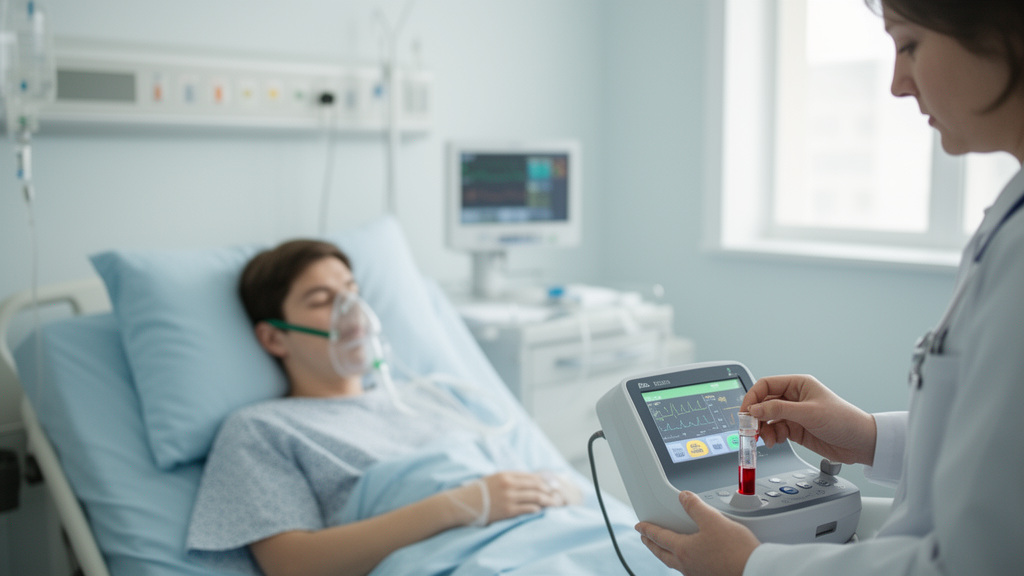
Every year, hundreds of thousands of people undergo surgery to remove lung tumors, and for most of them the operation itself goes smoothly. The danger often arrives afterward, in the form of pneumonia, respiratory failure, or the sudden need for a breathing tube that was supposed to come out hours earlier. Anesthesiologists have long searched for signals during the operation that might flag which patients are heading for trouble, and a new study suggests that one such signal may have been hiding in plain sight on the anesthesia monitor all along: the gap between two carbon dioxide numbers that surgeons and anesthesiologists glance at every day.
The study, published in Frontiers in Medicine by a team from Bengbu Medical University in China, mined a large perioperative database called INSPIRE, which contains detailed records from Seoul National University Hospital covering operations performed between 2011 and 2020. The researchers focused on 2,665 patients who underwent lung cancer resection and asked a deceptively simple question: does the difference between the carbon dioxide level measured in arterial blood and the carbon dioxide level measured at the end of each breath — the so-called arterial-to-end-tidal gradient — predict postoperative respiratory complications?
To understand why this gap matters, it helps to know what each number represents. The end-tidal carbon dioxide reading, displayed continuously on every anesthesia monitor, reflects the concentration of carbon dioxide in exhaled air at the very end of a breath, which normally approximates the level in the alveoli deep in the lungs. The arterial value, obtained from blood samples, reflects what is actually circulating in the bloodstream. In a healthy lung, these two numbers track each other closely. But when parts of the lung are poorly perfused with blood, or when air and blood flow become mismatched across different regions of the lung, the two readings drift apart. The wider the gap, the more inefficient the gas exchange — and during lung surgery, where one lung is often deliberately collapsed to give surgeons room to work, that mismatch can be dramatic.
The researchers paired each arterial blood gas measurement taken during surgery with the nearest end-tidal reading within ten minutes, then calculated each patient’s median gradient across the operation. Among the 2,436 patients with complete data, 80 experienced respiratory morbidity — either a new respiratory diagnosis such as pneumonia or acute respiratory failure, or a record of postoperative ventilation lasting at least six hours after leaving the operating room. The numbers were striking: for every 5 millimeters of mercury that the gradient rose, the odds of respiratory morbidity increased by 53 percent, and the absolute risk climbed from 2.28 percent in the lowest quartile of gradients to 3.46 percent in the highest — a difference of 1.18 percentage points.
What makes the finding particularly compelling is how robust it proved to statistical scrutiny. The team ran 108 different sensitivity analyses, varying how the gradient was calculated, how the outcome was defined, and which confounding factors were adjusted for. Every single specification produced a positive association. The effect held up when the researchers added operation duration, blood pressure, tidal volume, oxygen fraction, and positive end-expiratory pressure to their models. It held when they excluded whole-lung resections, when they restricted ventilation records to a narrower time window, and when they removed the most statistically influential patients from the analysis. The association was also visible in repeated-measurement models that treated each arterial-end-tidal pair as a separate observation, and in an empirical-Bayes analysis that estimated each patient’s underlying gradient level under standardized conditions.
But here is where the story takes a more sobering turn. When the researchers asked whether the gradient added anything beyond what the arterial carbon dioxide level alone could tell them, the answer was essentially no. In a post hoc analysis, adding the gradient to a prediction model that already included arterial carbon dioxide and clinical covariates changed the cross-validated area under the receiver operating characteristic curve from 0.7324 to 0.7325 — a difference of one ten-thousandth, with a confidence interval that comfortably included zero. The gradient’s statistical advantage over arterial carbon dioxide alone, measured by the Akaike information criterion, was negligible. In other words, the gradient is associated with respiratory morbidity, but it does not appear to carry independent prognostic information once you already know the arterial value.
This distinction matters enormously for clinical practice. End-tidal carbon dioxide is measured continuously and noninvasively on every anesthetized patient, while arterial blood gases require needle sticks and laboratory processing. If the gradient had added meaningful predictive power, it could have become a cheap, real-time early warning system. Instead, the study’s authors are careful to frame their finding as an observational association rather than a clinical tool. They note that the gradient is not equivalent to physiological dead space — the fraction of each breath that reaches airways where no gas exchange occurs — which requires volumetric capnography to measure properly. The Bohr and Enghoff equations used to calculate dead space rely on different measurements entirely, and findings from critical care studies linking dead-space fraction to mortality in acute respiratory distress syndrome cannot simply be transplanted to the operating room.
The physiological story behind the association remains plausible even if the incremental predictive value is modest. Arterial carbon dioxide reflects the balance between metabolic carbon dioxide production and effective alveolar ventilation, while end-tidal carbon dioxide is additionally shaped by regional lung perfusion, the sequence in which different lung units empty, and the technical details of gas sampling. During one-lung ventilation, when an entire lung is collapsed and perfusion is redirected, the gradient can swing widely. Studies dating back decades have documented this variability, and more recent work has shown that end-tidal carbon dioxide tracks changes in cardiac output during hemodynamic shifts. The gradient may therefore be capturing something about pulmonary perfusion and ventilation-perfusion matching that neither number alone reveals — even if that something overlaps substantially with what arterial carbon dioxide already tells us.
The study has important limitations that the authors acknowledge candidly. Arterial sampling was sparse and unstandardized: nearly 44 percent of patients contributed only one arterial-end-tidal pair, and more than three-quarters contributed no more than two. The timing and duration of one-lung ventilation were not recorded, so individual measurements could not be assigned to specific phases of surgery. The outcome definition relied on administrative codes and ventilation records rather than clinical adjudication, meaning both false positives and false negatives are possible. The database could not distinguish planned from unplanned postoperative ventilation, or invasive from non-invasive support. And because the analysis was retrospective and reconstructed after data access, without preregistration, the findings should be treated as hypothesis-generating rather than definitive.
What emerges from this study is a nuanced picture of a familiar monitoring signal. The arterial-to-end-tidal carbon dioxide gradient is associated with postoperative respiratory morbidity after lung cancer resection, and that association survives an unusually thorough battery of sensitivity analyses. But the gradient does not outperform the simpler and more widely available arterial carbon dioxide measurement when it comes to actually predicting who will develop complications. The authors call for prospective studies with standardized arterial gas sampling at defined operative phases, direct measurement of dead space and pulmonary perfusion, and independent external validation before the gradient finds a place in clinical decision-making. Until then, the gap between two numbers on the anesthesia monitor remains a fascinating physiological window into lung function during surgery — one that tells us something real about respiratory risk, even if it does not yet tell us anything we could not learn another way.
Subject of Research: Perioperative medicine and anesthesiology
Article Title: Higher intraoperative arterial-to-end-tidal carbon dioxide gradients are associated with postoperative respiratory morbidity after lung cancer resection: a retrospective INSPIRE cohort study
Article References: Li, L., Wang, D., Zhou, Q., & Shang, B. (2026). Higher intraoperative arterial-to-end-tidal carbon dioxide gradients are associated with postoperative respiratory morbidity after lung cancer resection: a retrospective INSPIRE cohort study. Frontiers in Medicine, 13, Article 1995794. https://doi.org/10.3389/fmed.2026.1995794
Image Credits: AI Generated
DOI: 10.3389/fmed.2026.1995794
Keywords: lung cancer surgery, carbon dioxide gradient, capnography, postoperative respiratory morbidity, anesthesiology, thoracic surgery, INSPIRE database, perioperative risk, Higher, intraoperative, arterial-to-end-tidal, carbon
Cite Scienmag News
Ophelia Keating. (October 15, 2026). The Carbon Dioxide Gap That Predicts Trouble After Lung Cancer Surgery. Scienmag. https://scienmag.com/the-carbon-dioxide-gap-that-predicts-trouble-after-lung-cancer-surgery/
Ophelia Keating. "The Carbon Dioxide Gap That Predicts Trouble After Lung Cancer Surgery." Scienmag, 15 October 2026, https://scienmag.com/the-carbon-dioxide-gap-that-predicts-trouble-after-lung-cancer-surgery/. Accessed 15 October 2026.
Ophelia Keating. "The Carbon Dioxide Gap That Predicts Trouble After Lung Cancer Surgery." Scienmag. October 15, 2026. https://scienmag.com/the-carbon-dioxide-gap-that-predicts-trouble-after-lung-cancer-surgery/


