


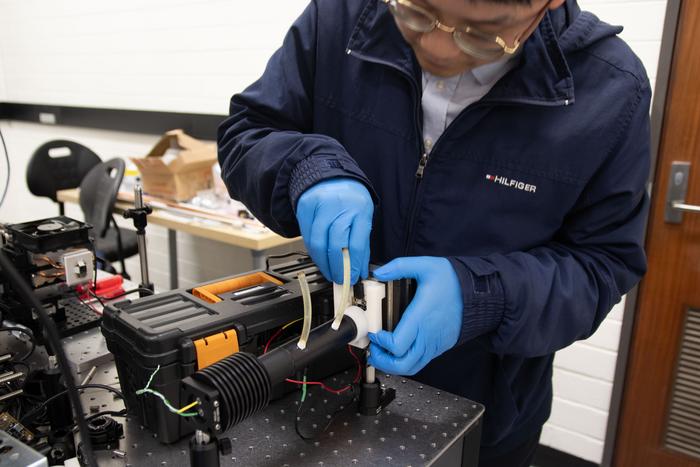
Physicists at the ARC Centre of Excellence for Transformative Meta-Optical Systems are working to address the challenge of consumer access to air quality data with the development of a portable infrared micro-spectrometers that could one day be integrated into wearable devices to monitor multiple toxic and greenhouse gases, giving individuals increased control over their own exposure to harmful gases so they can make better-informed decisions about their health.

Credit: (c) University of Melbourne
Physicists at the ARC Centre of Excellence for Transformative Meta-Optical Systems are working to address the challenge of consumer access to air quality data with the development of a portable infrared micro-spectrometers that could one day be integrated into wearable devices to monitor multiple toxic and greenhouse gases, giving individuals increased control over their own exposure to harmful gases so they can make better-informed decisions about their health.
This new technology, developed by the Centre’s University of Melbourne team and published today in Microsystems and Nanoengineering, uses a machine learning algorithm and metasurface spectral filter arrays to create a microspectrometer (MIMM) that detects the unique infrared signature of multiple gases using the one sensor. The prototype is currently the size of a matchbox but has the potential to be miniaturised far further.
Traditional infrared spectrometers are exceptional gas detectors but are bulky equipment usually only found in laboratories. Current portable multi-gas detectors that can be purchased and used in homes and office building are made of multiple bulk sensor systems in one housing, increasing the size and weight of the device, limiting their usefulness. They also use chemiresistors rather than spectroscopy, which provides inferior results and limits their lifespan. There is no path forward for the miniaturisation of either of these two devices using traditional optical components and thus current technology will never be wearable or integrated into the Internet of Things.
A metasurface filter integrated with an off-the-shelf IR detector, on the other hand, addresses the issues of miniaturization by creating sensors from materials on nanometres thick. In this case, TMOS researchers created a metasurface spectral filter array to create a sensor with the potential to sense all harmful gases. The filter array consists of metallic nanostructures on top of a silicon substrate. Specifically, by varying the periodicity of the nanostructures, the spectral features of these filters can be tuned in the wavelength of interest. In this study, they demonstrated its effectiveness with carbon dioxide, methane, ammonia and methyl-ethyl-ketone.
Lead author Jiajun Meng says, “The microspectrometer is a metasurface filter array integrated with a commercial IR camera that is consumable-free, compact (~ 1 cm3) and lightweight (~1 g). The machine learning algorithm is trained to analyze the data from the microspectrometer and predict the gases present.
TMOS Chief Investigator Kenneth Crozier says, “The next steps in the research are to increase the sensitivity of the device and make the platform more robust. We are excited about this technology because with a little more development it can be applied to lots of other chemical detection problems (e.g. solids and liquids).”
For more information about this research, please contact connect@tmos.org.au
Journal
Microsystems & Nanoengineering
Method of Research
Experimental study
Subject of Research
Not applicable
Article Title
Smart mid-infrared metasurface microspectrometer gas sensing system
Article Publication Date
7-Jun-2024
Cite Scienmag News
Russell Cooper. (June 7, 2024). New technology gives people a better sense of what they’re breathing. Scienmag. https://scienmag.com/new-technology-gives-people-a-better-sense-of-what-theyre-breathing/
Russell Cooper. "New technology gives people a better sense of what they’re breathing." Scienmag, 7 June 2024, https://scienmag.com/new-technology-gives-people-a-better-sense-of-what-theyre-breathing/. Accessed 4 September 2026.
Russell Cooper. "New technology gives people a better sense of what they’re breathing." Scienmag. June 7, 2024. https://scienmag.com/new-technology-gives-people-a-better-sense-of-what-theyre-breathing/

