


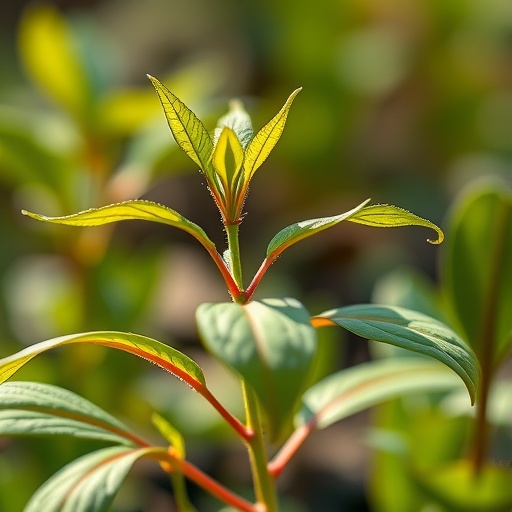
As global temperatures continue to escalate, understanding how plants respond and adapt to heat stress at the molecular level is becoming increasingly critical. Researchers at the University of Mississippi have dedicated years of inquiry into deciphering the intricate biological mechanisms that enable plants to survive and even thrive in warming environments. Their groundbreaking study, recently published in Nature Communications, delves deep into the molecular machinery that governs plant growth responses to elevated temperatures, offering profound insights with implications for agriculture and climate resilience worldwide.
Plants, unlike mobile animals, are inherently sedentary and must endure the environmental conditions where they grow. Rising global temperatures pose a significant threat to crop productivity and ecosystem stability because plants cannot simply migrate to more favorable climates. This reality underscores the urgency in unraveling how plants sense and acclimate to heat. The study led by biology professor Yongjian Qiu and postdoctoral researcher Haibo Xiong investigates these adaptive responses in the model plant Arabidopsis thaliana, better known as Thale cress, a cornerstone species in plant biology research due to its well-mapped genome and genetic tractability.
Central to the research is a transcription factor protein named PHYTOCHROME INTERACTING FACTOR 4, or PIF4. Transcription factors like PIF4 regulate gene expression by binding to specific DNA sequences and recruiting other proteins necessary for initiating the transcription of target genes. PIF4 has been shown to be a pivotal regulator of thermomorphogenesis—the suite of morphological changes plants undergo in response to warmer temperatures, including stem elongation, early flowering, and alterations in leaf orientation. By orchestrating these growth responses, PIF4 essentially functions as the molecular commander controlling key adaptive traits.
In typical scenarios, PIF4 activates target genes by directly binding to DNA and recruiting transcriptional machinery to turn on specific genetic programs favorable for heat adaptation. Surprisingly, however, the University of Mississippi team discovered that even when PIF4’s ability to bind DNA or activate transcription was experimentally disrupted, plants retained their capacity to respond to warm temperatures. This unexpected finding flips conventional understanding and suggests a remarkable functional redundancy and adaptability within plant molecular systems.
Their experiments demonstrated that PIF4 functions less like an autocratic controller and more like a delegator. When its direct DNA-binding capability is incapacitated, PIF4 compensates by collaborating with other proteins that take over the DNA binding and gene activation roles. This ability to form protein complexes, or oligomerize, enables it to outsource critical functions and maintain regulatory control of thermomorphogenic processes. In this way, plants employ a flexible and fail-safe regulatory network that preserves growth responses even under genetic perturbations.
The discovery underscores the sophisticated resilience encoded within plant molecular pathways. Instead of reliance on a single molecular interaction, plants harness a network of protein partnerships to ensure key physiological processes can proceed despite disruptions. This functional redundancy provides an evolutionary advantage, fortifying plants against fluctuating environmental stresses and genetic mutations.
From an applied perspective, these insights carry substantial weight. Crop species often suffer yield losses under heat stress due to compromised development and accelerated maturation. Understanding that proteins like PIF4 act as central hubs coordinating temperature responses by recruiting multiple partners opens new avenues for agricultural biotechnology. Instead of targeting singular genes or biochemical functions, future strategies may focus on enhancing or mimicking these integrative protein networks to develop heat-resilient crops capable of sustaining yields in warming climates.
The National Oceanic and Atmospheric Administration (NOAA) recently reported that 2024 is on track to become the warmest year recorded since 1850, with 2025 anticipated as the third warmest. These statistics punctuate the urgency of this research. As rising global temperatures threaten food security, unraveling the molecular bases of plant heat response is an indispensable step toward safeguarding agriculture. The work at Ole Miss exemplifies how fundamental plant science can intersect with urgent global challenges to provide solutions.
Further molecular characterization revealed that PIF4’s ability to oligomerize—forming multi-protein assemblies—is central to its function in thermomorphogenesis. This oligomerization allows PIF4 to remain an effective organizer, bridging and coordinating other transcription factors and cofactors. The plant’s molecular system thus exhibits an ingenious modularity, where disruption of one functional domain re-routes biological activity via protein-protein interactions, ensuring continuity in critical growth signaling pathways.
Beyond PIF4, the study highlights the broader concept that cellular regulatory networks are interdependent and robust. Proteins seldom act in isolation; instead, they form intricate networks where multiple components share similar or overlapping functions. These networks provide robustness by distributing control, a principle that may extend to various stress response mechanisms beyond temperature adaptation, such as drought tolerance or pathogen defense.
The implications extend into predictive modeling and crop breeding. By identifying proteins that function as molecular “hubs”—integrating and distributing regulatory signals—scientists can streamline the search for key genetic targets. Instead of chasing countless individual genes, focusing on central regulators like PIF4 and their interaction networks could accelerate the development of cultivars that grow consistently under thermal stress, thus bolstering food security amid climatic upheaval.
Although the molecular pathways of heat response have long been acknowledged, this research elevates our understanding of the dynamic flexibility embedded within these pathways. It challenges the canonical view of transcriptional regulation as a straightforward chain of command, revealing a more nuanced, distributed control system resilient to single points of failure. This paradigm shift reflects a broader trend in molecular biology, recognizing that complex biological systems rely on adaptability and redundancy to sustain function.
The work carried out by Qiu, Xiong, and their team emerges from five years of meticulous experimentation, involving state-of-the-art genetic manipulation, protein interaction assays, and plant phenotyping under precisely controlled temperature regimes. By integrating molecular, biochemical, and physiological approaches, their findings paint a comprehensive picture of how plants orchestrate thermomorphogenesis at an unprecedented level of detail.
In summary, this research not only advances fundamental plant biology but also offers a strategic blueprint for addressing one of the most pressing challenges of our era: ensuring agricultural productivity in a warming world. The revelation that PIF4 operates through functional redundancy and oligomerization underscores the complexity and resilience of plant systems, inspiring new strategies to engineer crops that can flourish despite increasing thermal stress.
- Nature Communications Article
- NOAA 2024 Climate Report
- NOAA 2025 Temperature Summary
Image Credits: Photo by Hunt Mercier/Ole Miss Digital Imaging Services
Keywords: Climate change, Climate change adaptation, Climate change effects, Environmental issues, Plant sciences, Plant development
Cite Scienmag News
Gavin Prescott. (June 15, 2026). New Study Uncovers Mechanisms Behind Plant Adaptation to Rising Temperatures. Scienmag. https://scienmag.com/new-study-uncovers-mechanisms-behind-plant-adaptation-to-rising-temperatures/
Gavin Prescott. "New Study Uncovers Mechanisms Behind Plant Adaptation to Rising Temperatures." Scienmag, 15 June 2026, https://scienmag.com/new-study-uncovers-mechanisms-behind-plant-adaptation-to-rising-temperatures/. Accessed 3 September 2026.
Gavin Prescott. "New Study Uncovers Mechanisms Behind Plant Adaptation to Rising Temperatures." Scienmag. June 15, 2026. https://scienmag.com/new-study-uncovers-mechanisms-behind-plant-adaptation-to-rising-temperatures/


