


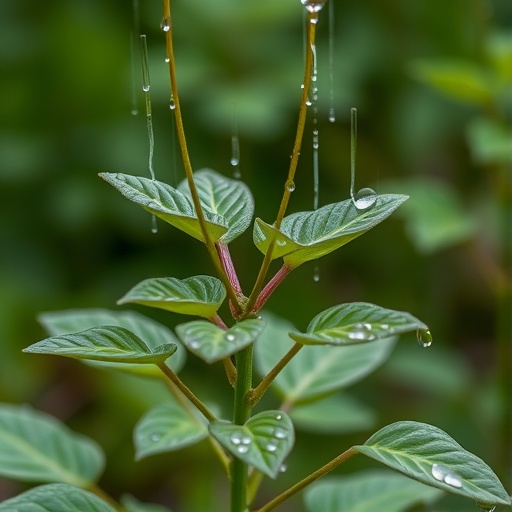
The gentle patter of rain cascading against a window often brings a sense of calm and tranquility. Yet, for a seed nestled just beneath a falling raindrop, this soothing soundtrack takes on a very different significance. According to groundbreaking research conducted by engineers at MIT, the sound of rain may actually awaken dormant seeds, stimulating them to germinate more rapidly. This revelation challenges our previous notions about how seeds interact with their environment, uncovering an acoustic dimension to plant biology previously overlooked.
In a series of meticulously controlled laboratory experiments, the MIT team observed rice seeds submerged in shallow water—an environment that closely mimics their natural aquatic or waterlogged field conditions. They found that when exposed to the sounds generated by falling water droplets, these seeds transitioned from dormancy to active germination faster than their silent, unexposed counterparts. This acceleration in germination suggests that seeds are capable of sensing and responding to the acoustic vibrations produced by rain.
This pioneering work, soon to be published in Scientific Reports, delivers the first direct evidence that seeds and seedlings can indeed detect sounds present in their natural environment. While rice seeds served as the initial model due to their ability to sprout in both soil and water, the researchers hypothesize that sound sensitivity could be a widespread trait among various seed types adapted to different ecological niches. Understanding this sensory capacity obliquely positions sound as a vital environmental cue in plant life cycles.
The team developed a compelling hypothesis to explain the underlying mechanism facilitating this sonic sensitivity. Upon impact with water puddles or soil, a raindrop generates localized pressure waves and acoustic vibrations that cause the surrounding medium to ripple. These subtle vibrations propagate to any seeds submerged or buried shallowly beneath the surface. At the cellular level, these vibrations are energetic enough to dislodge statoliths—microscopic, gravity-sensing organelles that reside inside specific plant cells. The displacement of these statoliths sends critical signals triggering the seed’s transition from dormancy to active growth.
Nicholas Makris, the lead mechanical engineering professor behind this research, explains that these findings represent a new frontier in understanding seed survival strategies. “The sound energy from raindrops is sufficient to expedite growth processes within the seed,” he states. This sensory mechanism equips seeds with valuable environmental intelligence, enabling them to estimate when conditions, such as soil moisture, are optimal for germination and seedling establishment.
Further exploration by Makris and co-author Cadine Navarro, formerly of MIT’s Department of Urban Studies and Planning, suggests that rain is but one of several natural sources of vibration that seeds might detect. Wind and other biomechanical forces also generate vibrations with the potential to jostle seeds, though these influences remain to be thoroughly studied. Their forthcoming work aims to unravel additional acoustic and vibrational cues that plants utilize to navigate their environments.
Plants, often underestimated in their sensory sophistication, have evolved remarkable adaptations to perceive and respond to diverse environmental stimuli. Certain species close their leaves upon touch, others curl when exposed to harmful odors, and nearly all plants orient their growth toward light through photoreceptors. Gravity detection is another critical sensory ability, guiding roots downward and shoots upward, mediated by statoliths within plant cells. These organelles, denser than the surrounding cytoplasm, move in response to gravitational pull, thereby signalling directional growth.
Intrigued by the possibility that sound vibrations could influence statolith behavior, Makris and Navarro delved into archival studies and measured underwater acoustic pressures caused by rainfall. They discovered that the density of water, far greater than that of air, substantially amplifies sound wave intensity from falling droplets underwater. This phenomenon subjects submerged seeds to acoustic pressures comparable to those experienced near a soaring jet engine in open air—an intensity sufficient to mobilize statoliths within cells.
To empirically validate their theory, the researchers conducted extensive experiments with approximately 8,000 rice seeds submerged in shallow laboratory tubs. By manipulating droplet size and fall height, they simulated the acoustic landscape of light to heavy rainstorms. Advanced hydrophone measurements captured the scale of underwater vibrations induced by these droplets, which were then cross-referenced with field recordings from natural water bodies and soil during real rain events, ensuring experimental authenticity.
The results were striking: seeds exposed to simulated rain sounds germinated a remarkable 30 to 40 percent faster than unexposed seeds kept in otherwise identical conditions. Moreover, seeds positioned closer to the water or soil surface demonstrated heightened sensitivity and accelerated growth compared to more deeply submerged seeds, highlighting a depth-dependent response that likely confers an evolutionary advantage.
Delving deeper into the physical dynamics, the team calculated the vibrational amplitudes generated by individual raindrops, factoring in variables like droplet size and terminal velocity—the steady speed achieved by falling objects. These calculations revealed that the induced mechanical vibrations were indeed potent enough to displace statoliths within seed cells. This mechanistic insight bridges the gap between external acoustic forces and intracellular responses responsible for stimulating germination.
This discovery adds a fascinating layer to our understanding of how plants integrate multiple environmental signals to optimize survival. The ability to hear rain, metaphorically speaking, affords seeds a non-visual, non-chemical signal to gauge their placement within soil or water bodies, ensuring they germinate only when conditions are ripe. By sensing rain acoustically, seeds might avoid premature germination at depths or times unfavorable for seedling development, a process critical for agronomic productivity and natural ecosystem resilience.
Makris puts the findings into cultural perspective by referencing a traditional Japanese microseason—“Falling rain awakens the soil”—which poetically encapsulates the awakening process his team uncovered. This interweaving of scientific discovery with cultural wisdom accentuates the profound connections between humans, plants, and their shared environment.
Supported by prestigious MIT fellowships, this research opens new avenues for exploring how acoustic ecology impacts plant biology. Future studies expanding beyond rice to other species and investigating additional natural sounds like wind are anticipated. Such insights could revolutionize agricultural practices, enabling optimized germination protocols tailored to the acoustic environments of crops, potentially enhancing food security in changing climates.
In conclusion, the MIT team’s work reveals a hidden acoustic world beneath raindrops, where seeds perceive and respond to their environment in novel and intricate ways. This discovery not only enriches fundamental botanical knowledge but also poses exciting possibilities for applied sciences, bringing sound into the realm of seed biology and challenging us to listen closely to the natural rhythms that govern life.
Web References: DOI: 10.1038/s41598-026-44444-1
Cite Scienmag News
Alan Morgan. (April 22, 2026). New Study Reveals Plants Can Detect the Sound of Rain. Scienmag. https://scienmag.com/new-study-reveals-plants-can-detect-the-sound-of-rain/
Alan Morgan. "New Study Reveals Plants Can Detect the Sound of Rain." Scienmag, 22 April 2026, https://scienmag.com/new-study-reveals-plants-can-detect-the-sound-of-rain/. Accessed 6 September 2026.
Alan Morgan. "New Study Reveals Plants Can Detect the Sound of Rain." Scienmag. April 22, 2026. https://scienmag.com/new-study-reveals-plants-can-detect-the-sound-of-rain/


