


In recent years, the intersection of traditional cultural practices and mental health has captured growing interest among researchers seeking alternative and accessible methods to enhance psychological well-being. A pioneering study conducted by Drexel University’s College of Nursing and Health Professions delves deeply into the therapeutic potential of heritage arts practices—indigenous and traditional art forms preserved and transmitted across generations. By examining these artistic expressions, the research highlights their capacity not only to support emotional regulation but also to serve as preventive resources for mental health challenges such as anxiety and mood disorders.
The study spearheaded by Dr. Girija Kaimal, EdD, a professor specializing in health professions, provides empirical evidence that engaging in heritage arts can yield significant psychosocial benefits. Heritage arts encompass a broad range of practices such as fiber arts, clay sculpting, distinctive regional painting styles, and other creative endeavors rooted in cultural identity and community history. These art forms, which have endured over centuries, act as a bridge between individual expression and collective cultural memory, offering both creative engagement and emotional solace.
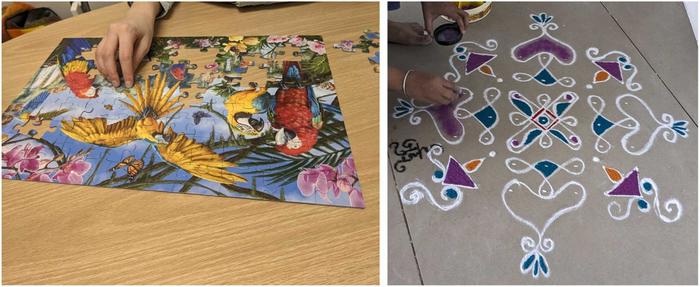
Critically, the research underscores that while many might associate these arts primarily with cultural preservation, they also have concrete impacts on mood improvement and anxiety reduction. Through controlled comparisons with neutral cognitive activities like jigsaw puzzle assembly, heritage arts emerged as not only more engaging but also more effective in eliciting positive affect and diminishing negative emotional states. This finding is especially pertinent given the growing global mental health crisis and the search for scalable, culturally sensitive interventions.
The methodological rigor of the study is notable. Researchers recruited 54 diverse participants across geographically and culturally distinct sites in the United States, Japan, and India. Each participant engaged in two separate 45-minute sessions: one involving their preferred heritage arts practice and another involving the assembly of puzzles serving as the control task. This dual-condition design allowed investigators to isolate the unique psychosocial effects attributable specifically to heritage art engagement, minimizing confounds associated with mere task involvement or distraction.
Within the U.S. cohort, activities such as temporary body art using natural henna and traditional cross-stitch embroidery were prevalent. Japanese participants performed arts like mizuhiki—decorative knot tying using thin paper strings—and classical calligraphy, both demanding precision and meditative focus. Indian participants engaged in pookalam, the creation of vibrant artworks using organic materials like flowers, plants, and clay, alongside traditional painting techniques like madhubani, which feature intricate and symbolically resonant motifs. These examples illustrate the heterogeneity of heritage arts and their embeddedness in local ecological and cultural systems, factors believed to enhance their therapeutic potency.
Quantitative measurements administered immediately before and after sessions included standardized scales assessing anxiety, mood and affect, perceived stress levels, creative self-efficacy, and creative agency. Participants consistently reported enhanced positive feelings and diminished negative affect following heritage art practice compared to puzzle completion. This pattern suggests that heritage art participation not only modulates emotional states acutely but may also foster feelings of mastery and artistic autonomy, psychological constructs linked to resilience and well-being.
An intriguing dimension of the research is its nuanced treatment of indigenous versus traditional arts practices. Indigenous arts are rooted within particular geographic communities and often imbued with spiritual and sacred significances, connected intrinsically to the history and worldview of those communities. These forms require respectful engagement, sensitivity to symbolic meaning, and avoidance of cultural appropriation. Traditional arts, by contrast, while inherited through generations, may be more adaptable and open to interpretation. This distinction introduces important ethical considerations in therapeutic applications, emphasizing collaboration with cultural custodians and acknowledgment of cultural sovereignty.
The therapeutic mechanisms underlying the efficacy of heritage arts appear multifaceted. Engaging the hands and eyes in purposeful creation activates sensory and motor circuits, potentially eliciting physiological relaxation responses mediated by parasympathetic nervous system activity. Artistic engagement also serves as a form of behavioral activation, countering rumination and passivity common in mood disorders. Moreover, the act of creating within a culturally meaningful framework may restore a sense of identity and continuity, bolstering psychological coherence and self-esteem, elements critical to emotional resilience.
Dr. Kaimal and her team emphasize the accessibility of these arts, highlighting how few materials or prior skills are necessary, which is salient for scalability in public health contexts. Their simplicity belies the potential for increasing complexity and artistic exploration over time, allowing participants to tailor the experience according to personal ability and interests. Such scalable interventions could be integrated into community mental health programs or even self-guided practice, democratizing access to psychosocial support tools rooted in cultural traditions.
Looking ahead, the research group plans to expand their inquiry, broadening the scope of heritage art forms studied and incorporating qualitative analyses from all participant sites. This holistic approach aims to deepen understanding of individual narratives and culturally specific experiences, shedding light on how these practices manifest therapeutic value differently across contexts. Parallel efforts include the development of an open-access resource book targeting psychosocial support specialists and art therapists, which promises to bridge academic research with applied practice.
The implications of these findings extend beyond clinical psychology into public health, emphasizing indigenous arts not only as cultural artifacts but as dynamic, living practices integral to mental wellness. By re-integrating heritage arts into daily life, societies may unlock creative resources that harness evolutionary mechanisms of self-regulation. This reconceptualization challenges conventional therapeutic paradigms, advocating a broader definition of mental health resources that are inclusive of cultural, artistic, and communal dimensions.
In a world grappling with increasing psychological stressors, this research advocates a return to elemental creative acts—connecting the mind, body, culture, and history. Heritage arts emerge as an underutilized wellspring for emotional balance, offering accessible and culturally affirming avenues to foster resilience, reduce anxiety, and promote positive mood states. As scientific validation continues to accumulate, these ancient practices may soon take center stage as vital tools in global mental health strategies.
- https://www.sciencedirect.com/science/article/pii/S0197455625000243
- https://drexel.edu/cnhp/
- https://drexel.edu/news/experts/kaimal-girija
- https://pubmed.ncbi.nlm.nih.gov/32612560/
- https://www.sciencedirect.com/science/article/abs/pii/S0197455621001246
References:
Kaimal, G. et al. (2025). Psychosocial benefits of engaging in heritage arts practices in art therapy. The Arts in Psychotherapy. DOI: 10.1016/j.aip.2025.102271
Image Credits: Photo from The Arts in Psychotherapy
Keywords: Mental health, Stress management, Psychological stress, Psychotherapy, Anxiety disorders, Emotional development, Emotions, Anxiety, Self perception
Cite Scienmag News
Glenn Wilkins. (May 19, 2025). New Study Reveals Health Benefits of Integrating Heritage Art Practices into Art Therapy. Scienmag. https://scienmag.com/new-study-reveals-health-benefits-of-integrating-heritage-art-practices-into-art-therapy/
Glenn Wilkins. "New Study Reveals Health Benefits of Integrating Heritage Art Practices into Art Therapy." Scienmag, 19 May 2025, https://scienmag.com/new-study-reveals-health-benefits-of-integrating-heritage-art-practices-into-art-therapy/. Accessed 7 September 2026.
Glenn Wilkins. "New Study Reveals Health Benefits of Integrating Heritage Art Practices into Art Therapy." Scienmag. May 19, 2025. https://scienmag.com/new-study-reveals-health-benefits-of-integrating-heritage-art-practices-into-art-therapy/


