


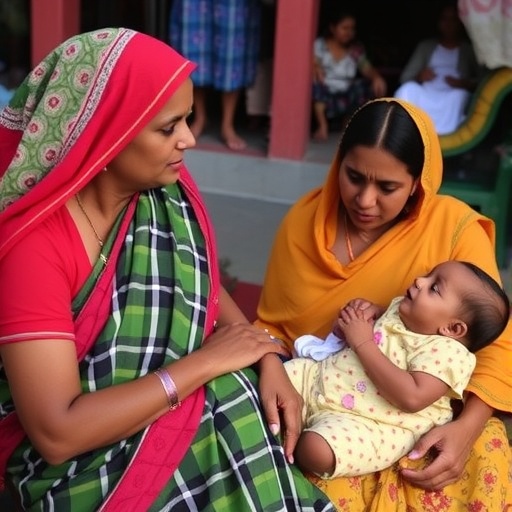
A groundbreaking study conducted by researchers at the University of Toronto has unveiled compelling evidence linking the residential environment within Indian urban areas—specifically whether a mother resides in a slum or a non-slum neighborhood—to her breastfeeding practices. This research provides crucial insight into how socioeconomic and structural factors mold early infant nutrition behaviors, shedding light on a subject that holds paramount importance for child health and development in rapidly urbanizing settings.
The initiation of breastfeeding within the first hour after birth is universally recognized for its immense health benefits. It plays a critical role in bolstering a newborn’s immune defenses, markedly reducing the susceptibility to infections, and significantly decreasing infant mortality rates, particularly in low- and middle-income countries where healthcare access can be patchy and infectious diseases remain a formidable threat to young lives. Beyond immediate immunological protection, exclusive breastfeeding—defined as feeding the infant solely on breast milk without the introduction of water or complementary foods during the first six months—offers robust protection against pervasive ailments such as diarrhea and pneumonia, which are leading contributors to child morbidity and mortality worldwide. Additionally, it supports optimal physical growth and cognitive development, setting a foundation for lifelong health.
Leveraging the comprehensive 2015–2016 National Family Health Survey data from India, the researchers meticulously analyzed breastfeeding behaviors among over 3,200 urban mothers spanning seven states and differentiated their findings based on whether the mothers lived in slum or non-slum urban neighborhoods. Their comparative approach allowed for an unprecedented examination of how urban microenvironments influence health behaviors at a granular level.
A striking dichotomy emerged from the analysis: approximately half of the mothers residing in slum communities (50.4%) initiated breastfeeding within the first hour after childbirth. In stark contrast, only just over a third (37.4%) of mothers living in better-resourced non-slum urban areas were observed initiating breastfeeding as promptly. This counterintuitive pattern challenges assumptions that better socioeconomic conditions uniformly translate to improved health behaviors and suggests complex underlying social, cultural, and service-related dynamics at play.
However, diving deeper into exclusive breastfeeding patterns tells a different story. Mothers from non-slum neighborhoods demonstrated higher prevalence rates of exclusive breastfeeding during the first five months of an infant’s life, at 55.8%, surpassing the rate found in slum areas, where the prevalence was 50.0%. This divergence suggests that while slum mothers may excel in beginning breastfeeding quickly, sustaining exclusive breastfeeding appears more achievable in environments with greater resources, better social support, or enhanced access to healthcare services.
The study’s lead author, Suliat Fehintola Akinwande, a doctoral candidate at the Factor-Inwentash Faculty of Social Work, University of Toronto, emphasized the nuanced nature of these findings. She articulated that the results underscore the futility of uniform, blanket strategies for breastfeeding promotion across heterogeneous urban landscapes. Instead, interventions must be finely tuned to the distinct challenges and barriers intrinsic to each community type, ensuring mother-centric and contextually appropriate support mechanisms.
Understanding why slum mothers initiate breastfeeding earlier than their non-slum counterparts requires a multilayered analysis. In many slum settings, cultural norms and community-driven knowledge may prioritize prompt initiation. Conversely, in non-slum areas, despite better healthcare infrastructure, factors like hospital policies, maternal employment commitments, or social perceptions might delay the initiation. Yet, sustaining exclusive breastfeeding, a demanding task requiring sustained knowledge, social encouragement, and often workplace and community support, is evidently more prevalent in non-slum neighborhoods, where such enabling conditions are more likely to be met.
Remarkably, over 90% of mothers in both residential settings delivered their babies in health facilities, highlighting the pivotal role these institutions could play in influencing early breastfeeding behavior. Hospital-based initiatives such as India’s Mother’s Absolute Affection (MAA) program have made substantive strides in promoting early skin-to-skin contact and breastfeeding initiation immediately post-delivery. This near-universal facility-based delivery landscape presents a golden opportunity to embed tailored breastfeeding support and education that address the unique needs of slum versus non-slum mothers.
Yet, the effectiveness of hospital-based interventions hinges on the continuity of care and support mothers receive after discharge. The research revealed that slum mothers whose preceding child was born more than two years prior were less likely to initiate breastfeeding within the first hour post-birth. This temporal gap indicates that earlier counseling impacts may wane over time unless reinforced periodically, highlighting a critical knowledge retention issue. Thus, sustained engagement with healthcare workers throughout the interpregnancy interval could serve as an essential strategy to refresh and reinforce breastfeeding knowledge among mothers.
Adopting a social-ecological framework, the investigators moved beyond viewing breastfeeding as an isolated maternal choice. This perspective integrates the influential role of family dynamics, community cultural norms, caste-based social stratifications, occupational demands, and resource accessibility. Such a comprehensive lens is crucial in designing effective interventions that recognize the embeddedness of breastfeeding practices within complex social fabrics and structural determinants.
Health facility births correlated strongly with early initiation of breastfeeding in non-slum areas, emphasizing the importance of healthcare provider support immediately after delivery. Skilled nursing care, individualized counseling, and the presence of lactation consultants can make the difference in establishing effective breastfeeding techniques and boosting maternal confidence. In resource-constrained slum settings, however, health workers may face challenges in delivering consistent postnatal support due to systemic limitations, underscoring the necessity for innovative service delivery models.
While statistical analyses adjusting for multifactorial influences did not pinpoint strong predictors of exclusive breastfeeding, the marked differences in breastfeeding trends between slum and non-slum localities clearly call for context-specific programming. A single national campaign is insufficient to address the variegated barriers and facilitators embedded within diverse urban environments. Policy frameworks and community interventions must adopt differentiated strategies that reflect the lived realities of mothers, from informal settlement contexts to more affluent urban neighborhoods.
In sum, this seminal study illuminates the profound impact of urban residential settings on breastfeeding behaviors in India, challenging simplistic narratives and advocating for socially and culturally attuned health policies. As urbanization accelerates globally, these insights resonate beyond India, offering a blueprint for tailoring maternal and child health initiatives to the nuanced demands of diverse urban populations. By harnessing targeted hospital-based support and reinforcing community-driven breastfeeding advocacy, public health strategists can make significant strides toward improving infant nutrition outcomes, thereby advancing global child health imperatives.
News Publication Date: 8-Apr-2026
Web References: 10.1371/journal.pone.0323861
Cite Scienmag News
Harold Sullivan. (April 8, 2026). New Study Reveals Distinct Breastfeeding Patterns in India’s Slums Compared to Other Urban Areas. Scienmag. https://scienmag.com/new-study-reveals-distinct-breastfeeding-patterns-in-indias-slums-compared-to-other-urban-areas/
Harold Sullivan. "New Study Reveals Distinct Breastfeeding Patterns in India’s Slums Compared to Other Urban Areas." Scienmag, 8 April 2026, https://scienmag.com/new-study-reveals-distinct-breastfeeding-patterns-in-indias-slums-compared-to-other-urban-areas/. Accessed 3 September 2026.
Harold Sullivan. "New Study Reveals Distinct Breastfeeding Patterns in India’s Slums Compared to Other Urban Areas." Scienmag. April 8, 2026. https://scienmag.com/new-study-reveals-distinct-breastfeeding-patterns-in-indias-slums-compared-to-other-urban-areas/


