


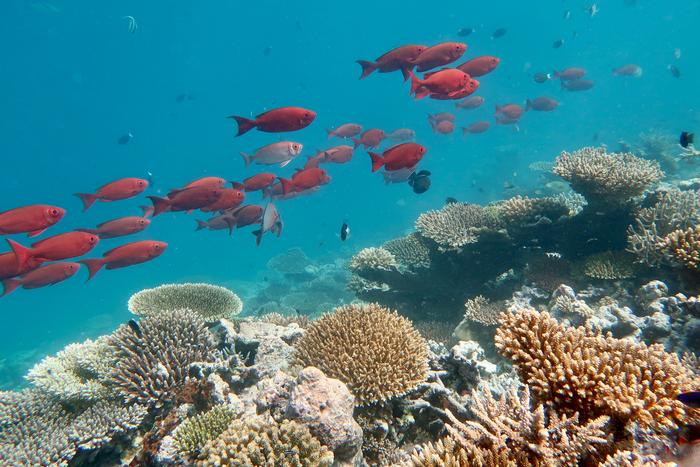
For decades, coral reefs have captivated scientists and nature enthusiasts alike, often portrayed as spectacular "marine oases" amid vast nutrient-poor ocean deserts. This compelling image, deeply entrenched in both scientific discourse and popular media, suggests that coral reefs are remarkable hotspots of biodiversity existing in isolation, sustained despite the scarcity of nutrients in surrounding waters. However, groundbreaking new research published in Current Biology challenges these long-held beliefs, unraveling misconceptions that have influenced coral reef science and conservation strategies for years.
The study critically examines the foundation of what is commonly referred to as “Darwin’s Paradox,” a narrative crediting Charles Darwin with the idea that coral reefs maintain extraordinary productivity while surrounded by oceanic deserts devoid of substantive nutrient input. Contrary to this prevailing notion, researchers demonstrate that most coral reefs actually inhabit waters with intermediate to elevated nutrient concentrations, contradicting the assumption that these environments are nutrient-poor. Furthermore, the analysis reveals that Darwin himself never proposed this paradox, and that the attribution is an inaccurate historical interpretation perpetuated over time.
To challenge the paradigm, the investigative team compiled and analyzed a comprehensive dataset encompassing coral reef locations worldwide, satellite-derived oceanic nutrient metrics, and measurements of phytoplankton productivity—a critical indicator of food availability for reef organisms. Their findings show that coral reefs predominantly thrive in nutrient-enriched waters, where chlorophyll a—a pigment used by phytoplankton for photosynthesis and a proxy for primary productivity—is often twice the median concentration found in tropical oceans. This recontextualizes the environment surrounding reef ecosystems, revealing a far richer and more dynamic interaction than previously understood.
One of the most enlightening revelations of this research comes from the comparative productivity analysis. By juxtaposing reef primary productivity with data from other global ecosystems—including forests, wetlands, rivers, and even coastal upwelling zones—the study confirms that coral reefs rank among the most productive ecosystems on Earth. However, their productivity parallels that of coastal wetlands, another nutrient-rich, highly diverse system. This comparison debunks the simplistic ‘reef as oasis’ concept and highlights complex ecological interactions sustained by the surrounding ocean environment.
The research methodology employed a multi-faceted approach, leveraging satellite data and empirical measurements to quantify both direct food sources for reef-dwelling organisms and broader environmental nutrient profiles. Phytoplankton abundance, measured via chlorophyll a concentrations, emerged as a critical factor, illustrating that reef productivity is closely tied to adjacent marine productivity rather than functioning as a self-contained system. This finding brings into question earlier models that viewed coral reefs as largely isolated from their environment.
An equally compelling dimension to this study is the historical reassessment of “Darwin’s Paradox.” Through thorough manual review and text mining of Darwin’s original works, the authors conclusively illustrate that Darwin neither formulated nor discussed the concept of reef nutrient isolation or paradoxical productivity. Instead, the misattribution likely arose due to Darwin’s towering influence and the lack of comprehensive global analyses before this study. This revelation underscores the necessity of revisiting scientific dogma with rigorous evidence-based approaches.
The ecological implications of this redefined understanding are profound. The realization that coral reef health and productivity are integrally linked to the conditions of their surrounding ocean waters elevates the importance of considering nutrient dynamics in reef conservation. Human activities such as agricultural runoff, coastal development, and climate change can modulate nutrient availability and plankton communities, thereby influencing reef resilience. The study cautions against simplistic management approaches that neglect these intricate oceanic-reef linkages.
Senior author Simon Brandl emphasizes that coral reefs’ exceptional productivity depends on nuanced and context-dependent interactions between reef organisms and their prey, heavily influenced by surrounding ocean conditions. This complexity signals that future conservation and restoration efforts must adopt holistic frameworks, addressing both reef ecosystems and adjacent marine environments to enhance sustainability and resilience.
Moreover, the study highlights the broader ramifications of anthropogenic change. Nutrient enrichment from human activities, combined with rising sea surface temperatures and shifts in phytoplankton communities, may reshape these delicate linkages, potentially destabilizing reef ecosystems. These insights advocate for integrated monitoring programs that couple terrestrial, coastal, and oceanographic data, enabling proactive management strategies that are responsive to changing environmental variables.
The research team, comprising international collaborators from the University of Texas Marine Science Institute, Université Paris Sciences et Lettres, and Central Queensland University, underscores the significance of challenging entrenched scientific narratives. Renato Moris, the lead author, remarks on the importance of revisiting foundational concepts to refine our understanding of complex ecological systems, highlighting how evidence-driven inquiry can recalibrate conservation priorities.
As global coral reefs continue to face unprecedented threats, this paradigm-shifting study arrives as a crucial call to action. By illuminating the vital connectivity between reefs and the nutrient-rich waters they inhabit, it invites scientists, policymakers, and conservationists to rethink strategies grounded in outdated assumptions. The hope is that these revelations will inspire a more informed and adaptive approach to preserving these vibrant marine ecosystems.
In essence, coral reefs are not isolated marvels persisting against the odds in barren deserts but are dynamic systems intricately woven into the fabric of their marine environment. Recognizing this interconnectedness provides a more accurate framework to understand their resilience and vulnerabilities, offering a scientifically robust foundation to safeguard them for future generations. This transformative insight rewrites our ecological narrative, challenging us to appreciate the complex realities beneath the ocean’s surface.
News Publication Date: 5-Jun-2025
Web References: https://doi.org/10.1016/j.cub.2025.05.033
References: Brandl, S. et al. (2025). Rethinking Darwin’s coral reef paradox and the ubiquity of “marine oases.” Current Biology. DOI: 10.1016/j.cub.2025.05.033
Cite Scienmag News
Margaret Porter. (June 5, 2025). New Study Questions the Idea of Coral Reefs as Marine Oases. Scienmag. https://scienmag.com/new-study-questions-the-idea-of-coral-reefs-as-marine-oases/
Margaret Porter. "New Study Questions the Idea of Coral Reefs as Marine Oases." Scienmag, 5 June 2025, https://scienmag.com/new-study-questions-the-idea-of-coral-reefs-as-marine-oases/. Accessed 8 September 2026.
Margaret Porter. "New Study Questions the Idea of Coral Reefs as Marine Oases." Scienmag. June 5, 2025. https://scienmag.com/new-study-questions-the-idea-of-coral-reefs-as-marine-oases/


