


Through a large-scale analysis, researchers at the Netherlands Institute for Neuroscience have uncovered the ways in which consensual touch can benefit a person’s physical and mental wellbeing.

Credit: Netherlands Institute for Neuroscience
Through a large-scale analysis, researchers at the Netherlands Institute for Neuroscience have uncovered the ways in which consensual touch can benefit a person’s physical and mental wellbeing.
You might recognize the comforting feeling when someone offers you a hug at the end of a stressful day or strokes your shoulder when you’re feeling down. But the question remains: can touch really help you feel better, and does it matter who it’s from or how they touch you? To explore these questions, researchers from the Social Brain Lab at the Netherlands Institute for Neuroscience and the University Hospital Essen conducted a large-scale analysis of studies exploring touch interventions.
The benefits of touch on mental and physical health
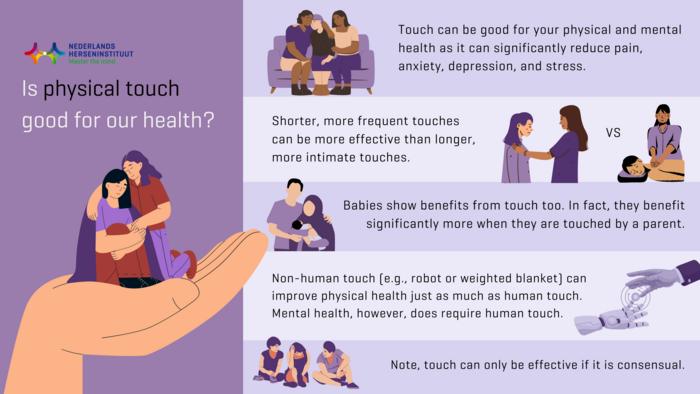
Does touch truly improve someone’s wellbeing? It is an easy question to ask but more complicated to answer. Individual studies often only focus on specific instances and may contradict each other. Combining all these studies together for a large-scale analysis offers a clearer answer: yes, touch substantially improves both physical and mental wellbeing, for example via reduction of pain, anxiety, depression, and stress in adults. But in fact, those with physical or mental health problems (and therefore most in need of support) benefit even more from touch than healthy adults. “This is especially relevant considering how often touch interventions are overlooked” Packheiser, first author, adds.
“A key question of our study is to leverage the hundreds of individual studies out there to identify what type of touch works best,” adds professor Keysers, director of the Social Brain Lab. “What if you don’t have a friend or partner close by to hug you? Would touch from a stranger or even a machine also help? And how often?. The study clearly shows that touch can indeed be optimized, but the most important factors are not necessarily those we suspect.”
Interestingly, the person touching you, how they touch you, and the duration of their touch doesn’t make a difference in terms of impact. A long-lasting massage by a therapist could therefore be just as effective as a quick hug offered by a friend. That is, until the frequency of the intervention is considered. The more often a touch intervention is offered, the greater the impact. A quick hug could therefore be even more impactful than a massage if it is offered more frequently.
Human or non-human touch?
The next question was whether touch intervention needs to be human at all. As it turns out, object or robot interventions can be equally effective at improving physical wellbeing. “There are lots of people in need of wellbeing improvements, perhaps because they’re lonely but also because they may be inflicted by clinical conditions. These results indicate that a touch-robot, or even a simple weighted blanket has the potential to help those people”, last author Frédéric Michon explains. However, the benefits of robot and object interventions are less effective for mental wellbeing. Mental health disorders like anxiety or depression might therefore require human touch after all, “perhaps suggestive of the importance for an emotional component associated with the touch”, Michon point out.
While the researchers were equally curious about human-to-animal contact, studies exploring this question are still lacking. “It would be useful to see whether an animal’s or pet’s touch could improve wellbeing, and inversely if they also benefit from it, but unfortunately there simply aren’t enough studies, or properly controlled ones, for us to draw any general conclusions on these topics”, Michon clarifies.
Touch interventions across ages
When the team looked into the impact of touch on newborns, they found out that newborns also benefited significantly from touch. However, the person conducting the touch intervention was more important: the benefits of touch are higher when done by a parent instead of a healthcare worker. “This finding could be impactful”, Packheiser adds. “Death rates due to premature births are high in some countries and the knowledge that a baby benefits more from the touch of their own parent offers another easily implementable form of support for the baby’s health”.
Due to a lack of studies, it proved difficult to draw conclusions about children and teenagers. “Large scale studies like this help us draw more general conclusions but they also help us identify where research is lacking”, Michon explains. “We hope that our findings can steer future research to explore lesser-known questions. This includes animal touch, but also touch across ages, and in specific clinical settings like autistic patients, another category that has not been explored extensively”.
Source: Nature Human Behaviour
Journal
Nature Human Behaviour
Article Title
A systematic review and multivariate meta-analysis of the physical and mental health benefits of touch interventions
Article Publication Date
8-Apr-2024
Cite Scienmag News
Courtney Benton. (April 8, 2024). New study highlights the benefit of touch on mental and physical health. Scienmag. https://scienmag.com/new-study-highlights-the-benefit-of-touch-on-mental-and-physical-health/
Courtney Benton. "New study highlights the benefit of touch on mental and physical health." Scienmag, 8 April 2024, https://scienmag.com/new-study-highlights-the-benefit-of-touch-on-mental-and-physical-health/. Accessed 4 September 2026.
Courtney Benton. "New study highlights the benefit of touch on mental and physical health." Scienmag. April 8, 2024. https://scienmag.com/new-study-highlights-the-benefit-of-touch-on-mental-and-physical-health/

