


The biological brain, especially the human brain, is a desirable computing system that consumes little energy and runs at high efficiency. To build a computing system just as good, many neuromorphic scientists focus on designing hardware components intended to mimic the elusive learning mechanism of the brain. Recently, a research team has approached the goal from a different angle, focusing on measuring information transfer instead. Their method went through biological and simulation experiments and then proved effective in an electronic neuromorphic system. It was published Feb. 1 in Intelligent Computing, a Science Partner Journal.

Credit: DANIELA GANDOLFI ET AL.
The biological brain, especially the human brain, is a desirable computing system that consumes little energy and runs at high efficiency. To build a computing system just as good, many neuromorphic scientists focus on designing hardware components intended to mimic the elusive learning mechanism of the brain. Recently, a research team has approached the goal from a different angle, focusing on measuring information transfer instead. Their method went through biological and simulation experiments and then proved effective in an electronic neuromorphic system. It was published Feb. 1 in Intelligent Computing, a Science Partner Journal.
Although electronic systems have not fully replicated the complex information transfer between synapses and neurons, the team has demonstrated that it is possible to transform biological circuits into electronic circuits while maintaining the amount of information transferred. “This represents a key step toward brain-inspired low-power artificial systems,” the authors note.
To evaluate the efficiency of information transfer, the team drew inspiration from information theory. They quantified the amount of information conveyed by synapses in single neurons, then measured the quantity using mutual information, the analysis of which reveals the relationship between input stimuli and neuron responses.
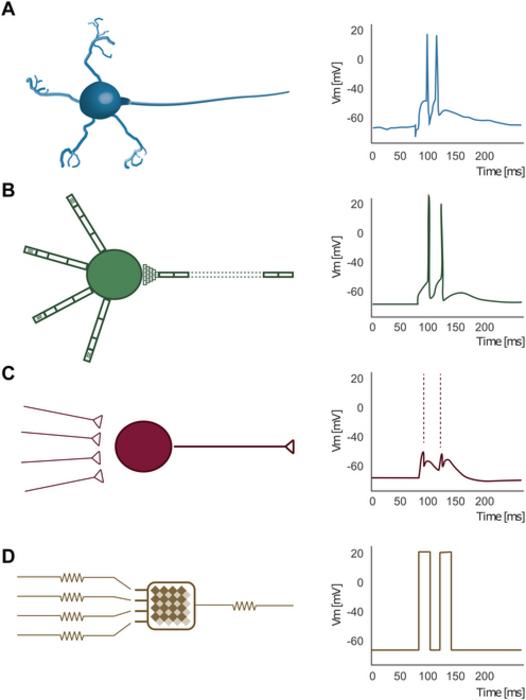
First, the team conducted experiments with biological neurons. They used brain slices from rats, recording and analyzing the biological circuits in cerebellar granule cells. Then they evaluated the information transmitted at the synapses from mossy fiber neurons to the cerebellar granule cells. The mossy fibers were periodically stimulated with electrical spikes to induce synaptic plasticity, a fundamental biological feature where the information transfer at the synapses is constantly strengthened or weakened with repeated neuronal activity.
The results show that the changes in mutual information values are largely consistent with the changes in biological information transfer induced by synaptic plasticity. The findings from simulation and electronic neuromorphic experiments mirrored the biological results.
Second, the team conducted experiments with simulated neurons. They applied a spiking neural network model, which was developed by the same research group. Spiking neural networks were inspired by the functioning of biological neurons and are considered a promising approach for achieving efficient neuromorphic computing.
In the model, four mossy fibers are connected to one cerebellar granule cell, and each connection is given a random weight, which affects the information transfer efficiency like synaptic plasticity does in biological circuits. In the experiments, the team applied eight stimulation patterns to all mossy fibers and recorded the responses to evaluate the information transfer in the artificial neural network.
Third, the team conducted experiments with electronic neurons. A setup similar to those in the biological and simulation experiments was used. A previously developed semiconductor device functioned as a neuron, and four specialized memristors functioned as synapses. The team applied 20 spike sequences to decrease resistance values, then applied another 20 to increase them. The changes in resistance values were investigated to assess the information transfer efficiency within the neuromorphic system.
In addition to verifying the quantity of information transferred in biological, simulated and electronic neurons, the team also highlighted the importance of spike timing, which as they observed is closely related to information transfer. This observation could influence the development of neuromorphic computing, given that most devices are designed with spike-frequency-based algorithms.
Journal
Intelligent Computing
Article Title
Information Transfer in Neuronal Circuits: From Biological Neurons to Neuromorphic Electronics
Article Publication Date
1-Feb-2024
Cite Scienmag News
Cassandra Pierce. (April 8, 2024). Brain-inspired computing may boil down to information transfer. Scienmag. https://scienmag.com/brain-inspired-computing-may-boil-down-to-information-transfer/
Cassandra Pierce. "Brain-inspired computing may boil down to information transfer." Scienmag, 8 April 2024, https://scienmag.com/brain-inspired-computing-may-boil-down-to-information-transfer/. Accessed 4 September 2026.
Cassandra Pierce. "Brain-inspired computing may boil down to information transfer." Scienmag. April 8, 2024. https://scienmag.com/brain-inspired-computing-may-boil-down-to-information-transfer/

