


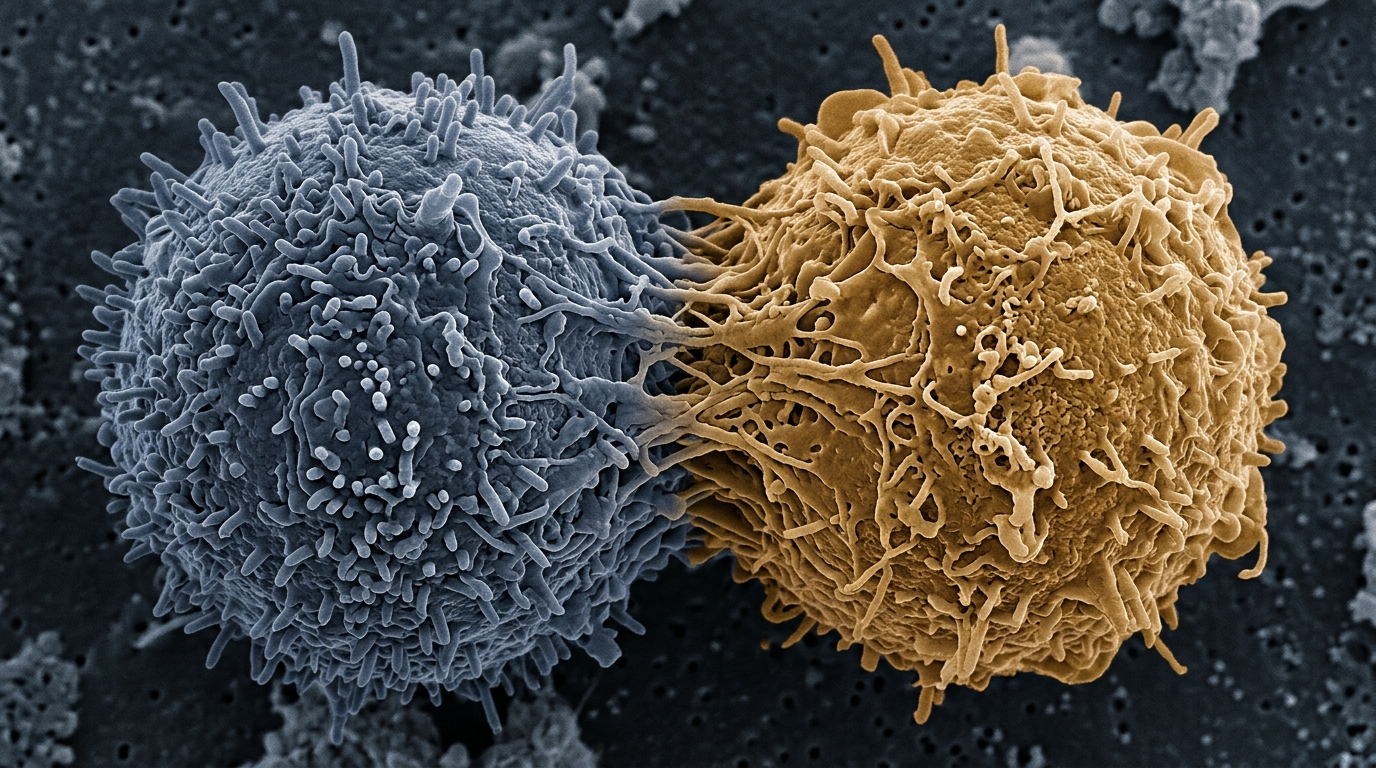
Researchers published a mathematical study in the journal Advances in Continuous and Discrete Models investigating the stability of Human T-cell lymphotropic virus type I (HTLV-I) dynamic models. The study, authored by Matuka A. Alshaikh, integrates two distinct forms of Cytotoxic T Lymphocyte (CTL) immune responses into a single framework. By combining self-regulating and predator-prey CTL responses, the model offers a more comprehensive representation of how the immune system interacts with the virus within the host. The work addresses a gap in the literature where most existing models have considered only the predator-prey CTL response, leaving the integrated effect of both mechanisms previously unstudied.
The research focuses on the population dynamics of four specific compartments: uninfected CD4+ T cells, latently HTLV-I-infected CD4+ T cells, actively HTLV-I-infected CD4+ T cells, and CTL immunity. HTLV-I is a retrovirus that primarily targets CD4+ T cells, which are essential components of the adaptive immune response. Infection by this virus can lead to severe conditions such as HTLV-I associated myelopathy/tropical spastic paraparesis and adult T-cell leukemia. The virus spreads through vertical transmission, involving the replication of actively infected cells, and horizontal transmission, where the virus spreads through direct cell-to-cell contact.
The authors first developed a continuous-time HTLV-I infection model to describe these interactions. They then utilized the nonstandard finite difference (NSFD) method to derive a discrete-time version of the model. This discretization approach is significant because conventional methods, such as Euler or Runge-Kutta, can induce numerical instabilities or systematic bias when applied to nonlinear systems with large step sizes. The NSFD method is designed to preserve the essential qualitative characteristics of the original continuous-time model, ensuring that the discrete approximation remains biologically plausible and mathematically stable.
A central component of the analysis is the derivation of the basic reproduction number, denoted as R0. This threshold parameter determines whether the infection persists or dies out within the host. Biologically, R0 quantifies the average number of secondary infected cells generated by a single infected cell through viral transmission and cell-to-cell interaction mechanisms. The study establishes that the stability of the system’s equilibrium points is governed by this value. When R0 is less than or equal to 1, the infection is cleared due to immune response and natural cellular dynamics. Conversely, when R0 is greater than 1, the virus successfully establishes and persists within the host.
The theoretical findings are supported by rigorous mathematical proofs using Lyapunov functions. The researchers demonstrated that the infection-free equilibrium point is globally asymptotically stable when R0 is less than or equal to 1. This implies that if the viral replication is insufficient to sustain infection, the system will converge to a state where the virus is eliminated. In this scenario, the immune system and natural cell turnover are sufficient to clear the infection, leading to a stable population of uninfected target cells.
When R0 exceeds 1, the study shows that an infected equilibrium point with immunity exists and is globally asymptotically stable. This state represents a chronic infection where uninfected cells, infected cells, and the immune response coexist at stable levels. The numerical simulations confirm that in this regime, infected cells continue to produce new infections, allowing the virus to maintain its presence. The immune response, particularly the CTL cells, is activated and partially controls the infection but does not eliminate it completely, resulting in a sustained viral load.
Numerical simulations were employed to validate the theoretical stability analysis. In one case, with parameters set such that R0 was 0.37, the solutions converged to the infection-free equilibrium, confirming the extinction of the virus. In another case, with R0 at 3.73, the solutions converged to an infected equilibrium, demonstrating the persistence of the virus. These results align with the theoretical predictions derived from the Lyapunov stability analysis, providing empirical support for the model’s behavior under different parameter conditions.
The study also investigated the effect of the mitotic transmission parameter on the dynamics of HTLV-I infection. Mitotic transmission involves the replication of actively infected cells, contributing to the spread of the virus within the host. The simulations showed that increasing this parameter leads to a decrease in healthy cells and an increase in infected cell populations. This indicates that mitotic transmission plays a crucial role in the persistence of HTLV-I infection, while the immune response remains relatively stable under these variations.
A comparative analysis was conducted between the NSFD method and the Runge-Kutta method to evaluate numerical accuracy and stability. The results showed a strong agreement between the solutions obtained by both methods. However, the NSFD method demonstrated superior stability properties, maintaining the stability of equilibria regardless of the step size. In contrast, the Runge-Kutta method with a fixed step size showed increased numerical error as the step size grew, potentially affecting the accuracy of the results. This comparison reinforces the advantage of using NSFD for modeling nonlinear viral dynamics.
Sensitivity analysis was performed to determine which parameters have the most significant impact on the basic reproduction number R0. The analysis revealed that parameters such as the infection rate, production rate of uninfected cells, and activation rate of latently infected cells exhibit the largest positive sensitivity indices. This means that an increase in these parameters strongly amplifies R0, enhancing viral proliferation.
The study acknowledges several limitations, including the assumption of homogeneous interactions among cells and the neglect of spatial heterogeneity. The parameters are considered constant over time, whereas in biological reality, immune response and transmission processes may vary across individuals and disease stages. The deterministic framework does not incorporate stochastic fluctuations, treatment effects, or vaccination strategies, which could significantly influence infection outcomes in clinical settings.
Future research directions suggested by the authors include extending the model to include stochastic dynamics, spatial diffusion, and time delays representing intracellular viral replication processes. Incorporating treatment strategies, immune modulation mechanisms, and time-dependent parameters would provide a more realistic description of infection progression. Additionally, considering individual heterogeneity and more complex immune regulatory interactions may enhance the predictive capability of the model and offer deeper insights into the dynamics of chronic HTLV-I infection.
In the absence of infection, the host cellular dynamics reach a baseline state where uninfected target cells stabilize at the ratio of their constant production rate to their natural death rate, while cytotoxic T lymphocytes persist at an immune baseline determined by their self-regulating production divided by their natural decay. To ensure biological plausibility, the author proved that all system trajectories initiating from positive initial concentrations remain strictly positive and uniformly bounded within a compact invariant region. This boundedness establishes that cell populations cannot grow unboundedly, governed by a composite decay constant that incorporates the minimum clearance rate across all cellular and immune compartments.
The derivation of the basic reproduction number relies on the next-generation matrix framework applied to the infected compartments comprising latently and actively infected cells. By partitioning the dynamic transitions into new infection occurrences and net cellular transfers, the author computed the spectral radius of the associated operator matrix. To prove global asymptotic stability of the chronic infected steady state, the author applied the arithmetic mean-geometric mean inequality to evaluate the derivative of a logarithmic Lyapunov function, invoking the Lyapunov-LaSalle theorem to confirm that all trajectories converge to the endemic equilibrium.
In formulating the discrete-time system, the nonstandard finite difference scheme introduces a customized denominator function defined in terms of the exponential decay of uninfected cells. A vital mathematical property established for this scheme is the unconditional preservation of solution positivity across all discrete time increments. For each successive time step, the updating equations for latently and actively infected cells yield a quadratic algebraic equation for the immune lymphocyte concentration. Because the leading quadratic coefficient is strictly positive while the constant term is negative, the discriminant remains positive, ensuring the existence of a unique positive root. Mathematical induction then establishes that cellular and immune concentrations remain positive and ultimately bounded across all subsequent time steps.
The numerical investigations provide concrete quantitative profiles for these dynamic states under specific parameter selections. In the infection-clearing regime, the system converged to an uninfected cell population of 833.33 and an immune lymphocyte concentration of 20, with infected compartments approaching zero. Under chronic conditions, uninfected cells declined to 245.465 while latent cells reached 214.058, active cells stabilized at 0.96, and cytotoxic lymphocytes increased to 22.12. Furthermore, analytical differentiation in the sensitivity analysis revealed exact symmetric relationships between key indices, demonstrating that the sensitivity index for latent activation equals the negative sensitivity index for latent death, while the index for immune decay exactly balances the negative indices for cytotoxic lysis and immune self-regulation.
Subject of Research: Mathematical modeling of HTLV-I dynamics and CTL immune response stability
Article Title: Stability investigation of HTLV-I dynamic models with integrated self-regulating and predator-prey CTL responses
Article References: Alshaikh, M. A. (2026). Stability investigation of HTLV-I dynamic models with integrated self-regulating and predator-prey CTL responses. Advances in Continuous and Discrete Models, 2026(1), Article 80. https://doi.org/10.1186/s13662-026-04113-z
Image Credits: AI Generated
DOI: 10.1186/s13662-026-04113-z
Keywords: HTLV-I, Mathematical Modeling, CTL Response, Viral Dynamics, Stability Analysis, Nonstandard Finite Difference, Basic Reproduction Number, Immune Response, Stability, investigation, dynamic, models
Cite Scienmag News
Kristina Jarvis. (November 7, 2026). HTLV-I Model Shows Immune Response Integration. Scienmag. https://scienmag.com/htlv-i-model-shows-immune-response-integration/
Kristina Jarvis. "HTLV-I Model Shows Immune Response Integration." Scienmag, 7 November 2026, https://scienmag.com/htlv-i-model-shows-immune-response-integration/. Accessed 9 November 2026.
Kristina Jarvis. "HTLV-I Model Shows Immune Response Integration." Scienmag. November 7, 2026. https://scienmag.com/htlv-i-model-shows-immune-response-integration/




