


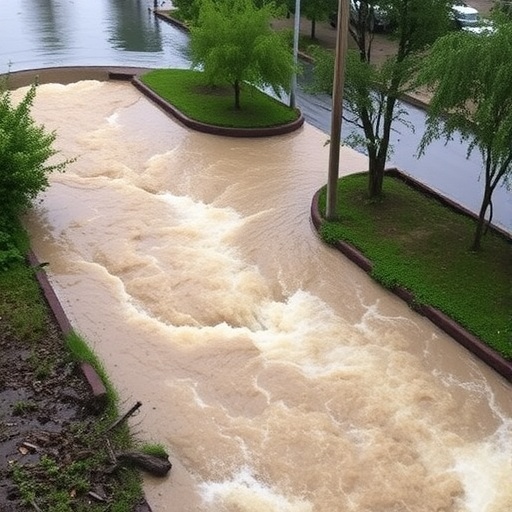
A groundbreaking study has recently shed light on the paradoxical nature of some of the most intense and destructive rainstorms in Portugal. Contrary to long-held assumptions that extreme weather events are inherently chaotic and unpredictable, this research reveals that these powerful storms, particularly those linked with atmospheric rivers, possess a surprising degree of intrinsic predictability. This insight could pioneer advancements in early warning systems, potentially saving lives and mitigating infrastructure damage in vulnerable coastal regions.
The research team, led by Ehud Bartfeld and Dr. Assaf Hochman from the Hebrew University of Jerusalem, in collaboration with Dr. Alexandre M. Ramos from the Karlsruhe Institute of Technology, embarked on an in-depth investigation into Heavy Precipitation Events (HPE) in the western Iberian Peninsula. These extreme precipitation episodes have recently been linked with growing risks to urban infrastructure, water management systems, and overall public safety amid a shifting climate paradigm that intensifies hydrological extremes.
Central to their findings is the pivotal role of atmospheric rivers, which are long, narrow bands of concentrated water vapor that traverse oceans and transport vast quantities of moisture into coastal regions. The study identified that storms involving atmospheric rivers produce markedly heavier rainfall — approximately 36% more intense on average than events without such moisture conveyor belts. This increase in precipitation intensity does not simply arise from an overall elevation in atmospheric moisture content. Instead, it is fundamentally driven by amplified low-level winds that channel moisture more efficiently into affected regions, thereby enhancing rainfall delivery to the surface.
In the words of the researchers, “It’s not just how much water the atmosphere holds. It’s how effectively the system delivers that water to the ground.” This distinction underscores a nuanced understanding of precipitation dynamics: it’s the meteorological mechanisms organizing moisture transport and convergence that govern extreme rain events, not solely the atmospheric moisture budget.
One of the most challenging questions the study addresses is the intrinsic predictability of these extreme rainfall occurrences. Utilizing a novel dynamical systems approach, the researchers meticulously analyzed the evolution of atmospheric patterns before and during heavy precipitation episodes. This method involves examining both the lower and upper atmospheric layers to capture the full spectrum of dynamic interactions governing storm development and progression.
Their analysis uncovered a remarkable bifurcation in predictability. The most intense and destructive rainfall events are not random anomalies but are consistently linked with well-organized, deep extra-tropical cyclones forming over the North Atlantic, near 50°N latitude and 15°W longitude. These cyclonic systems are characterized by pressure anomalies nearly double the magnitude of those seen in less predictable storms, clearer jet stream interactions, and more coherent large-scale atmospheric wave patterns.
The practical implications of this finding are profound. The highly predictable storms exhibited rainfall intensities approximately 80% greater than their less organized counterparts, making them both exceptionally dangerous and notably “readable” from a forecast perspective. This revelation defies the common perception that the severest storms are the most capricious, revealing instead that strong atmospheric signals can precede the most hazardous events.
The December 2022 storm that ravaged western Portugal served as a pivotal case study illustrating this phenomenon. This particular event featured an atmospheric river that aligned synchronously with a powerful extratropical cyclone and a well-defined jet stream configuration. This confluence resulted not only in prodigious rainfall and widespread flooding but also in relatively high forecast confidence leading up to the storm. Such alignment can provide vital lead time for preparations and emergency responses if the atmospheric signals are correctly interpreted and communicated.
Integrating atmospheric river detection with dynamical systems analysis presents a promising frontier in meteorological research. By combining these methodologies, forecasters could enhance their ability to pinpoint the timing and magnitude of heavy precipitation events with unprecedented accuracy. Such advances could extend beyond the Iberian Peninsula, benefiting any coastal regions prone to moisture-driven storms, including parts of North America, Asia, and Oceania.
The study also carries broader implications in the context of a changing climate. As anthropogenic warming intensifies the hydrological cycle, extreme rainfall events are expected to increase both in frequency and severity. Distinguishing between chaotic atmospheric noise and organized, predictable patterns becomes critical for improving resilience and adaptive planning. This research highlights that the atmosphere occasionally broadcasts clear, coherent signals of extreme weather—signals which humanity can learn to read more effectively.
From a scientific perspective, these findings challenge meteorologists to reconsider traditional forecasting paradigms that have often regarded extreme events as irreducibly uncertain. By applying advanced frameworks from dynamical systems theory, the atmospheric community can better understand and anticipate the nonlinear interactions that precipitate heavy rainstorms. This could revolutionize predictive capabilities, converting the chaos of climate extremes into more manageable and forecastable phenomena.
The implications extend as well to infrastructure design and emergency management. Knowing in advance that a forecasted event is both intense and intrinsically predictable enables more targeted preparations, reducing economic losses and saving lives. Furthermore, as researchers decode the atmospheric signatures that precede these storms, they open new avenues for improving numerical weather prediction models, which are the cornerstone of operational forecasting worldwide.
In conclusion, this study marks a significant leap in meteorological science by unveiling the hidden predictability of some of the most intense storms impacting Portugal and similar regions. As climate change continues to reshape weather patterns globally, unlocking the secrets of atmospheric predictability will be essential in safeguarding vulnerable communities. The atmospheric rivers and cyclonic systems previously thought to produce chaotic havoc may, paradoxically, offer some of the clearest windows into the future of extreme weather forecasting.
Cite Scienmag News
Russell Cooper. (April 13, 2026). New Study Finds Atmospheric Rivers Intensify and Predict Flooding Patterns. Scienmag. https://scienmag.com/new-study-finds-atmospheric-rivers-intensify-and-predict-flooding-patterns/
Russell Cooper. "New Study Finds Atmospheric Rivers Intensify and Predict Flooding Patterns." Scienmag, 13 April 2026, https://scienmag.com/new-study-finds-atmospheric-rivers-intensify-and-predict-flooding-patterns/. Accessed 4 September 2026.
Russell Cooper. "New Study Finds Atmospheric Rivers Intensify and Predict Flooding Patterns." Scienmag. April 13, 2026. https://scienmag.com/new-study-finds-atmospheric-rivers-intensify-and-predict-flooding-patterns/


