


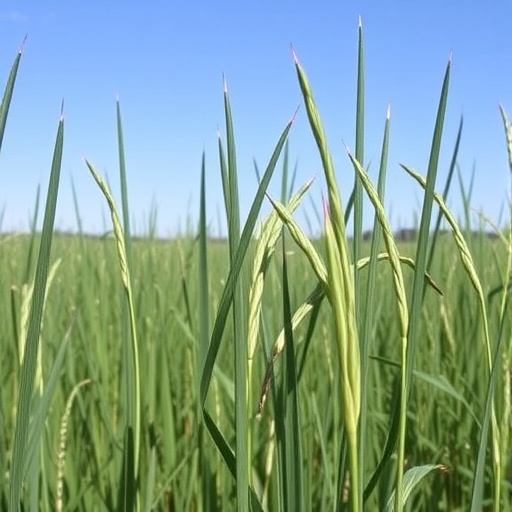
In a groundbreaking advance for agricultural genomics, researchers have successfully assembled a near-complete genome of Northern wild rice (Zizania palustris), a resilient and nutritionally rich aquatic grass native to North America’s Great Lakes region. This achievement not only fills a critical gap in cereal crop genomics but also offers an unprecedented genetic blueprint to inform future breeding programs aimed at enhancing food security amid a changing climate.
Northern wild rice, distinct from the widely cultivated Asian rice (Oryza sativa), has long been recognized for its exceptional nutrient profile, boasting elevated levels of proteins, vitamins, minerals, dietary fiber, and flavonoids. Despite its importance as a specialty crop, progress in genetic and agronomic research was hampered by incomplete genomic data—early assemblies were notably fragmented and lacked the resolution required to fully understand the species’ unique adaptations and genetic potential.
Led by Professors Zhongfeng Zhang and Ning Yan at the Chinese Academy of Agricultural Sciences, the research team employed state-of-the-art sequencing technologies, leveraging long-read sequencing and advanced assembly algorithms to reconstruct a 1.41 gigabase (Gb) genome with remarkable continuity and accuracy. The resulting assembly encompasses 47,804 predicted genes, representing a quantum leap forward from previously assembled drafts that covered roughly 89.4% of the genome. This new assembly achieved approximately 97% completeness, setting a new standard for wild rice genomics.
This comprehensive genome map sheds light on the evolutionary trajectory of Zizania palustris in relation to other members of the Poaceae family. One notable discovery includes the genome’s significant expansion through the proliferation of long terminal repeats—repetitive DNA elements that play a role in genome evolution and adaptation. Intriguingly, the research revealed key expansions in gene families related to sphingolipid metabolism and DNA replication, which may underpin the plant’s enhanced stress tolerance and environmental resilience.
Comparative genomic analyses further elucidated the shared evolutionary roots between Zizania palustris and its close relative, Zizania latifolia, as well as conserved clusters of biosynthetic genes such as the phytocassane gene cluster. These gene clusters are implicated in key defensive and metabolic pathways and appear to have emerged prior to the divergence of rice genera, hinting at ancient genetic architectures that confer agronomically valuable traits.
Beyond evolutionary insights, the newly generated genome assembly opens exciting avenues for applied crop science. Traits encoded within the Northern wild rice genome, especially those conferring tolerance to cold environments, pathogen resistance, and nutrient biosynthesis, present valuable targets for introgression into cultivated rice varieties. By harnessing these genetic resources through biotechnology or hybridization, breeders could cultivate rice strains with enhanced nutritional profiles and greater climate resilience—essential qualities for sustaining global food systems in the face of environmental challenges.
Experts emphasize that this advances the concept of rapid, genome-informed ‘life design blueprints’ for specialty crops, enabling precise interventions rather than the traditional, labor-intensive trial-and-error approaches. According to Professor Zhang, the near-complete genome serves as a precise map akin to GPS navigation for future breeding efforts—transforming wild rice from a relatively understudied resource into a cornerstone of crop innovation with substantial implications for nutrition and sustainability.
Importantly, this research aligns with a broader shift in agricultural science towards leveraging underutilized, regionally important crops with unique nutritional and adaptive traits. The Northern wild rice genome project exemplifies how cutting-edge genomics can unlock the latent potential of such species, promoting agrobiodiversity and complementing staple crop development efforts worldwide.
The assembly and characterization of Zizania palustris’s genome were published in The Crop Journal in September 2025, marking a milestone that will resonate across disciplines, from evolutionary biology to crop biotechnology. This work not only enriches our fundamental understanding of grass genomics but also establishes practical groundwork for addressing global food security under the dual pressures of climate change and population growth.
As climate change impacts agriculture by intensifying flooding, drought, and temperature extremes, integrating genetic resilience from wild species like Northern wild rice into mainstream crops becomes imperative. Dr. Ning Yan encapsulates this vision: genes from Northern wild rice hold the promise of fortifying staple cereals to better withstand biotic and abiotic stresses, thus reinforcing the resilience and sustainability of global food systems.
In summary, this near-complete genome assembly stands as a pioneering achievement that bridges fundamental genomics and translational crop improvement. By capturing the full genetic complexity and adaptive mechanisms of Northern wild rice, researchers have equipped the scientific and agricultural communities with a powerful tool to innovate future rice breeding strategies—unlocking new pathways towards enhanced nutrition, sustainability, and food security globally.
News Publication Date: 12 September 2025
Web References:
References:
Published in The Crop Journal, September 2025
Cite Scienmag News
Alan Morgan. (September 29, 2025). New Study by The Crop Journal Reveals Nearly Complete Genome Map of Northern Wild Rice. Scienmag. https://scienmag.com/new-study-by-the-crop-journal-reveals-nearly-complete-genome-map-of-northern-wild-rice/
Alan Morgan. "New Study by The Crop Journal Reveals Nearly Complete Genome Map of Northern Wild Rice." Scienmag, 29 September 2025, https://scienmag.com/new-study-by-the-crop-journal-reveals-nearly-complete-genome-map-of-northern-wild-rice/. Accessed 5 September 2026.
Alan Morgan. "New Study by The Crop Journal Reveals Nearly Complete Genome Map of Northern Wild Rice." Scienmag. September 29, 2025. https://scienmag.com/new-study-by-the-crop-journal-reveals-nearly-complete-genome-map-of-northern-wild-rice/


