


Liver disease, due to viral infections, alcohol abuse, obesity, or cancer, accounts for 1 in every 25 deaths worldwide. A liver transplant can be life saving for people with end-stage liver disease. However, the procedure has limitations related to donor shortage, a technically challenging and invasive surgical procedure, and the requirement for lifelong immunosuppressive medication in the transplant recipients. An alternative to whole organ transplantation is the less invasive injection of dissociated human liver cells, but donor shortage is still an issue. Utilizing interspecies blastocyst complementation to obtain transplantable human liver cells or whole organs in sufficient quantity in a different animal species was one way to overcome these barriers.

Credit: Chinese Academy of Sciences, Beijing
Liver disease, due to viral infections, alcohol abuse, obesity, or cancer, accounts for 1 in every 25 deaths worldwide. A liver transplant can be life saving for people with end-stage liver disease. However, the procedure has limitations related to donor shortage, a technically challenging and invasive surgical procedure, and the requirement for lifelong immunosuppressive medication in the transplant recipients. An alternative to whole organ transplantation is the less invasive injection of dissociated human liver cells, but donor shortage is still an issue. Utilizing interspecies blastocyst complementation to obtain transplantable human liver cells or whole organs in sufficient quantity in a different animal species was one way to overcome these barriers.
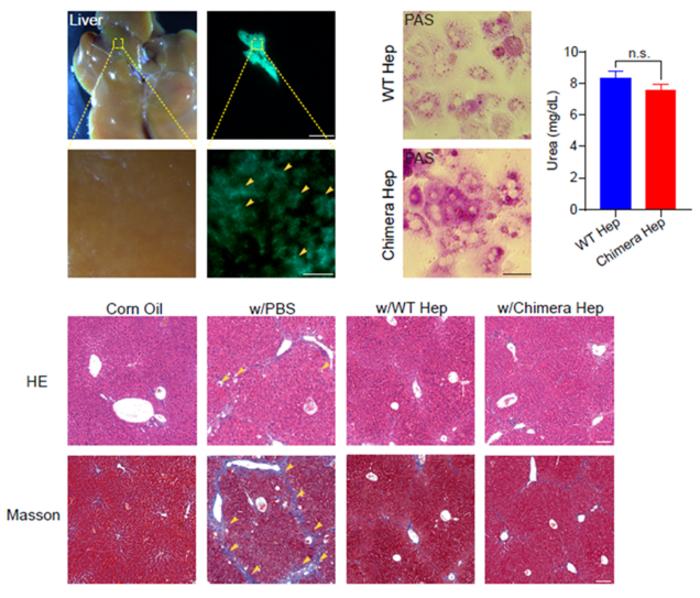
One important question is whether liver cells grown in a different species would be fully functional. To find out, Wei Li and colleagues from the Chinese Academy of Sciences in Beijing injected mouse embryonic stem cells into early rat embryos. Mouse-rat chimeras born from these engineered embryos contained mouse cells in most parts of the body including the livers. The percentage of live mouse liver cells enriched was up to 20.6% from chimeric livers. Encouragingly, mouse liver cells grown in mouse-rat chimeras had normal appearance and mature function in a panel of lab-based tests. Moreover, mouse liver cells from mouse-rat chimeras could be transplanted into mice with liver damage and had a similar therapeutic effect as normal mouse liver cells in relieving chronic liver fibrosis. This data, recently published in the journal Stem Cell Reports, provides proof of principle that functional liver cells can be grown in a different species…and could represent a solution to transplant shortage. Future work is needed to develop efficient techniques to grow human liver cells in large animals such as pigs, and to investigate whether these human liver cells are fully functional.
Journal
Stem Cell Reports
Article Title
Functional Mouse Hepatocytes Derived from Interspecies Chimeric Livers Effectively Mitigate Chronic Liver Fibrosis
Article Publication Date
9-May-2024
Cite Scienmag News
Drew Townsend. (May 9, 2024). New stem cell research may have implications for liver transplantation. Scienmag. https://scienmag.com/new-stem-cell-research-may-have-implications-for-liver-transplantation/
Drew Townsend. "New stem cell research may have implications for liver transplantation." Scienmag, 9 May 2024, https://scienmag.com/new-stem-cell-research-may-have-implications-for-liver-transplantation/. Accessed 4 September 2026.
Drew Townsend. "New stem cell research may have implications for liver transplantation." Scienmag. May 9, 2024. https://scienmag.com/new-stem-cell-research-may-have-implications-for-liver-transplantation/

