


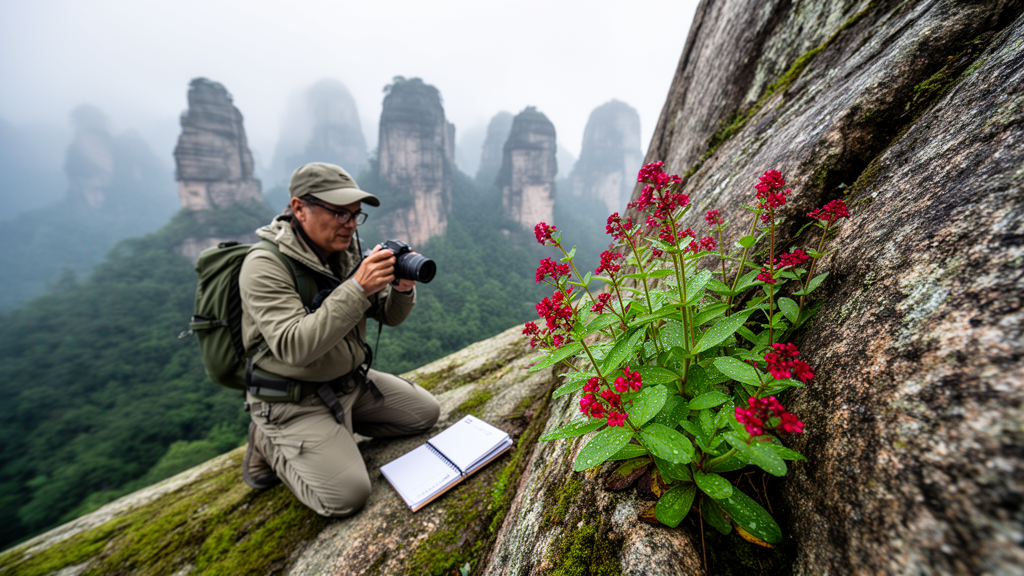
High on the mist-wrapped slopes of Mount Fanjing in China’s Guizhou Province, botanists have identified a spurge species so distinct that both its DNA and its appearance set it apart from every known relative. The plant, now formally named Euphorbia fanjingshanensis, joins one of the largest and most notoriously difficult flowering plant genera on Earth, a group that contains more than 2,000 species and has frustrated taxonomists since Linnaeus himself described the genus in 1753. The discovery, published in the journal PhytoKeys, is a reminder that even well-studied temperate floras still hide species in plain sight.
The new species belongs to Euphorbia subgenus Esula, section Helioscopia, a lineage of temperate perennial herbs that includes familiar plants such as the sun spurge. Members of this section share subtle traits: leafy stems, tiny cup-shaped flower structures called cyathia whose glands lack appendages, and fruits covered in wart-like bumps. Those shared features, combined with enormous geographic range and rampant convergent evolution, have made the genus what the study’s authors describe as a hard nut for classification. Integrative approaches that combine physical traits with molecular phylogenetics have only recently begun to untangle the group’s true evolutionary branches.
Fieldwork began in the Fanjingshan National Nature Reserve, where researchers encountered two populations of an unfamiliar Euphorbia growing on humid, open rocky slopes. The same plant later turned up hundreds of kilometers away at Chuankongdong Cave in Yichang, Hubei Province, and again in Langao County in Shaanxi Province. All three localities sit within the transitional zone between the Yunnan-Guizhou Plateau and the Wuling Mountains, a geography that hints the species may be more widespread than current records suggest. The type specimen was collected near the summit of Mount Fanjing at roughly 2,263 meters elevation, within the reserve’s celebrated cloud-forest zone.
What makes Euphorbia fanjingshanensis immediately recognizable is a striking combination of features. It bears lanceolate leaves with sharply pointed tips, and its flower stalks, involucres, and styles flush a vivid reddish to crimson hue that its closest relatives lack. Its capsules carry moderate wart-like tubercles, and its seeds are ovoid-globose, dark brown, and slightly shiny, measuring about 2.5 by 2 millimeters. The plant itself is an erect herb reaching up to 75 centimeters tall, with clustered stems numbering as many as eight and vertical cylindrical roots roughly 10 centimeters long.
Distinguishing a new species in this genus requires ruling out lookalikes with precision. The researchers compared the new plant against Euphorbia micractina and Euphorbia pekinensis, its two closest morphological relatives. Euphorbia micractina has much smaller leaves, oblong to elliptic with rounded tips, and tuberous or rhizomatous roots. Euphorbia pekinensis grows taller roots of 20 to 30 centimeters and elliptic leaves with acuminate tips. Neither relative displays the intense crimson coloring of the new species’ reproductive structures, and both have more sparsely tuberculate capsules. A detailed character table in the paper documents these differences across roots, stems, leaves, glands, fruits, and seeds.
To confirm that the visual differences reflected genuine evolutionary separation, the team turned to DNA. They sequenced two molecular markers widely used in Euphorbia systematics: the nuclear ribosomal Internal Transcribed Spacer region and the plastid ndhF gene. The dataset ultimately included 82 samples representing 79 species, spanning section Helioscopia and three closely related sections used as outgroups. Four sequences were newly generated for this study, including two from the new species, while the remainder came from the NCBI GenBank database.
The phylogenetic results were unambiguous. Section Helioscopia was recovered as monophyletic with strong statistical support, and the two accessions of Euphorbia fanjingshanensis clustered together with full support, deeply nested within the section. The species emerged as sister to a clade of five East Asian relatives: Euphorbia micractina, E. lucorum, E. pekinensis, E. fauriei, and E. hylonoma. This placement confirms the new species belongs to the East Asian Clade, a group corresponding to the Sino-Japanese and Sino-Himalayan biogeographic elements defined in earlier work. In plain terms, the plant’s DNA tells the same story as its distinctive crimson flowers and warty capsules.
The methods behind the analysis reflect modern systematic practice. Sequences were aligned with MAFFT, trimmed with TrimAl, and analyzed under both maximum likelihood and Bayesian inference frameworks using IQ-TREE and MrBayes. Statistical tests confirmed the two genetic markers could be safely combined, and the resulting trees from both analytical approaches produced largely identical topologies. Pollen grains examined under scanning electron microscopy added another layer of evidence, revealing radially symmetrical, three-colporate grains roughly 30 by 25 micrometers with distinctive perforated ornamentation.
Interestingly, the species had been sitting in herbarium collections for decades before anyone recognized it as new. Paratype specimens date back to 1941, with additional collections from 1959, 2008, 2016, and 2023, all filed under other names or left unidentified. Only the convergence of fresh fieldwork, careful morphological comparison against digitized herbarium images from resources like the Chinese Virtual Herbarium and JSTOR Global Plants, and molecular sequencing allowed the plant to finally claim its own name. The species epithet honors Fanjingshan Mountain, one of its type localities and a UNESCO World Heritage site famed for its endemic flora.
For conservation, the outlook is cautiously positive. A rapid assessment using the GeoCAT tool estimated an area of occupancy of about 12 square kilometers and an extent of occurrence near 31,385 square kilometers, and the species has been preliminarily assessed as Least Concern under IUCN criteria. All known populations occur within protected areas or intact montane habitat, with stable numbers and no observed major threats. Yet with only three confirmed localities and a flowering window from May to July, researchers caution that the species’ full range remains an open question. As China’s spurge diversity continues to yield surprises, with several new species described in recent years alone, Euphorbia fanjingshanensis stands as evidence that the age of botanical discovery is far from over.
Subject of Research: Description and phylogenetic placement of the new plant species Euphorbia fanjingshanensis from southwestern and central China
Article Title: Euphorbia fanjingshanensis ( Euphorbiaceae ), a new species from section Helioscopia in southwestern and central China
Article References: Feng, Y.-L., Shi, L., Ratsiferanarivo, R. T., Qiu, X.-D., Xin, Z.-H., Yao, H.-Y., Wang, S.-W., Wei, N., & Wang, Q.-F. (2026). Euphorbia fanjingshanensis (Euphorbiaceae), a new species from section Helioscopia in southwestern and central China. PhytoKeys, 277, 181-195. https://doi.org/10.3897/phytokeys.277.187415
Image Credits: AI Generated
DOI: 10.3897/phytokeys.277.187415
Keywords: Euphorbia fanjingshanensis, new species, Euphorbiaceae, phylogenetics, China, Mount Fanjing, section Helioscopia, plant taxonomy, biodiversity, molecular systematics, PhytoKeys, botany
Cite Scienmag News
Margaret Porter. (October 18, 2026). New Spurge Species With Crimson Flowers Discovered on China’s Sacred Mount Fanjing. Scienmag. https://scienmag.com/new-spurge-species-with-crimson-flowers-discovered-on-chinas-sacred-mount-fanjing/
Margaret Porter. "New Spurge Species With Crimson Flowers Discovered on China’s Sacred Mount Fanjing." Scienmag, 18 October 2026, https://scienmag.com/new-spurge-species-with-crimson-flowers-discovered-on-chinas-sacred-mount-fanjing/. Accessed 18 October 2026.
Margaret Porter. "New Spurge Species With Crimson Flowers Discovered on China’s Sacred Mount Fanjing." Scienmag. October 18, 2026. https://scienmag.com/new-spurge-species-with-crimson-flowers-discovered-on-chinas-sacred-mount-fanjing/


