


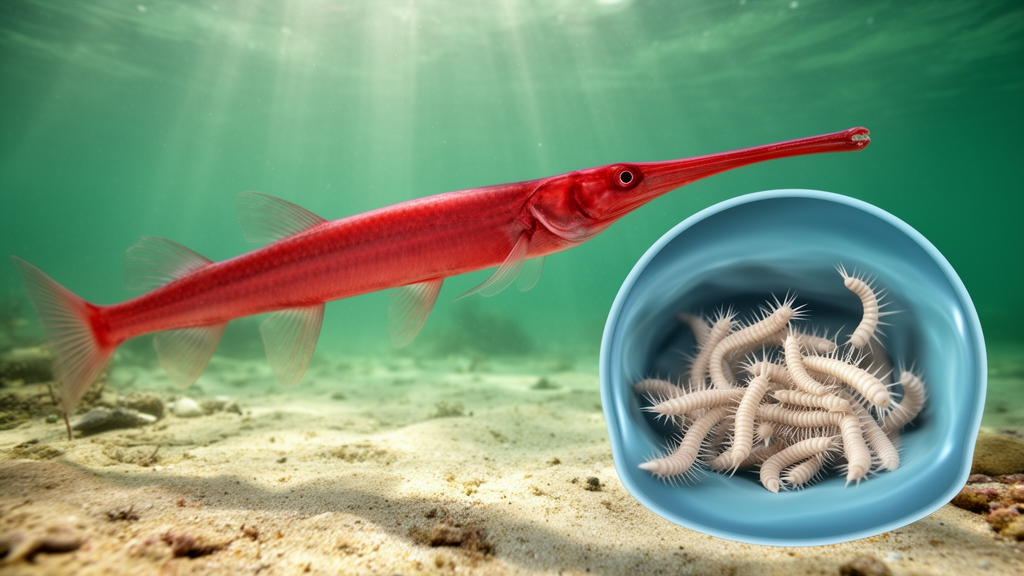
Marine biologists have identified a new species of spiny-headed worm, a parasitic invertebrate that has long remained a shadowy figure in the complex web of oceanic life. The newly described organism, named Gorgorhynchus fistularius, was discovered in the intestines of the red cornetfish, a slender and unusual fish found in tropical waters. This discovery not only adds a new entry to the growing catalog of marine parasites but also provides critical genetic data that helps resolve the evolutionary relationships within a specific group of acanthocephalans. The research, published in the journal Zoosystematics and Evolution, combines detailed morphological analysis with advanced genomic sequencing to offer a comprehensive profile of this previously unknown species.
The red cornetfish, scientifically known as Fistularia petimba, is a distinctive member of the family Fistulariidae. Characterized by its elongated body and tubular snout, this fish inhabits the tropical Atlantic and Indo-West Pacific Oceans, including the South China Sea. It primarily feeds on small fishes and shrimps, a diet that exposes it to various parasitic organisms. Prior to this study, only two species of acanthocephalans had been reported from this host, both belonging to the order Echinorhynchida. The discovery of Gorgorhynchus fistularius marks the first record of a member of the family Isthmosacanthidae in this particular fish host, highlighting the ongoing potential for new parasitic associations in marine ecosystems.
The identification of the new species relied on a multi-faceted approach that integrated traditional microscopy with modern molecular techniques. Researchers examined specimens collected from the South China Sea off Sanya, Hainan Island, using both light and scanning electron microscopy to observe the worm’s physical characteristics. The worm possesses a long, slender trunk armed with a single field of small spines and a club-shaped proboscis equipped with multiple rows of hooks. These morphological features, particularly the arrangement and size of the proboscis hooks, distinguish G. fistularius from other species in the genus Gorgorhynchus, which currently includes thirteen known species.
To confirm the distinct identity of the new species, the researchers sequenced several key genetic markers, including the nuclear 18S and 28S ribosomal RNA genes, the internal transcribed spacer region, and the mitochondrial cytochrome c oxidase subunits I and II. The analysis revealed no nucleotide divergence among the individuals sampled, indicating a genetically uniform population. When compared to the closest known relative, Gorgorhynchus medius, the new species showed significant genetic distance in the mitochondrial cox1 gene, with divergence ranging from 17.4% to 18.0%. This level of variation is well above the threshold typically used to define separate species in acanthocephalans, providing strong molecular evidence for the validity of the new taxon.
A particularly significant aspect of this study is the sequencing of the complete mitochondrial genome of G. fistularius. This 14,409-base-pair genome represents the first mitogenomic data for the genus Gorgorhynchus and the entire family Isthmosacanthidae. The genome contains 36 genes, including 12 protein-coding genes, 22 transfer RNA genes, and two ribosomal RNA genes, along with two non-coding regions. Notably, the genome lacks the atp8 gene, a feature common among acanthocephalans. The overall A+T content of the genome is 68.1%, which is distinctly higher than the range of 54.5% to 64.4% observed in other known mitogenomes of the order Polymorphida. This high A+T bias is likely driven by mutational pressure and evolutionary history rather than functional adaptation.
The comparative analysis of the mitochondrial genome arrangement revealed that the gene order in G. fistularius is identical to that of other polymorphid species, with the exception of Southwellina hispida, which exhibits a slight rearrangement in two tRNA genes. This conservation of gene order provides a stable framework for phylogenetic comparisons. By aligning the amino acid sequences of the 12 protein-coding genes from the new species with those of 47 other acanthocephalan species, the researchers constructed phylogenetic trees using both maximum likelihood and Bayesian inference methods. These analyses confirmed that the Isthmosacanthidae form a distinct monophyletic group within the order Polymorphida.
The phylogenetic results offer new insights into the evolutionary history of the Isthmosacanthidae. Previous studies based on limited genetic markers had placed this family in different positions within the acanthocephalan tree of life, often associating it with the order Echinorhynchida. However, the current mitogenomic data strongly support its placement within the order Polymorphida. The analysis suggests that the Isthmosacanthidae are sister to a clade comprising the Centrorhynchidae and Polymorphidae families. This finding refines the understanding of interfamilial relationships within Polymorphida, although the authors note that further sampling of other families, such as the Plagiorhynchidae and Pyriprobosicidae, is needed to fully resolve the deep phylogenetic structure of the order.
The discovery of Gorgorhynchus fistularius underscores the importance of integrating morphological and genomic data in the description of new parasitic species. Parasites are often overlooked in biodiversity assessments, yet they play crucial roles in ecosystem dynamics and can serve as indicators of environmental health. The red cornetfish, with its unique ecological niche, provides a valuable host for studying such interactions. The genetic data generated in this study will serve as a reference for future research, enabling more accurate identification of related species and facilitating the study of their distribution and host specificity.
As marine biodiversity continues to be explored, the use of next-generation sequencing technologies is revealing a hidden dimension of life that was previously inaccessible. The complete mitochondrial genome of G. fistularius fills a significant gap in the genomic database of acanthocephalans, a phylum that includes over 1,300 described species. By providing the first mitogenomic data for the Isthmosacanthidae, this study enhances the ability of scientists to reconstruct the evolutionary history of these parasites. The findings contribute to a broader understanding of the diversity and evolution of marine invertebrates, highlighting the ongoing need for detailed taxonomic and genomic studies in understudied groups.
In conclusion, the description of Gorgorhynchus fistularius sp. nov. represents a significant advance in the taxonomy of acanthocephalans. The combination of detailed morphological characterization and comprehensive genomic analysis has not only defined a new species but also clarified its evolutionary position within the order Polymorphida. The high A+T content of its mitochondrial genome and the conservation of gene order provide valuable comparative data for future phylogenomic studies. This work exemplifies the power of integrative taxonomy in uncovering the hidden diversity of the marine world, offering new perspectives on the complex relationships between parasites and their hosts in tropical ocean environments.
Subject of Research: Discovery and genomic characterization of a new acanthocephalan parasite species
Article Title: Morphology, genetic characterization and mitochondrial genome of Gorgorhynchus fistularius sp. nov. ( Acanthocephala , Isthmosacanthidae ) from the red cornetfish Fistularia petimba (Lacépède, 1803) ( Gasterosteiformes , Fistulariidae ), with phylomitogenomics of the family Isthmosacanthidae
Article References: Chen, H.-X., Yang, R.-J., Wu, S.-S., Yu, Z.-J., & Li, L. (2026). Morphology, genetic characterization and mitochondrial genome of Gorgorhynchus fistularius sp. nov. (Acanthocephala, Isthmosacanthidae) from the red cornetfish Fistularia petimba (Lacépède, 1803) (Gasterosteiformes, Fistulariidae), with phylomitogenomics of the family Isthmosacanthidae. Zoosystematics and Evolution, 102(1), 367-385. https://doi.org/10.3897/zse.102.184032
Image Credits: AI Generated
Keywords: Acanthocephala, Marine Parasitology, Mitogenomics, Isthmosacanthidae, Red Cornetfish, Phylogenetics, Taxonomy, Genome Sequencing, Morphology, genetic, characterization, mitochondrial
Cite Scienmag News
Juliet Wilcox. (October 18, 2026). New Spiny Worm Species Discovered in Red Cornetfish. Scienmag. https://scienmag.com/new-spiny-worm-species-discovered-in-red-cornetfish/
Juliet Wilcox. "New Spiny Worm Species Discovered in Red Cornetfish." Scienmag, 18 October 2026, https://scienmag.com/new-spiny-worm-species-discovered-in-red-cornetfish/. Accessed 18 October 2026.
Juliet Wilcox. "New Spiny Worm Species Discovered in Red Cornetfish." Scienmag. October 18, 2026. https://scienmag.com/new-spiny-worm-species-discovered-in-red-cornetfish/


