


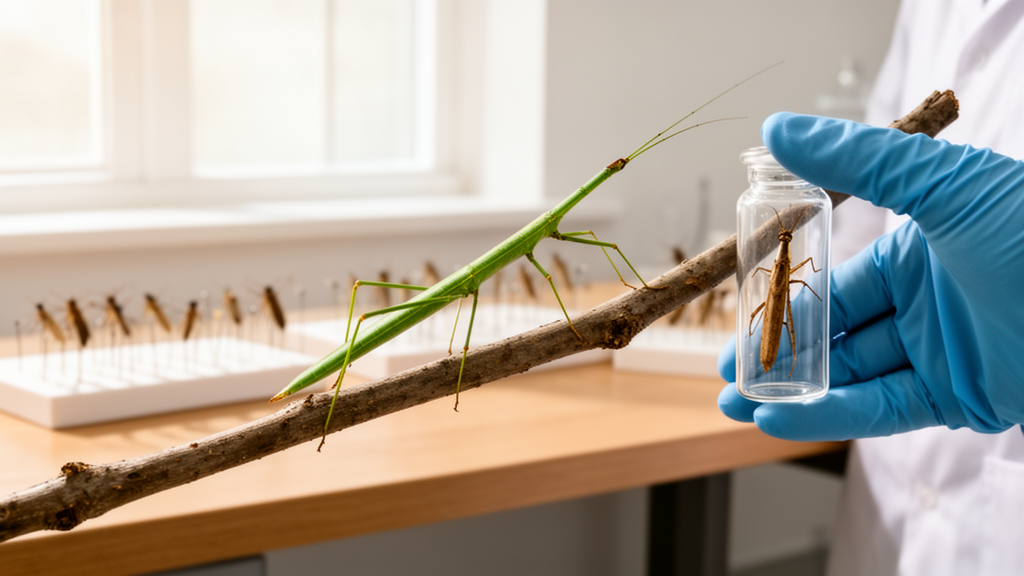
A name that has haunted the stick insect literature of southern Africa for nearly seven decades has now been formally laid to rest. A new study published in African Invertebrates demonstrates that Bactricia nematodes Kirby, 1894, a name cited for a South African stick insect specimen in 1957, is a nomen nudum, an unavailable name in zoological nomenclature. The research goes further, resolving the actual identity of the specimen behind the name: a male of Bactricia bituberculata (Schaum, 1857), a species that was already well known to science when the erroneous record was published.
The case illustrates how a single misattributed citation can propagate through the literature. When Klaus Günther assigned the Lund University Swedish South African Expedition specimen to “Bactricia nematodes K[ir]by., 1894” in his 1957 review of the expedition’s stick insects, he created a record that a later author, Schoeman in 1985, repeated without independent verification. This pattern, in which a secondary citation inherits the errors of its source, is a well-recognised hazard in taxonomy, and it is precisely why the International Commission on Zoological Nomenclature requires that names be accompanied by descriptions, diagnoses, or explicit bibliographic references to be considered available.
The nomenclatural reasoning in the study rests on several independent lines of evidence, each of which would be sufficient on its own to disqualify the name. Günther provided no description, diagnosis, or illustration of the specimen he was naming, and his own introductory remarks indicate that he considered only one species in the expedition sample to be new, the stick insect he described as Ramulus rubrotaeniatus. Since Günther habitually illustrated his new species, the absence of any figure for Bactricia nematodes is telling. Furthermore, the name cannot be validated by reference to a 1894 publication by Kirby, because Günther cited no such work, none of Kirby’s known publications appeared in that year, and the genus Bactricia itself was only described in 1896. Had Günther intended to transfer an epithet originally coined in another genus, standard practice would have required parentheses around the author’s name, which he did not supply.
The study also identifies the likely psychological origin of the error. The specific epithet nematodes does exist in stick insect nomenclature, but it belongs to Phasma (Bacteria) nematodes de Haan, 1842, a large, wingless Asian species. Kirby himself, writing in 1904, treated that epithet only as a synonym of other de Haan names and never claimed to have coined it. The authors conclude that Günther’s citation represents a lapsus memoriae, a slip of memory in which he conflated the authorship of the genus Bactricia with the authorship of a species name, misremembered the date of Kirby’s publication, and confused the Asian Ramulus nematodes with a name appropriate to his African material. Comparable lapses are documented elsewhere in Günther’s work, including his genus-level name Poecilobactron, which similarly arose from a garbled recollection of an earlier taxon.
Resolving the actual identity of the specimen required direct examination of the physical material, which is housed in the Biological Museum at Lund University. The specimen carries four labels documenting its collection during the expedition and its determination by Günther himself. Morphological comparison with historical illustrations and descriptions, including Westwood’s meticulous 1859 plates and later treatments by Kirby and Brunner von Wattenwyl, shows that the specimen’s shape, proportions, and ornamentation fall squarely within the known variation of Bactricia bituberculata and its four synonyms. Particularly diagnostic are the large, flat, wide, curved cerci at the tip of the male abdomen, structures that the authors note are especially distinctive for this species within the African fauna.
Locality data provide independent corroboration. The specimen was collected at Locality 302, described in the first volume of the expedition’s results as a fairly fast-running stream with pools, sandy and stony bottoms, and shores overgrown by dense bush and tree vegetation. Although the original expedition map lacks geocoordinates, the authors overlaid it on satellite imagery, using Pretoria, Maputo, and Beitbridge as reference landmarks, and identified a likely site near 25 degrees south, 31 degrees east. This location falls within the documented distribution and typical habitat of Bactricia bituberculata in the region encompassing eSwatini and the South African provinces of Mpumalanga and Limpopo, close to the type locality of Hyrtacus carinatus Kirby, 1902, which is now recognised as a synonym of the same species.
The study also settles a question about the publication date of Günther’s chapter, which matters for nomenclatural purposes. The volume bearing his contribution carries copyright and printing dates of 1956 but no explicit publication date. Under the International Code of Zoological Nomenclature, when a work lacks a stated date of publication, the effective date is the earliest day on which the work is demonstrated to exist as a published work. Previous research established that the book was received by the Lund University Library on 19 March 1957, and it is reasonable to assume that this library would have been among the first recipients, given that it employed the volume’s editors and housed the specimens Günther documented. Accordingly, 19 March 1957 stands as the earliest date on which the chapter, including the description of Ramulus rubrotaeniatus, was obtainable.
Beyond the specific resolution, the case offers broader lessons for biodiversity documentation. Databases such as the Phasmid Species File Online, which flagged the doubtful status of Bactricia nematodes with the tentative annotation “no such species?”, play a crucial role in surfacing anomalies that might otherwise persist unexamined. Formal taxonomic acts like the present study convert such informal suspicion into settled nomenclature, removing ambiguity for ecologists, conservation planners, and museum curators who rely on species lists. The distinction between a nomen nudum, which is unavailable and cannot be used, and a nomen dubium, whose application is uncertain, is not merely pedantic; it determines which names carry legal and scientific weight in contexts ranging from protected species listings to phylogenetic analyses.
The episode also underscores the enduring value of historical type illustrations and museum specimens. Westwood’s 1859 engravings, produced more than a century and a half ago, proved decisive both in diagnosing the misidentification and in confirming the specimen’s true identity. The photographs of the Lund specimen, made freely available under an open licence, now allow any researcher to verify the conclusions independently. As molecular and morphological datasets continue to expand, the careful reconciliation of legacy records with physical evidence remains an essential, if unglamorous, foundation for accurate biodiversity knowledge, and cases like Bactricia nematodes demonstrate that even names published in good faith decades ago may require modern scrutiny before they can be trusted.
Subject of Research: Taxonomic review establishing that Bactricia nematodes is a nomen nudum and identifying the associated specimen as Bactricia bituberculata.
Article Title: “ Bactricia nematodes Kby., 1894” ( Phasmida , Diapheromeridae , Diapheromerinae ) is a nomen nudum
Article References: Villet, M. H. (2024). “Bactricia nematodes Kby., 1894” (Phasmida, Diapheromeridae, Diapheromerinae) is a nomen nudum. African Invertebrates, 65(1), 1-7. https://doi.org/10.3897/afrinvertebr.65.115507
Image Credits: AI Generated
DOI: 10.3897/AfrInvertebr.65.115507
Keywords: Phasmida, stick insects, nomen nudum, taxonomy, Bactricia bituberculata, zoological nomenclature, ICZN, Lund University Swedish South Africa Expedition, African Invertebrates, Klaus Günther, South Africa, species inquirenda
Cite Scienmag News
Gavin Prescott. (October 18, 2026). Ghost Name in Stick Insect Taxonomy Finally Resolved as Nomen Nudum. Scienmag. https://scienmag.com/ghost-name-in-stick-insect-taxonomy-finally-resolved-as-nomen-nudum/
Gavin Prescott. "Ghost Name in Stick Insect Taxonomy Finally Resolved as Nomen Nudum." Scienmag, 18 October 2026, https://scienmag.com/ghost-name-in-stick-insect-taxonomy-finally-resolved-as-nomen-nudum/. Accessed 18 October 2026.
Gavin Prescott. "Ghost Name in Stick Insect Taxonomy Finally Resolved as Nomen Nudum." Scienmag. October 18, 2026. https://scienmag.com/ghost-name-in-stick-insect-taxonomy-finally-resolved-as-nomen-nudum/


