


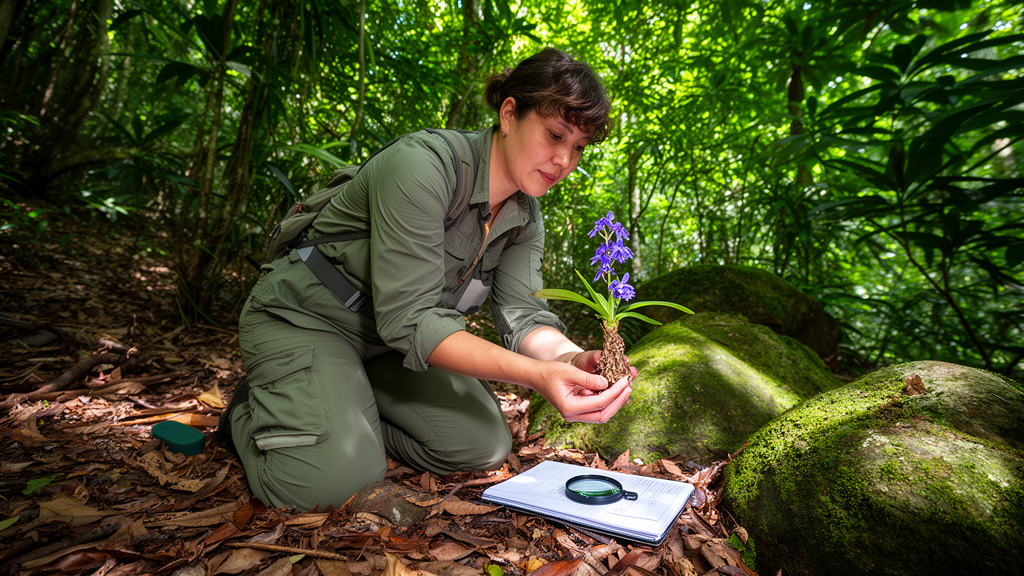
Botanists surveying a forest-edge valley in a provincial nature reserve near Guangzhou have described a previously unknown species of skullcap, the genus Scutellaria, formally naming it Scutellaria chenhedongensis after the Chenhedong Provincial Nature Reserve in Conghua District, Guangdong Province, southern China. The plant was first collected on 28 March 2026 during a floristic survey, when its unusual combination of traits—a woody stem base, a dense one-sided terminal flower cluster, and a sharply bent corolla base without any pouch or spur—made it impossible to match with any known species. The description, published in the journal PhytoKeys, rests on both detailed morphological comparison and DNA sequence evidence.
Scutellaria is one of the largest genera in the mint family, Lamiaceae, although estimates of its size vary considerably: classic treatments recognized roughly 360 species, while World Flora Online currently accepts 479. The genus is distributed almost worldwide, favoring temperate regions of the Northern Hemisphere and tropical mountains, and is absent only from places such as the Amazon lowlands, the lowland tropics of Africa, and Pacific islands. Its greatest diversity lies in the Irano-Turanian region, peaking in the Caucasus and on the Iranian Plateau, with the eastern Mediterranean and the Andes as secondary centers.
Members are typically annual or perennial herbs with square stems, opposite leaves, and two-lipped flowers, and the genus is named for the scutellum—a sail- or shield-shaped appendage on the upper calyx lip that serves as its most diagnostic feature. The genus also carries substantial medicinal weight. The roots of S. baicalensis have been used in East Asian medicine for more than two thousand years, and together with relatives such as S. barbata and S. indica they form a widely used group of heat-clearing and detoxifying remedies in traditional Chinese medicine.
Modern pharmacological studies have shown that these plants are rich in flavonoids with reported antitumor, anti-inflammatory, antioxidant, and hepatoprotective activities. That continuing record of medicinal value has sharpened scientific interest in how many skullcap species actually exist, particularly in China, which is the genus's East Asian stronghold with approximately 100 species and 25 varieties recorded in the Flora of China, concentrated in the mountains of the southwest and the hilly south. Taxonomy within Chinese Scutellaria has long been difficult because species boundaries are subtle and many close relatives show continuous variation in the field.
Over the past decade, molecular markers—nuclear ribosomal ITS and ETS sequences, increasingly supplemented by plastome data—have driven a wave of new species descriptions, including S. wuana from Sichuan, S. jishouensis from Hunan, S. wushanensis from Chongqing, S. cavicola from a karst cave entrance in Guangxi, and S. albovillosa and S. yangchunensis from southwestern Guangdong. Strikingly, three new species were described from southern China in 2025 alone, a signal that the region's skullcap diversity remains underexplored and that further fieldwork is likely to yield more discoveries. To pin down the new species' identity, the team generated ITS and ETS sequences from three individuals collected at the type locality and analyzed them alongside sequences of 43 Scutellaria taxa retrieved from GenBank, building a combined matrix of 992 base pairs after alignment and trimming.
Maximum likelihood analysis in IQ-TREE and Bayesian inference in MrBayes produced highly congruent topologies. The three sampled individuals of S. chenhedongensis formed a strongly supported monophyletic clade, with ultrafast bootstrap support of 100 and a Bayesian posterior probability of 1.00—the highest possible support in both frameworks. However, the deeper placement of S. chenhedongensis relative to that pair received only weak support, with bootstrap values of 46 and a posterior probability of 0.56, and the relationships among neighboring lineages such as S. axilliflora and S. hunanensis were likewise weakly supported or unresolved.
The authors caution that these close relationships require further evidence from broader sampling and additional molecular data. Even so, the combination of maximal support for the species' own monophyly and consistent morphological differences firmly justifies its recognition as distinct. Morphologically, S. chenhedongensis stands apart from its four closest relatives through a suite of characters.
It is a perennial subshrub 40 to 100 centimeters tall with a woody stem base—unique within its clade, where the other species are herbaceous, including the annual S. calcarata, which barely reaches 30 centimeters. Its lanceolate to narrowly lanceolate leaves contrast with the cordate leaves of S. calcarata, the ovate to orbicular leaves of S. jishouensis, and the triangular-ovate leaves of S. hunanensis and S. axilliflora. The corolla base is strongly geniculate but lacks any saccate or spur-like projection, whereas S. calcarata bears a saccate spur roughly 2.5 millimeters long—the very feature that gave that species its name—and S. jishouensis has a straight tube with a saccate projection.
The new species also bears a distinctive combination of stipitate glandular hairs and yellow sessile glandular dots across its stems, leaf undersides, flower stalks, and calyces, a pattern not reported in any of the compared congeners. Geography and phenology reinforce the separation. The five related species occupy different parts of southern to southwestern China, from Guangzhou at 444 meters elevation to S. calcarata's montane streamsides at around 2,650 meters in Yunnan.
S. chenhedongensis and its closest phylogenetic relative, S. calcarata, are fully allopatric, separated by more than 1,200 kilometers in linear distance and over 2,200 meters in elevation, and their flowering periods are offset by nearly half a year—March to April for the new species versus September for S. calcarata—constituting a strong reproductive barrier despite their close relationship. The comparison also reveals striking variation in life history among closely related taxa. S. chenhedongensis is tall and woody-based, S. jishouensis is a creeping herb only 2 to 4 centimeters tall with adventitious roots, and the remaining relatives are erect perennial herbs.
Notably, the subshrubby habit also occurs in S. tsinyunensis from Chongqing and the recently described S. cavicola from Guangxi, which form a sister pair related to S. indica rather than to the new species' clade. This implies that the woody stem base may have evolved independently at least twice within this larger group. Because all three subshrubby species grow in moist, shaded subtropical habitats at low to mid elevations—karst cave entrances or valleys within evergreen broad-leaved forests—the authors suggest that lignification of the stem base may represent a convergent adaptation to similar environmental pressures, offering a useful system for future study of life-history evolution in the genus.
Conservation is an immediate concern. Field investigations confirm that S. chenhedongensis is known from a single locality within the reserve, with a population of approximately 300 mature individuals. Under IUCN criteria it has been provisionally assessed as Vulnerable (VU D1+D2), reflecting both its small population size, fewer than 1,000 mature individuals, and its restriction to a single location, where any local disturbance could rapidly push it toward Endangered or Critically Endangered status.
Encouragingly, the entire known population lies within the core area of the Chenhedong reserve, which protects the source area of the Liuxi River and its well-preserved subtropical evergreen broad-leaved forest, and no conspicuous threats have been observed so far.
Subject of Research: Taxonomic description and phylogenetic placement of the new plant species Scutellaria chenhedongensis from Guangdong, China
Article Title: Scutellaria chenhedongensis ( Lamiaceae ), a new species from Guangzhou, Guangdong, southern China
Article References: Yi, X.-W., Chen, Y.-F., Xu, W., Zhong, P.-S., Chen, H.-J., Shen, L.-R., & Fan, Q. (2026). Scutellaria chenhedongensis (Lamiaceae), a new species from Guangzhou, Guangdong, southern China. PhytoKeys, 280, 195-212. https://doi.org/10.3897/phytokeys.280.202471
Image Credits: AI Generated
DOI: 10.3897/phytokeys.280.202471
Keywords: Scutellaria, new species, Lamiaceae, Guangzhou, taxonomy, phylogenetics, ITS, ETS, Guangdong, biodiversity, conservation, Vulnerable
Cite Scienmag News
Margaret Porter. (October 27, 2026). New Skullcap Species With Woody Stem Discovered in Guangzhou Nature Reserve. Scienmag. https://scienmag.com/new-skullcap-species-with-woody-stem-discovered-in-guangzhou-nature-reserve/
Margaret Porter. "New Skullcap Species With Woody Stem Discovered in Guangzhou Nature Reserve." Scienmag, 27 October 2026, https://scienmag.com/new-skullcap-species-with-woody-stem-discovered-in-guangzhou-nature-reserve/. Accessed 27 October 2026.
Margaret Porter. "New Skullcap Species With Woody Stem Discovered in Guangzhou Nature Reserve." Scienmag. October 27, 2026. https://scienmag.com/new-skullcap-species-with-woody-stem-discovered-in-guangzhou-nature-reserve/


