

Tuesday, October 27, 2026
Science
No Result
View All Result
  • Login
  • HOME
  • SCIENCE NEWS
  • CONTACT US
  • HOME
  • SCIENCE NEWS
  • CONTACT US
No Result
View All Result
Scienmag
No Result
View All Result
Home Science News Social Science

Eyes Reveal How Anxious Language Learners Rethink Communication

October 27, 2026
in Social Science
Courtney Benton
By Courtney Benton Scienmag Editorial Profile - Science and Technology Policy
Reading Time: 2 mins read
0
Eyes Reveal How Anxious Language Learners Rethink Communication

Eyes Reveal How Anxious Language Learners Rethink Communication

65
SHARES
587
VIEWS
Share on FacebookShare on Twitter
ADVERTISEMENT

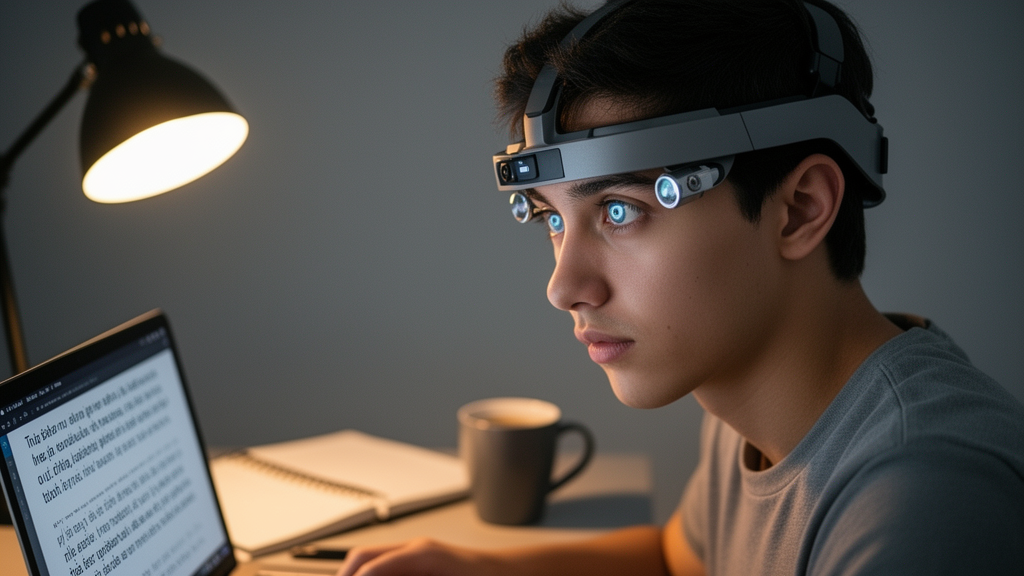
Language anxiety can quietly reshape not just what foreign-language learners say, but how they look, gesture, and move their faces while saying it. A new study published in npj Science of Learning combined eye-tracking with multimodal discourse analysis to observe how English as a Foreign Language (EFL) learners regulate communication under stress, and the results point to a distinctive, measurable pattern of anxious communication.

The researchers, Ting Wen and Yuqing Wei, recruited 120 college students whose scores on the Self-Rating Anxiety Scale fell between 50 and 59, indicating moderate anxiety. Using stratified random sampling, they split the participants into experimental and control groups of 60 each. During impromptu speech and debate tasks, the team recorded language output alongside eye movements, gestures, facial expressions, and physiological signals, creating a rich multimodal picture of communication under anxiety.

The comparison between higher- and lower-anxiety learners revealed a systematic pattern. Anxious participants showed rigid, text-biased gaze behavior, produced redundant language output, and displayed inhibitory nonverbal behavior. Together, the authors interpret these shifts as compensatory pragmatic regulation: strategies the learners deploy to manage communicative pressure when anxiety constrains their usual flexibility.

The eye-tracking measures proved more than descriptive. According to the study, eye-movement indicators related to the students showed strong predictive power for language anxiety levels, suggesting that gaze patterns could serve as an objective, real-time window into an otherwise internal emotional state that learners often struggle to report accurately.

Beyond observation, the team ran exploratory intervention tests using Eye Movement Desensitization and Reprocessing (EMDR) training, a technique better known from trauma therapy. These preliminary tests indicated that EMDR could alleviate anxiety-related cognitive constraints and improve multimodal communication performance. The authors stress that this applied component is supplementary and exploratory, so the findings should be treated as an early signal rather than an established classroom prescription.

The study’s contribution is twofold. Theoretically, it expands understanding of the cognitive mechanisms underlying language anxiety by tying them to observable, coordinated changes across speech, gaze, gesture, and facial expression. Practically, it offers what the authors call actionable intervention pathways for EFL teaching, from recognizing anxious learners’ rigid gaze patterns to testing anxiety-reduction techniques that may free up communicative resources.

Limitations remain worth noting. The sample consisted of college students with moderate anxiety, and the intervention evidence is exploratory, so generalization to other populations, anxiety severities, and learning contexts awaits further research. Still, by grounding an emotional construct in hard physiological and behavioral data, the study moves language anxiety research closer to measurable, teachable territory.

Subject of Research: Eye-tracking study of communicative strategy selection and multimodal pragmatic regulation in language-anxious EFL learners

Article Title: Communicative strategy selection in language anxiety: eye-tracking evidence of EFL learners’ multimodal pragmatic regulation

Article References: Wen, T., & Wei, Y. (2026). Communicative strategy selection in language anxiety: eye-tracking evidence of EFL learners’ multimodal pragmatic regulation. npj Science of Learning. https://doi.org/10.1038/s41539-026-00461-3

Image Credits: AI Generated

DOI: 10.1038/s41539-026-00461-3

Keywords: language anxiety, EFL learners, eye-tracking, multimodal communication, pragmatic regulation, EMDR, impromptu speech, gaze patterns, nonverbal behavior, npj Science of Learning, Communicative, strategy

Cite Scienmag News

Courtney Benton. (October 27, 2026). Eyes Reveal How Anxious Language Learners Rethink Communication. Scienmag. https://scienmag.com/eyes-reveal-how-anxious-language-learners-rethink-communication/

Courtney Benton. "Eyes Reveal How Anxious Language Learners Rethink Communication." Scienmag, 27 October 2026, https://scienmag.com/eyes-reveal-how-anxious-language-learners-rethink-communication/. Accessed 27 October 2026.

Courtney Benton. "Eyes Reveal How Anxious Language Learners Rethink Communication." Scienmag. October 27, 2026. https://scienmag.com/eyes-reveal-how-anxious-language-learners-rethink-communication/


Tags: anxiety measurement in language educationanxious communication patternscommunication strategies for anxious learnerscommunicativeEFL learnersEMDReye trackingeye-tracking in language learningforeign language anxiety effectsgaze patternsimpact of anxiety on language outputimpromptu speechlanguage anxietymultimodal communicationmultimodal discourse analysisnonverbal behaviornonverbal communication in language learnersnpj Science of Learningphysiological signals in language anxietypragmatic regulationpragmatic regulation under stressspeech and gesture analysis in EFL learnersStrategy
Share26Tweet16
Previous Post

Liquid Biopsy Cancer Screening Faces a Steep Climb From Lab Promise to Clinical Proof

Next Post

Research report: Integrating MaxEnt and MaxNet for climate-resilient habitat restoration: Predicting the ecological niche of Eucalyptus tereticornis in semi-arid landscapes

Related Posts

Why International Human Rights Law Keeps Falling Short of Its Promises
Social Science

Why International Human Rights Law Keeps Falling Short of Its Promises

October 27, 2026
Defendants’ final words in Chinese courts reveal five distinct patterns of remorse and protest
Social Science

Defendants’ final words in Chinese courts reveal five distinct patterns of remorse and protest

October 27, 2026
Dismissed symptoms linked to suicidal distress in autoimmune patients with FND
Social Science

Dismissed symptoms linked to suicidal distress in autoimmune patients with FND

October 27, 2026
Narcissistic brains fall out of sync when watching others lose face, fMRI study finds
Social Science

Narcissistic brains fall out of sync when watching others lose face, fMRI study finds

October 26, 2026
Large language models take on four new roles in social science research
Social Science

Large language models take on four new roles in social science research

October 26, 2026
Childhood poverty alone does not determine how politicians view inequality, study finds
Social Science

Childhood poverty alone does not determine how politicians view inequality, study finds

October 26, 2026
Next Post
Research report: Integrating MaxEnt and MaxNet for climate-resilient habitat restoration: Predicting the ecological niche of Eucalyptus tereticornis in semi-arid landscapes

Research report: Integrating MaxEnt and MaxNet for climate-resilient habitat restoration: Predicting the ecological niche of Eucalyptus tereticornis in semi-arid landscapes

  • Mothers who receive childcare support from maternal grandparents show more optimized

    Mothers who receive childcare support from maternal grandparents show more parental warmth, finds NTU Singapore study

    27656 shares
    Share 11059 Tweet 6912
  • University of Seville Breaks 120-Year-Old Mystery, Revises a Key Einstein Concept

    1061 shares
    Share 424 Tweet 265
  • Bee body mass, pathogens and local climate influence heat tolerance

    682 shares
    Share 273 Tweet 171
  • Researchers record first-ever images and data of a shark experiencing a boat strike

    546 shares
    Share 218 Tweet 137
  • Groundbreaking Clinical Trial Reveals Lubiprostone Enhances Kidney Function

    531 shares
    Share 212 Tweet 133
Science

Embark on a thrilling journey of discovery with Scienmag.com—your ultimate source for cutting-edge breakthroughs. Immerse yourself in a world where curiosity knows no limits and tomorrow’s possibilities become today’s reality!

RECENT NEWS

  • Research report: Integrating MaxEnt and MaxNet for climate-resilient habitat restoration: Predicting the ecological niche of Eucalyptus tereticornis in semi-arid landscapes
  • Eyes Reveal How Anxious Language Learners Rethink Communication
  • Liquid Biopsy Cancer Screening Faces a Steep Climb From Lab Promise to Clinical Proof
  • A Century of Herpetology Revisited: New Reptile Discoveries Across Greece’s Sporades Islands

Categories

  • Agriculture
  • Anthropology
  • Archaeology
  • Athmospheric
  • Biology
  • Biotechnology
  • Blog
  • Bussines
  • Cancer
  • Chemistry
  • Climate
  • Earth Science
  • Editorial Policy
  • Marine
  • Mathematics
  • Medicine
  • Pediatry
  • Policy
  • Psychology & Psychiatry
  • Science Education
  • Science News
  • Social Science
  • Space
  • Technology and Engineering

Subscribe to Blog via Email

Enter your email address to subscribe to this blog and receive notifications of new posts by email.

Join 5,151 other subscribers

© 2025 Scienmag - Science Magazine

Welcome Back!

Login to your account below

Forgotten Password?

Retrieve your password

Please enter your username or email address to reset your password.

Log In
No Result
View All Result
  • HOME
  • SCIENCE NEWS
  • CONTACT US

© 2025 Scienmag - Science Magazine

Discover more from Science

Subscribe now to keep reading and get access to the full archive.

Continue reading