


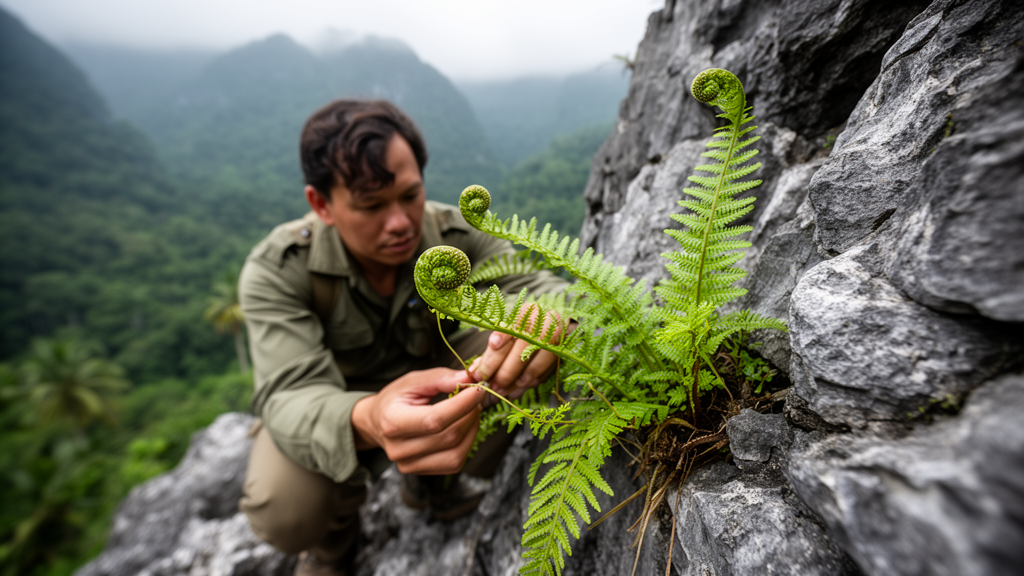
Deep on the limestone ridges of Phong Nha–Ke Bang National Park in central Vietnam, botanists have identified a fern that does not fit any species known to science. The plant, now formally named Cyrtomium lacrimipinnum, belongs to a genus of holly ferns whose members are scattered from the tropics to warm temperate regions of the Old World. Its discovery, published in the journal PhytoKeys, is the latest result of a field survey program that has been documenting the flora of limestone karsts across Laos and Vietnam since 2023, and it adds a distinctive new branch to one of the most species-rich families of extant ferns, the Dryopteridaceae.
The genus Cyrtomium is a major clade within Dryopteridaceae and sits as a sister to Polystichum, together forming a group that also includes Phanerophlebia and Pseudarachniodes. At least 40 species are currently recognized, with high diversity concentrated in southwestern China, Vietnam, and adjacent regions. Several new species have been described from this area in recent years, including C. adenotrichum, C. calcis, and C. remotipinnum. As of mid-February 2026, twelve species of Cyrtomium had been recorded in Vietnam according to GBIF. The steady stream of discoveries within a short period suggests that the true diversity of the genus in this region remains poorly charted, and that further exploration of remote karst landscapes could yield more surprises.
The story of the new species began in December 2024, when researchers conducting fieldwork in Phong Nha–Ke Bang National Park encountered a distinctive population of Cyrtomium growing on limestone ridges at around 777 meters elevation. The plants were immediately notable because most species in the genus have rounded-cuneate to truncate pinna bases, while only a handful, including C. hemionitis and C. pachyphyllum, bear cordate, or heart-shaped, bases. The Vietnamese population shared this cordate character but also displayed features that did not match either of those species, prompting a closer investigation that would eventually span two field expeditions, multiple herbaria, and molecular laboratory work.
To determine whether the plants represented something new, the team collected ten individuals during expeditions in December 2024 and July 2025. Leaf tissue was dried on silica gel for DNA extraction, and voucher specimens were pressed and dried with hot air for twelve hours before being deposited in the herbaria FOF, KAG, MAK, and VNM. The researchers also searched herbarium collections in Vietnam and beyond, and examined digitized specimens online through GBIF, including records from the vascular plant collection at P and collections at MO, to see whether similar material had been recorded from other parts of Vietnam or neighboring countries. Despite extensive examination of specimens in VNM, HN, PE, and P, no additional material was found outside the limestone region now included in Quang Tri Province, nor from neighboring regions of Laos or southwestern China.
Detailed morphological observations, conducted with a Leica EZ4W stereomicroscope for gross morphology and a Leica DM2500 light microscope for fine characters, revealed a combination of traits that separates the new fern from all previously known species of Cyrtomium. The lateral pinnae are conspicuously cordate at the base and sharply attenuate at the apex, and hair-like microscales, black or dark brown in color, are present on both surfaces of the pinnae. In C. pachyphyllum, the closest species in overall appearance, the pinna apices are obtuse rather than acute and attenuate, the margins are entire rather than entire to undulate-serrate, and the microscales are confined to the abaxial, or lower, surface. In C. hemionitis, the fronds are usually simple or bear only a single pair of lateral pinnae, whereas the new species carries one to five pairs. The specific epithet lacrimipinnum combines the Latin word for tear, Lacrima, with pinna, a reference to the teardrop-like outline of the lateral pinnae.
One of the most consequential findings concerns the reproductive mode of the new species. In homosporous ferns, the number of spores per sporangium serves as a practical indicator of how the plant reproduces. Sexual sporogenesis typically produces 64 spores per sporangium, whereas apogamy, a form of asexual reproduction in which embryos form without fertilization, is often associated with a halved count of 32 spores per sporangium due to modified sporogenesis, a pattern documented in Cyrtomium as early as Manton’s classic work on C. falcatum. The researchers counted spores from mature sporangia of two individuals, opening three sporangia per individual on slides and counting under a light microscope. Although the condition of the sporangia did not allow all spores to be clearly counted, the number was estimated at 64 per sporangium, with up to 61 ellipsoidal spores of uniform size, about 35 micrometers in diameter, directly counted. This clearly distinguishes the new fern from the 32-spore condition typical of apogamous plants and supports a sexual reproductive mode.
The sexual mode is noteworthy because sexually reproducing species are considered rare in Cyrtomium, in which most members are thought to reproduce apogamously. The researchers attempted to determine the ploidy level by counting somatic chromosomes, but no suitable material for chromosome observation was obtained, and further cytological studies will be necessary to clarify the biological characteristics of the species. The spore evidence, however, places C. lacrimipinnum among the minority of the genus known to reproduce sexually, a trait that may influence how the species maintains genetic diversity across its limestone habitat and how it responds to environmental change over time.
Molecular phylogenetic analysis provided independent support for the recognition of the new species. Total DNA was extracted from mature leaf fragments using the CTAB method, and two chloroplast regions, the rbcL gene and the trnL–F intergenic spacer including the trnL intron, were amplified by polymerase chain reaction and sequenced directly. The combined dataset of rbcL and trnL–L–F comprised 2,340 base pairs, including 106 parsimony-informative sites. A total of 42 sequences representing 22 taxa of Cyrtomium and three species of Polystichum as outgroups were downloaded from GenBank and combined with the newly generated sequences. Maximum likelihood analysis conducted in IQ-TREE3 and Bayesian inference carried out in MrBayes produced congruent trees, with branch support assessed through 1,000 standard non-parametric bootstrap replicates and two independent Markov chain Monte Carlo runs of two million generations each.
The phylogenetic results placed the new species as the closest relative of Cyrtomium grossum, a sexual, tetraploid species known from Guizhou and Yunnan in China. However, the two taxa differed by at least 11 substitutions and were clearly separated on the phylogeny, with a bootstrap support of 75 and a Bayesian posterior probability of 0.99. C. grossum differs morphologically as well, with oblong lateral pinnae bearing rounded-truncate bases and rounded-obtuse apices, and microscales absent from both surfaces. These molecular results are fully consistent with the morphological comparisons and strongly support recognition of the Vietnamese plants as a new species of Cyrtomium.
The new fern is a perennial evergreen plant standing 13 to 40 centimeters tall, with erect, short rhizomes densely covered in dark brown, slightly twisted scales up to 8.5 millimeters long. Its stipes run 7 to 25 centimeters long, and the coriaceous laminae, oblong or triangular and 5 to 15 by 5 to 11 centimeters, bear obscure venation in which veinlets anastomose to form three to four rows of areoles on each side of the midrib, each areole containing one to two included veinlets. The sori appear in two to five irregular rows along the margins on the abaxial surface of the pinnae, with dark reddish brown indusia about 1.0 to 1.2 millimeters in diameter and weakly dentate margins. The species is lithophytic, growing on semi-shaded limestone outcrops and in crevices under shrubby moist forests on ridges, and is currently known only from Phong Nha–Ke Bang National Park and adjacent limestone areas in Quang Tri Province. Because more than 30 individuals were observed at the type locality, the researchers consider it likely that the species is more widespread along inaccessible and poorly collected limestone ridges. The discovery underscores how much undocumented diversity may persist on karst summits that few collectors ever reach, and how targeted fieldwork combined with herbarium surveys and molecular analysis can bring hidden species to light.
Subject of Research: Description of a new sexually reproducing fern species, Cyrtomium lacrimipinnum, from limestone karst in Vietnam
Article Title: Cyrtomium lacrimipinnum ( Dryopteridaceae ), a new sexually reproducing fern from Phong Nha–Ke Bang National Park, Vietnam
Article References: Yoneoka, K., Fujiwara, T., Dang, V.-S., Pham, Q. T., Souladeth, P., Sengthong, A., Masuda, R., Yamamoto, T., Tanaka, N., & Tagane, S. (2026). Cyrtomium lacrimipinnum (Dryopteridaceae), a new sexually reproducing fern from Phong Nha–Ke Bang National Park, Vietnam. PhytoKeys, 275, 177-189. https://doi.org/10.3897/phytokeys.275.183837
Image Credits: AI Generated
DOI: 10.3897/phytokeys.275.183837
Keywords: Cyrtomium lacrimipinnum, Dryopteridaceae, fern taxonomy, Phong Nha–Ke Bang National Park, Vietnam, limestone karst, spore count, apogamy, molecular phylogenetics, rbcL, trnL–F, new species
Cite Scienmag News
Gavin Prescott. (October 19, 2026). New sexually reproducing fern species discovered on Vietnamese limestone karst. Scienmag. https://scienmag.com/new-sexually-reproducing-fern-species-discovered-on-vietnamese-limestone-karst/
Gavin Prescott. "New sexually reproducing fern species discovered on Vietnamese limestone karst." Scienmag, 19 October 2026, https://scienmag.com/new-sexually-reproducing-fern-species-discovered-on-vietnamese-limestone-karst/. Accessed 19 October 2026.
Gavin Prescott. "New sexually reproducing fern species discovered on Vietnamese limestone karst." Scienmag. October 19, 2026. https://scienmag.com/new-sexually-reproducing-fern-species-discovered-on-vietnamese-limestone-karst/


