


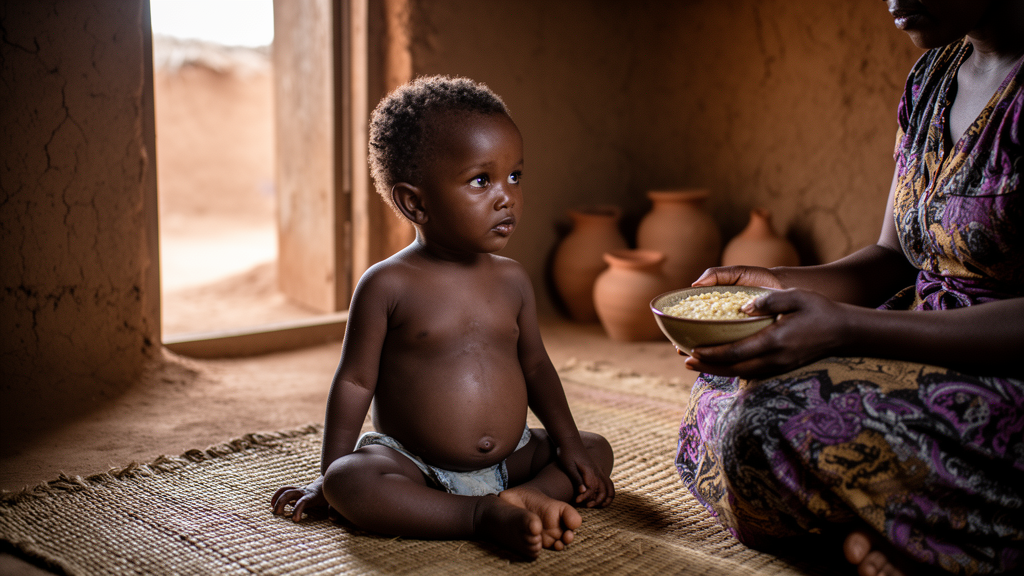
In a rural district tucked into the highlands of southern Tigray, Ethiopia, nearly one in two toddlers is growing up too short for their age, a quiet but devastating signal of chronic malnutrition. A new community-based study has found that 42.3 percent of children between six and twenty-three months in Endamekoni District are stunted, a figure that exceeds both the national average and the threshold at which the World Health Organization declares a nutrition crisis a public health problem. The research, conducted by a team of Ethiopian and international investigators and published in BMC Pediatrics, offers one of the most detailed local portraits yet of how poverty, illness, sanitation, and maternal circumstances converge to shape a child’s growth during the most vulnerable window of early life.
Stunting is not simply being small. It is the physical signature of chronic undernutrition, defined clinically as a height-for-age measurement falling more than two standard deviations below the median of a well-nourished reference population. Unlike wasting, which reflects acute food shortage and can reverse with recovery, stunting accumulates slowly over months and years of inadequate nutrition, repeated infection, and environmental stress. Once established in the first thousand days of life, the developmental window from conception to a child’s second birthday, it is largely irreversible. Children who are stunted face diminished cognitive development, weaker immune systems, lower educational attainment, and reduced earning capacity as adults, which is why researchers treat the condition as one of the most consequential and stubborn indicators in global health.
The research team, led by Abreham Habtemariam Weldu of Mekelle University’s College of Health Sciences, set out to fill a gap in the evidence. National surveys such as the Ethiopian Demographic and Health Survey have long documented high rates of stunting across the country, but national averages can conceal enormous variation between regions, districts, and even neighboring villages. Localized data are essential for designing interventions that match the actual determinants on the ground. Endamekoni District, an agricultural area in the Southern Tigray Zone, had lacked a dedicated study of stunting among children in the six-to-twenty-three-month age band, the period when complementary feeding begins and growth faltering typically accelerates.
To capture that picture, the investigators conducted a community-based cross-sectional survey over five weeks, from June 5 to July 10, 2024. Rather than recruiting families at health facilities, which would have skewed the sample toward households already connected to care, they went door to door. Using systematic random sampling, they enrolled 633 mother-child pairs, or caregiver-child pairs, from across the district. Each child’s length was measured against age to calculate the height-for-age index, and trained data collectors administered structured questionnaires covering household demographics, feeding practices, maternal health, income, and sanitation. The data were entered twice into EpiData version 7 to catch entry errors, then exported to SPSS version 25 for statistical analysis, where bivariate screening was followed by multivariable logistic regression to isolate the factors independently associated with stunting, with statistical significance set at a P-value below 0.05.
The headline number, 268 stunted children out of 633, translates to a prevalence of 42.3 percent, a level the World Health Organization classifies as very high and requiring urgent, large-scale intervention. But the study’s deeper value lies in its regression results, which map the social and biological terrain of the problem. Boys were more than twice as likely to be stunted as girls, with an adjusted odds ratio of 2.17. This male vulnerability has been reported in many settings worldwide and is thought to reflect subtle biological differences in immune competence and growth sensitivity to early-life stress, though the exact mechanisms remain an open question in pediatric nutrition research.
Where a family lived mattered enormously. Children in rural households carried nearly three times the odds of stunting compared with their urban counterparts, an adjusted odds ratio of 2.91. Rural residence in this highland district typically means longer distances to health posts, less dietary diversity, and greater exposure to agricultural livelihoods vulnerable to drought and conflict. The region’s recent history compounds these structural disadvantages; Tigray has endured years of armed conflict and disruption to health and food systems, pressures that local health authorities have repeatedly flagged as threats to child nutrition. The study’s cross-sectional design cannot disentangle these historical shocks from chronic poverty, but the rural-urban gradient it documents is consistent with both explanations.
Mother’s circumstances emerged as perhaps the most powerful and most modifiable cluster of determinants. Children whose mothers had any formal education had dramatically lower odds of stunting, an adjusted odds ratio of 0.14, meaning educated mothers were roughly 86 percent less likely to have a stunted child after other factors were controlled. Maternal occupation told a similar story: children of housewife mothers had 81 percent lower odds, and children of farmer mothers had 90 percent lower odds, compared with the reference category, a finding the authors interpret in light of mothers who work outside the home having less time for responsive feeding and childcare. Household income above 1,000 Ethiopian birr per month was also strongly protective, cutting the odds of stunting by 90 percent, a stark illustration of how even modest cash resources translate into food security and healthcare access in a low-income setting.
Illness and sanitation completed the risk profile. Children who had been sick in the two weeks before the survey had more than three times the odds of stunting, an adjusted odds ratio of 3.34, while mothers who had experienced illness after delivery raised their child’s odds by a factor of 2.29. These findings capture the vicious cycle at the heart of child undernutrition: infection suppresses appetite, impairs nutrient absorption, and diverts energy toward immune defense, while undernourished children are more susceptible to infection in the first place. On the protective side, the availability of a functional latrine in the household reduced the odds of stunting by 76 percent, an adjusted odds ratio of 0.24. Sanitation interrupts the fecal-oral transmission of diarrheal pathogens and, by extension, the subclinical gut inflammation that researchers increasingly implicate in environmental enteric dysfunction, a condition that blunts nutrient uptake even when food is available.
The authors conclude that stunting in Endamekoni District is not the product of any single deficiency but of an interlocking system of risks spanning education, income, healthcare, and infrastructure. Their recommendations follow directly from the regression coefficients: expand maternal education and literacy programs, provide income-generating support targeted at mothers, strengthen access to healthcare services for both sick children and postpartum women, and invest in sanitation infrastructure so that functional latrines become the norm rather than the exception. Because the study was cross-sectional, it captures association rather than proven causation, and the authors acknowledge that longitudinal and intervention research will be needed to confirm which levers move the needle fastest. Still, the granularity of the findings gives district health planners something national statistics cannot: a ranked, locally grounded map of where to act.
The stakes extend far beyond one district in northern Ethiopia. Globally, an estimated 148 million children under five are stunted, and the first two years of life remain the period when interventions yield the greatest lifelong returns. Studies like this one, precise about who is affected and why, are the raw material for that effort. If a mother’s schooling, a functioning latrine, and a small monthly income can each cut a child’s odds of stunting by three-quarters or more, the path forward is expensive but clear, and the cost of inaction, measured in diminished minds and bodies for an entire generation, is far higher.
Subject of Research: Prevalence and determinants of stunting among children aged 6 to 23 months in Endamekoni District, Tigray, Ethiopia
Article Title: The burden of stunting during early childhood: a study of children aged 6–23 months in Endamekoni District, Tigray, Ethiopia 2024
Article References: Weldu, A. H., Kiros, H. B., Gebretsadik, G. G., Lema, G. K., Lo, K. K.-H., Gebrekidan, M. G., Suffa, M., Berhe, K., & Teklemedhin, S. W. (2026). The burden of stunting during early childhood: a study of children aged 6–23 months in Endamekoni District, Tigray, Ethiopia 2024. BMC Pediatrics. https://doi.org/10.1186/s12887-026-07683-9
Image Credits: AI Generated
DOI: 10.1186/s12887-026-07683-9
Keywords: stunting, child malnutrition, Ethiopia, Tigray, pediatric nutrition, maternal education, household income, sanitation, cross-sectional study, growth disorders, public health, child health
Cite Scienmag News
Harold Sullivan. (October 19, 2026). Chronic Malnutrition Strikes More Than 40 Percent of Toddlers in Northern Ethiopia, Study Finds. Scienmag. https://scienmag.com/chronic-malnutrition-strikes-more-than-40-percent-of-toddlers-in-northern-ethiopia-study-finds/
Harold Sullivan. "Chronic Malnutrition Strikes More Than 40 Percent of Toddlers in Northern Ethiopia, Study Finds." Scienmag, 19 October 2026, https://scienmag.com/chronic-malnutrition-strikes-more-than-40-percent-of-toddlers-in-northern-ethiopia-study-finds/. Accessed 19 October 2026.
Harold Sullivan. "Chronic Malnutrition Strikes More Than 40 Percent of Toddlers in Northern Ethiopia, Study Finds." Scienmag. October 19, 2026. https://scienmag.com/chronic-malnutrition-strikes-more-than-40-percent-of-toddlers-in-northern-ethiopia-study-finds/


