


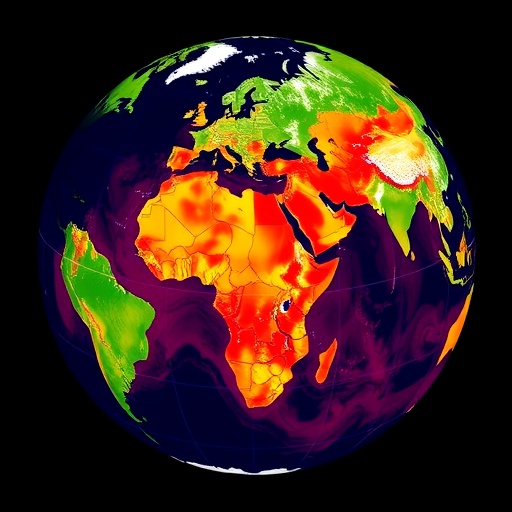
Earth system science is facing a problem that is both enormous and surprisingly practical: there is now more climate and environmental information than any researcher, policymaker, or journalist can reliably process alone. Satellite observations, climate-model outputs, ecological surveys, paleoclimate records, assessment reports, and rapidly expanding scientific literature all describe a changing planet—but they do so in different formats, with different assumptions, spatial scales, and levels of uncertainty. A new study presents a domain-adapted retrieval-augmented framework designed to help artificial intelligence navigate this complexity while making its answers easier to inspect and verify.
Published in Communications Earth & Environment, the study by Ö. Kart Tokmak, L. Caesar, J. Ludescher and colleagues introduces an approach for transparent Earth system assessment. Its central idea is to combine the language-generation abilities of modern artificial intelligence with a retrieval system that searches relevant scientific sources before producing an answer. Instead of relying only on information encoded during a model’s training, the system can identify documents and evidence connected to a specific question, use them as context, and show users where its conclusions come from.
This architecture addresses one of the most serious weaknesses of generative AI: a system can produce fluent, confident text even when it is missing key evidence or has misunderstood a technical concept. In scientific applications, that failure is not merely embarrassing. An incorrect statement about climate risks, tipping points, carbon-cycle feedbacks, or adaptation strategies could influence public communication and policy decisions. Retrieval-augmented generation, commonly abbreviated as RAG, is intended to reduce this danger by grounding responses in selected external material rather than allowing the model to answer entirely from statistical patterns.
The framework is described as domain-adapted because general-purpose AI systems are not automatically prepared for the language and structure of Earth system research. Climate science, for example, depends heavily on specialized terminology, carefully defined variables, geographic references, time periods, model ensembles, and statements about uncertainty. The word “risk” can have a precise technical meaning in one assessment, while “sensitivity,” “forcing,” “resilience,” or “abrupt change” may refer to concepts that cannot be interpreted safely without their scientific context. A domain-adapted system is designed to recognize these distinctions and retrieve information accordingly.
A crucial feature of the proposed approach is transparency. In a conventional chatbot interaction, a user may receive a polished paragraph without knowing which evidence supports it, whether the sources disagree, or how current the information is. A retrieval-based framework can expose the documents, passages, or references used to construct an answer. That creates an evidence trail, allowing researchers to check whether a statement accurately reflects the cited material. It can also reveal when a question is poorly supported, when sources conflict, or when the available literature is too limited for a confident conclusion.
The system’s relevance extends beyond producing summaries. Earth system assessment often requires connecting findings across disciplines: atmospheric physics, oceanography, hydrology, ecology, economics, and social science may all contribute to a single question. These fields do not always use identical terminology or organize knowledge in the same way. A retrieval framework can help assemble related evidence across those boundaries, while domain-specific instructions and source selection can limit the risk that an apparently relevant passage is technically unsuitable. The goal is not to replace expert judgment, but to make the process of locating and comparing evidence faster and more systematic.
For scientists, such a tool could become a research companion capable of scanning large collections of papers and assessment documents, identifying relevant passages, and organizing information around a defined question. For decision-makers, it could provide a more accessible route into highly technical literature—provided that every answer remains tied to verifiable sources. For communicators and educators, the ability to distinguish established findings from uncertain or contested claims could be especially valuable at a time when climate information is frequently simplified, distorted, or stripped of its qualifications.
The framework also highlights why artificial intelligence used in science must be evaluated differently from ordinary consumer applications. Fluency is not enough. A useful Earth system system must retrieve appropriate sources, preserve the meaning of technical language, respect publication dates, distinguish observations from projections, and communicate uncertainty without burying it. It must also resist the temptation to produce a single definitive answer when the scientific literature contains multiple plausible interpretations. Transparency therefore becomes a technical requirement, not just a desirable feature: users need to understand both what the system knows and how it reached its response.
The study arrives as institutions around the world search for ways to turn the expanding climate knowledge base into practical guidance. The amount of information will continue to grow as new satellite missions, high-resolution models, sensor networks, and scientific publications generate evidence at unprecedented speed. A domain-adapted retrieval-augmented framework could help transform that flood of material into structured, traceable assessments. Its real test, however, will be whether experts can reproduce its answers, identify its limitations, and trust it without surrendering responsibility for scientific interpretation. If those conditions are met, AI may become less a mysterious answer machine and more a transparent research instrument for understanding a rapidly changing planet.
Cite Scienmag News
Violet Maxwell. (August 10, 2026). New retrieval-augmented framework makes Earth system assessments more transparent. Scienmag. https://scienmag.com/new-retrieval-augmented-framework-makes-earth-system-assessments-more-transparent/
Violet Maxwell. "New retrieval-augmented framework makes Earth system assessments more transparent." Scienmag, 10 August 2026, https://scienmag.com/new-retrieval-augmented-framework-makes-earth-system-assessments-more-transparent/. Accessed 4 September 2026.
Violet Maxwell. "New retrieval-augmented framework makes Earth system assessments more transparent." Scienmag. August 10, 2026. https://scienmag.com/new-retrieval-augmented-framework-makes-earth-system-assessments-more-transparent/


