


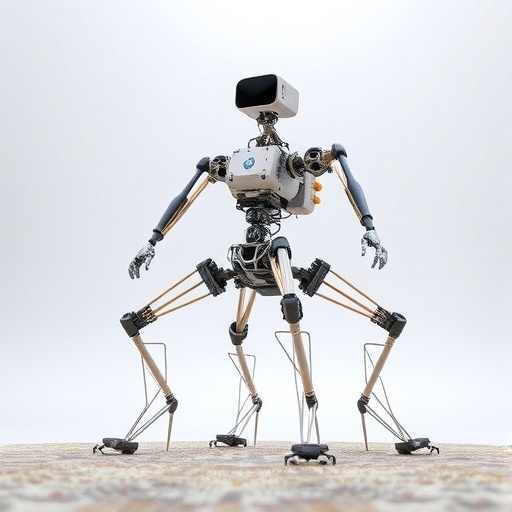
For decades, roboticists have imagined machines that could be dropped into places too dangerous, remote or unpredictable for conventional vehicles. Now, a new tensegrity robot has taken a significant step toward that vision. Called Tribar, the three-bar machine is designed to absorb violent impacts, recover its orientation and navigate unfamiliar ground without human intervention. In experiments reported in Nature Machine Intelligence, the robot survived falls of at least 5.7 metres and continued moving after landing, including after a cliff fall that would likely disable many wheeled or legged platforms.
Tensegrity, short for “tensional integrity,” is an architectural principle in which rigid components do not rest directly on one another. Instead, they are held in position by a network of tensioned cables, creating a structure in which compression and tension are distributed throughout the system. The result is a lightweight framework that can deform under impact and spread mechanical loads rather than transmitting them immediately to a single rigid body. This makes tensegrity attractive for planetary exploration, aerial deployment and disaster response, where robots may have to endure uncontrolled drops, collisions or rough terrain.
The basic idea is not new. Non-robotic tensegrity structures have demonstrated remarkable impact resistance, including the ability to absorb energy through cable extension, structural deformation and redistribution of forces. Turning that passive resilience into a functioning autonomous robot, however, presents a much more difficult engineering problem. Motors, batteries, sensors, control electronics and communication systems must all be protected inside a structure that is expected to flex. At the same time, the robot must be able to generate controlled movement even though its rigid elements are suspended rather than connected by conventional joints.
Tribar addresses this challenge with a compact tensegrity architecture built around three rigid struts and elastic cables. The cables maintain the robot’s overall geometry while allowing the frame to deform during impact. That deformation is not merely a weakness to be tolerated; it is part of the machine’s protective mechanism. When Tribar strikes the ground, the cable network can absorb and distribute energy across the structure, reducing the peak loads experienced by the internal components. Afterward, the same arrangement provides the mechanical foundation for locomotion and stabilization.
The robot’s movement depends on actively changing the forces within its cable network. By controlling the tension and length relationships among the cables, Tribar can shift its centre of mass and produce rolling or other body motions that carry it across the ground. This approach differs fundamentally from the locomotion of a wheeled rover, whose motion is generated primarily at wheel–ground contact points, or a walking robot, which relies on carefully coordinated leg placements. In a tensegrity system, the entire body can participate in movement, making the robot’s dynamics more complex but potentially giving it a broader ability to recover from awkward landings.
That complexity also makes autonomous navigation a demanding task. A robot that has just landed may not be upright, may be oriented unpredictably and may have no reliable assumption about which direction is “forward.” Tribar must therefore combine sensing, state estimation and motion control to determine its configuration and select actions that move it through unstructured terrain. Instead of following a prepared route on a flat surface, it is intended to operate in environments where obstacles, slopes and irregular ground can alter the robot’s behaviour from one moment to the next.
The researchers characterized Tribar’s locomotion and evaluated its ability to navigate autonomously after impact. They also compared its performance with that of existing tensegrity robots, providing a benchmark for a field in which structural resilience and mobility are often studied separately. The central significance of the work is that the robot is not simply a crash-resistant object or a laboratory demonstration of tensegrity mechanics. It combines impact survival with the ability to resume autonomous travel, bringing the architecture closer to practical robotic deployment.
The most dramatic demonstration involved a cliff fall followed by successful locomotion. Tribar’s survival after a drop of at least 5.7 metres suggests that a robot of this kind could potentially be delivered without the elaborate landing systems normally required for a rover. Aerial deployment could allow future machines to reach hazardous zones, rubble fields or distant planetary surfaces without a conventional lander or carefully controlled touchdown. The concept is especially appealing for missions in which terrain is too uneven for a safe landing or where a robot must be scattered across a broad area.
Important challenges remain before tensegrity robots can become routine planetary explorers or disaster-response machines. Their flexible bodies create complicated interactions between structure, control software and terrain, and the same compliance that protects them can make precise movement more difficult. Energy consumption, communication reliability, sensing after impact and long-term cable durability will also matter in real deployments. Nevertheless, Tribar demonstrates a powerful design principle: instead of building a robot that must avoid every dangerous impact, engineers can create one that expects to fall, absorbs the shock and keeps working. That shift could redefine how autonomous machines are delivered into the world’s most unforgiving environments.
Cite Scienmag News
Denise Maddox. (August 10, 2026). Impact-Resistant Autonomous Robots Inspired by Tensegrity Architecture. Scienmag. https://scienmag.com/impact-resistant-autonomous-robots-inspired-by-tensegrity-architecture/
Denise Maddox. "Impact-Resistant Autonomous Robots Inspired by Tensegrity Architecture." Scienmag, 10 August 2026, https://scienmag.com/impact-resistant-autonomous-robots-inspired-by-tensegrity-architecture/. Accessed 4 September 2026.
Denise Maddox. "Impact-Resistant Autonomous Robots Inspired by Tensegrity Architecture." Scienmag. August 10, 2026. https://scienmag.com/impact-resistant-autonomous-robots-inspired-by-tensegrity-architecture/


