


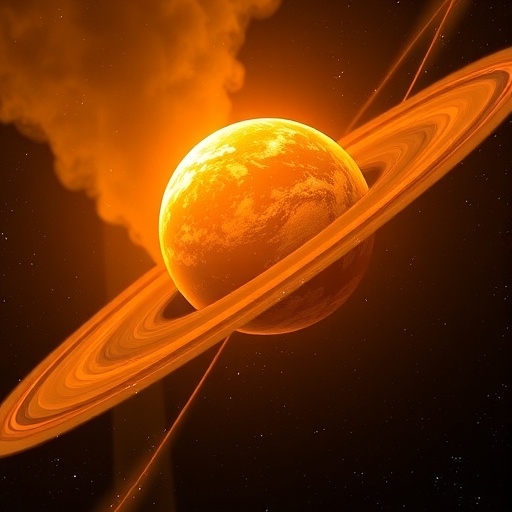
In the quest for understanding life beyond our solar system, astrobiologists focus their efforts on “water worlds,” particularly exoplanets known as sub-Neptunes. These intriguing celestial bodies, characterized by their size and mass lying between Earth and Neptune, are theorized to possess a water-rich interior, despite their scorching proximity to their host stars. Consequently, the extreme heat on these planets prevents the presence of liquid water on their surfaces, leading to atmospheres dominated by vapor and layers of exotic water phases.
Recent research conducted by a team of scientists from the University of California, Santa Cruz, has significantly advanced our understanding of these steam worlds. Through a sophisticated modeling approach, the researchers aim to decode the composition and evolutionary processes of sub-Neptunes, which in turn informs the ongoing search for potentially habitable exoplanets. Artem Aguichine, a postdoctoral researcher, emphasizes the importance of this work, asserting that by unraveling the formation of these commonly observed planets, researchers can refocus their attention on rarer exoplanets that might harbor life.
The significance of their findings is underscored by the groundbreaking observations made by the James Webb Space Telescope (JWST), which recently confirmed the presence of steam on several sub-Neptunes. As astronomers anticipate identifying many more of these exoplanets, the refined models developed by Aguichine and his colleagues are poised to bridge the gap between surface observations and the underlying geological and atmospheric conditions of these intriguing worlds.
Historically, the models utilized to characterize sub-Neptunes were primarily derived from studies of icy moons in our solar system, such as Europa and Enceladus. However, sub-Neptunes are vastly different due to their greater mass and closer orbits to their stars, characteristics that engender thick atmospheres of steam and layers of “supercritical water.” These distinctions require models that accurately reflect the unique physical conditions represented by these enormous planets, rather than relying on models suited for smaller, icy celestial bodies.
In the context of the extreme environments present within sub-Neptunes, the behavior of water becomes remarkably complex. The supercritical phase of water—characterized by a state where traditional liquid and gas properties merge—is one area of focus for the research team. They have recreated and studied this unique phase, which behaves far differently than conventional forms of water found here on Earth. There is evidence suggesting that under specific high-pressure and high-temperature conditions, water in sub-Neptunes could even transform into “superionic ice.” This exotic state allows water molecules to arrange themselves with mobility among hydrogen ions, revealing yet more mysteries of planetary science.
Aguichine’s team seeks to account for the diverse behaviors of water in their models, addressing not only the interactions of steam and supercritical fluid but also the implications of extreme conditions on these water states. The understanding gained from these models can yield profound insights into the planetary formations that shape water’s journey through the cosmos. The properties of water, including its dual behavior as an acid and base, its capacity to dissolve various compounds, and its unique hydrogen bonding, position it as a crucial component for examining the complexities of potential biological processes that could emerge on these worlds.
Equally important, the research team’s approach doesn’t present static snapshots of sub-Neptunes; instead, it emphasizes the evolutionary journey of these planets over millions and billions of years. Such a dynamic approach is fundamental for understanding the significant transformations that the interiors and atmospheres of these celestial bodies undergo. As Aguichine notes, accurately predicting the traits of these planets must involve a comprehensive consideration of their evolution over eons.
The revelations derived from this work hold the potential to reshape our understanding of exoplanets and their habitability prospects. Observations from JWST will serve as a vital testing ground for the proposed models, informing scientists not just about current planetary characteristics but also about their developmental histories. Additionally, future missions, notably the European Space Agency’s PLATO telescope, will further refine these models and validate their predictive capabilities in the ongoing search for life beyond our planet.
As scientists continue to explore the enigmatic realms of these steam worlds, they anticipate discovering subgroups that harbor the right conditions for life as we know it. The findings highlight a pivotal era in our quest to comprehend the universe and our place within it, suggesting that among the vast desert of stars and planets, certain niches may be ripe for discovery.
This ongoing research reminds us that the realms beyond our solar system continue to offer mysteries worthy of exploration. The complex behaviors of water in the context of astrobiology delve into the depths of planetary conditions that might, against all odds, cultivate life. With every advancement in observation and modeling, we draw closer to understanding the delicate interplay of elements that constitute planetary formation and evolution.
In summary, the studies on sub-Neptunes and their water manifestations delineate not only a path toward exploration but also evoke a sense of cosmic wonder. As we contemplate the implications of increasingly sophisticated models and the discovery of new exoplanets, we reaffirm our collective ambition to understand life beyond Earth and expand the horizons of our existential inquiry.
Keywords
Exoplanets, sub-Neptunes, astrobiology, James Webb Space Telescope, water worlds, planetary formation, supercritical water, superionic ice, life beyond Earth, computational modeling, evolutionary modeling, planetary science.
Cite Scienmag News
Grant Pearson. (August 25, 2025). New Research Unravels the Mysteries of Exoplanetary ‘Steam Worlds’ Beyond Our Solar System. Scienmag. https://scienmag.com/new-research-unravels-the-mysteries-of-exoplanetary-steam-worlds-beyond-our-solar-system/
Grant Pearson. "New Research Unravels the Mysteries of Exoplanetary ‘Steam Worlds’ Beyond Our Solar System." Scienmag, 25 August 2025, https://scienmag.com/new-research-unravels-the-mysteries-of-exoplanetary-steam-worlds-beyond-our-solar-system/. Accessed 4 September 2026.
Grant Pearson. "New Research Unravels the Mysteries of Exoplanetary ‘Steam Worlds’ Beyond Our Solar System." Scienmag. August 25, 2025. https://scienmag.com/new-research-unravels-the-mysteries-of-exoplanetary-steam-worlds-beyond-our-solar-system/


