

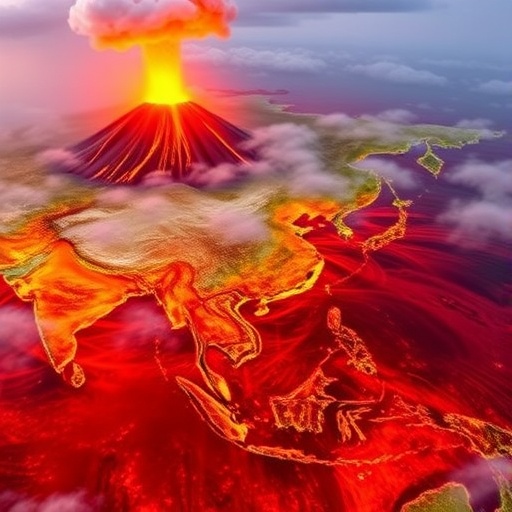
From the fertile rice paddies of South Asia to the expansive wheat fields spread across northern China, the summer monsoon rains represent a lifeline for billions of people. These rains, however, do not follow a predictable pattern; instead, they fluctuate dramatically over decades. This variability in monsoon rainfall has posed a significant challenge to climate scientists, who have long sought to decipher the underlying mechanisms governing these shifts. A recent study led by Dr. Wenmin Man at the Institute of Atmospheric Physics, Chinese Academy of Sciences, has shed new light on this enduring question by unveiling a complex interplay between volcanic eruptions and internal climate variability that shapes Asian monsoon rainfall patterns.
The volatility of summer monsoon rains is influenced not only by internal climate oscillations but also by external factors, including volcanic activity. Dr. Man’s research reveals that major volcanic eruptions inject sulfate aerosols into the stratosphere, which in turn influence sea surface temperatures (SSTs) and atmospheric circulation patterns. These volcanic aerosols act as climatic perturbations, echoing effects similar to those produced by natural climate oscillations, thereby generating rainfall responses across Asia that mirror intrinsic climate variability. This discovery provides a new framework for understanding decadal-scale changes in monsoon precipitation.
Published in Geophysical Research Letters, the study addresses the critical question of whether the decade-to-decade changes in Asian monsoon rainfall stem from endogenous climate modes or exogenous forcing. By combining paleoclimate reconstructions with sophisticated climate model simulations spanning the past thousand years, the research identifies a tripolar pattern of summer monsoon rainfall variability across Asia. This tripolar pattern manifests as wetter-than-average conditions in South Asia coinciding with drier conditions in Southeast Asia, with northern East Asia’s monsoon behavior generally aligning with South Asia’s precipitation trends.
At the heart of this monsoon variability lies the Interdecadal Pacific Oscillation (IPO), an extended Pacific Ocean climate phenomenon akin to the more familiar El Niño-Southern Oscillation but operating on multi-decadal timescales. The IPO modulates SST anomalies that redistribute heat and moisture across the Pacific basin, which in turn influence atmospheric circulation patterns over Asia. The study confirms that these IPO-driven SST anomalies induce the characteristic tripolar monsoon rainfall response, demonstrating how internal climate oscillations exert a dominant influence on the distribution and intensity of Asian summer monsoon rainfall.
However, the scope of the study extends beyond natural variability. Dr. Man’s team discovered that the climatic signals following significant volcanic eruptions strikingly resemble the IPO-influenced rainfall pattern. When volcanoes erupt explosively, they inject large quantities of aerosols into the stratosphere. These aerosols scatter and absorb solar radiation, resulting in a transient cooling of the Earth’s surface, particularly over the oceans. This cooling alters SSTs in a manner that mimics the IPO pattern, effectively ‘projecting’ volcanic forcing onto internal modes of variability. The resulting rainfall anomalies across Asia, therefore, bear the hallmarks of both internal oscillations and external forcings, blurring the lines between the two.
This ability of volcanic aerosols to emulate IPO-driven climate variability challenges existing assumptions about the decadal fluctuations in Asian monsoon precipitation. It implies that volcanic eruptions can exert a prolonged influence on regional climate patterns well beyond their immediate aftermath by interacting with internal variability modes. This finding underscores the importance of considering both volcanic forcing and natural oscillations when interpreting past climate records and predicting future monsoon behavior.
Despite the resemblance between volcanic and IPO-induced rainfall anomalies, the study importantly highlights fundamental differences. One of the key distinctions lies in hemispherical symmetry. IPO-related SST anomalies tend to be symmetrical about the equator, affecting both hemispheres relatively equally. In contrast, volcanic forcing generates a distinct asymmetry due to the geographic location and timing of each eruption. This causes pronounced cooling in one hemisphere relative to the other, introducing a spatial pattern that differentiates volcanic impact from natural oscillations. Recognizing these subtle, yet systematic, discrepancies is crucial for climate scientists attempting to unravel the respective influences of internal and external drivers on monsoon variability.
Understanding these dynamics holds immense implications for contemporary climate science and policy. As the world grapples with rising global temperatures, geoengineering concepts such as stratospheric aerosol injection have gained attention as potential tools to mitigate climate warming. These proposed interventions aim to mimic volcanic aerosol effects by deliberately introducing reflective particles into the stratosphere to reduce solar insolation. However, Dr. Man’s research warns that such interventions might not simply produce uniform cooling; instead, they could interact complexly with existing climate modes, potentially exacerbating or altering natural variability in regional monsoon rainfall.
Given that billions of people in Asia rely on predictable monsoon rainfall patterns for agriculture, water resources, and overall socioeconomic stability, understanding the multifaceted impact of both naturally occurring volcanic eruptions and potential climate interventions is critical. The research implies that unanticipated shifts in rainfall due to aerosol injection schemes may exacerbate vulnerabilities and create new challenges for regional water security and food production.
The study further enriches the dialogue concerning climate sensitivity and response timescales. Volcanic-induced SST anomalies and their subsequent impact on monsoon precipitation reveal the climate system’s intricate feedback mechanisms and temporal lags. The delayed response in the atmosphere and oceans to volcanic forcing imparts a memory effect, causing monsoon rainfall to fluctuate in patterns that resemble the IPO for several years to decades after an eruption. This complex interplay emphasizes the need for integrated climate models capable of capturing both fast and slow feedback processes.
By leveraging paleoclimate data extending back a millennium, the researchers provide a robust historical context to differentiate between natural oscillations and volcanic influences on Asian monsoons. This methodological approach strengthens confidence in the attribution of observed rainfall patterns to their specific causes, a critical step for improving future climate projections in this climatically sensitive region.
This research not only advances scientific understanding of Asian monsoon dynamics but also bridges knowledge gaps linking atmospheric chemistry, oceanography, and climate variability. It encourages interdisciplinary collaboration to refine predictive models and develop adaptive strategies for climate resilience, particularly in the face of increasing anthropogenic impacts.
Dr. Wenmin Man’s contribution, supported by the National Natural Science Foundation of China, offers a transformative perspective on how volcanic forcings integrate with internal climate modes to shape regional precipitation. As scientists continue to unravel the intricate workings of the climate system, such insights serve as essential guideposts for anticipating and managing the environmental challenges posed by a changing climate.
Subject of Research: Asian monsoon rainfall variability driven by the interaction of volcanic forcing and internal climate oscillations
Article Title: Asian precipitation changes in the past millennium: Projection of volcanic forcing onto internal mode
Web References:
https://doi.org/10.1029/2025GL118463
Image Credits: Wenmin Man
Keywords: Monsoons, Volcanoes, Interdecadal Pacific Oscillation, Asian monsoon, volcanic aerosols, stratospheric injection, sea surface temperature, climate variability, geoengineering


