


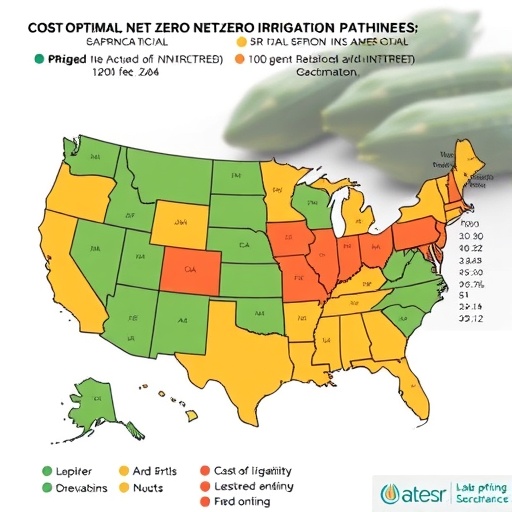
In an era where climate change mitigation and sustainability are paramount, agriculture faces a unique paradox. It is a sector essential for survival yet a significant contributor to greenhouse gas emissions. Among agricultural practices, irrigation stands out not only for its role in food production but also for its considerable energy consumption and environmental footprint. A groundbreaking study set to reshape how we approach irrigation in the United States has emerged from the collaborative efforts of Späte, Mingolla, and Rosa, as detailed in their forthcoming paper in Nature Communications. Their research delineates pathways to achieve cost-optimal and net-zero emissions irrigation across the vast and diverse American agricultural landscape, embodying a major leap toward climate-resilient farming.
The irrigation sector in the United States is a complex interplay of water usage, energy dependency, and diverse farming requirements spread across regions with varying climates and hydrogeological conditions. Historically, irrigation systems have been heavily reliant on fossil fuels, making them significant emitters of carbon dioxide. This research systematically evaluates the energy inputs, emission profiles, and economic considerations associated with current irrigation technologies and proposes innovative frameworks to retrofit or replace existing systems with those aligned with a net-zero emissions future.
Central to the study’s methodology is a comprehensive cost-optimization model. This model integrates detailed agricultural datasets, energy consumption statistics, and emission factors to identify the most economically and environmentally viable strategies for irrigation. What sets this research apart is its granular resolution; it considers localized climatic variables, crop types, and water availability to tailor solutions that maximize efficiency and sustainability without compromising productivity. By doing so, the authors challenge the conventional, one-size-fits-all approach to irrigation modernization.
One of the critical revelations from the study is the potential of renewable energy technologies to power irrigation systems sustainably. Solar-powered pump systems, for instance, emerge as a frontline technology in reducing dependency on grid electricity and fossil-fuel-powered diesel pumps. The analysis shows that incorporating solar photovoltaic (PV) installations, especially in sun-rich states like California, Arizona, and Texas, can drastically cut operational emissions at a competitive or even reduced long-term cost compared to traditional energy sources.
The researchers also delve into advanced irrigation scheduling and water management techniques that synergize with low-emission energy sources. Precision irrigation, enabled by sensor networks and digital monitoring systems, reduces energy and water waste by supplying exactly the right amount of water at the optimal time. This approach not only lowers the energy demand for pumping but also enhances crop yields and conserves critical freshwater resources, addressing the dual challenge of environmental stewardship and food security.
Moreover, the team explores innovations in energy storage and grid interaction. By combining renewable energy generation with sophisticated storage solutions, irrigation systems can maintain reliable performance during periods of low solar radiation or at night. Integration with smart grids allows for dynamic energy management, enabling farmers to minimize costs by utilizing electricity during off-peak hours or selling excess power back to the grid, creating economic incentives for sustainable practices.
A fascinating aspect of their analysis concerns the socioeconomic implications of transitioning to net-zero irrigation systems. The study recognizes the significant upfront investment required for adopting new technologies and infrastructure updates. To overcome these economic barriers, the authors propose a suite of policy interventions, subsidies, and financing mechanisms designed to ease capital burdens on farmers, especially smallholders who are often disproportionately affected by costs and technical complexity.
Transition pathways are meticulously mapped out for different regions, reflecting the heterogeneity of United States agriculture. For instance, in the arid Southwest, the combination of solar-powered drip irrigation and water recycling technologies presents a robust solution, while in the Midwest, enhancements in energy-efficient center pivot systems paired with emerging wind energy sources offer a tailored route to decarbonization. Such regional specificity ensures that recommendations are feasible and resonate with local agricultural practices and environmental conditions.
The study emphasizes that achieving net-zero emissions irrigation is not merely a matter of technology substitution but requires systemic changes. This includes fostering collaborations among agricultural producers, technology firms, energy providers, and policymakers. Building capacity through education and extension services is highlighted as essential to ensure widespread adoption and effective use of new irrigation technologies and management practices.
Importantly, the environmental benefits projected extend beyond greenhouse gas reductions. Enhanced water-use efficiency will contribute to alleviating groundwater depletion, a pressing issue in many irrigation-intensive regions. Reduced energy consumption cuts air pollution, improving public health outcomes, while the shift to cleaner energy sources supports broader efforts to transition to sustainable rural economies throughout the country.
The researchers employ scenario analysis to project the temporal dynamics of emissions reductions and investment needs. Their models demonstrate that aggressive adoption of optimized irrigation pathways aligned with net-zero goals could reduce sectoral emissions by up to 90 percent within the next two decades. This trajectory aligns with national climate commitments and contributes significantly to overall decarbonization targets in the agriculture sector.
Critically, this research underlines the pivotal role of data and precision agriculture in driving sustainable transitions. The increasing availability of remote sensing, IoT devices, and machine learning algorithms enables real-time monitoring and adaptive management of irrigation systems. Such digital transformation is not only a technological opportunity but a strategic necessity for integrating energy and water conservation in farming.
The implications of the study reach beyond the United States, offering a replicable framework for other countries grappling with the challenge of sustainable irrigation. The integration of cost optimization, renewable energy technologies, and precision irrigation forms a universal blueprint that can be adapted to the specific climatic, economic, and agricultural conditions elsewhere.
As global demand for food intensifies with population growth, and climate change stresses water and energy systems, transforming irrigation practices emerges as a critical nexus of innovation and policy intervention. The pathways illuminated by Späte, Mingolla, and Rosa provide a tangible and scientifically robust roadmap for this transformation—balancing economic viability with environmental imperatives in one of the most resource-intensive sectors.
This visionary research not only advances academic understanding but sets practical benchmarks for stakeholders striving to cultivate farms that are resilient, efficient, and climate-friendly. The prospect of net-zero emissions irrigation is no longer a distant ideal but an attainable reality driven by technological ingenuity and informed policy strategies.
In summary, the comprehensive analysis provided by this study offers a beacon of hope for sustainable agriculture, putting emissions reduction within reach without sacrificing productivity or livelihood. It underscores the critical need for coordinated action, innovative financing, and continuous technological advancement to turn net-zero irrigation from concept to widespread implementation, ultimately contributing to a more sustainable and food-secure future.
Cite Scienmag News
Denise Maddox. (March 31, 2026). Cost-Optimal, Net-Zero Irrigation Pathways in U.S. Scienmag. https://scienmag.com/cost-optimal-net-zero-irrigation-pathways-in-u-s/
Denise Maddox. "Cost-Optimal, Net-Zero Irrigation Pathways in U.S." Scienmag, 31 March 2026, https://scienmag.com/cost-optimal-net-zero-irrigation-pathways-in-u-s/. Accessed 3 September 2026.
Denise Maddox. "Cost-Optimal, Net-Zero Irrigation Pathways in U.S." Scienmag. March 31, 2026. https://scienmag.com/cost-optimal-net-zero-irrigation-pathways-in-u-s/


