

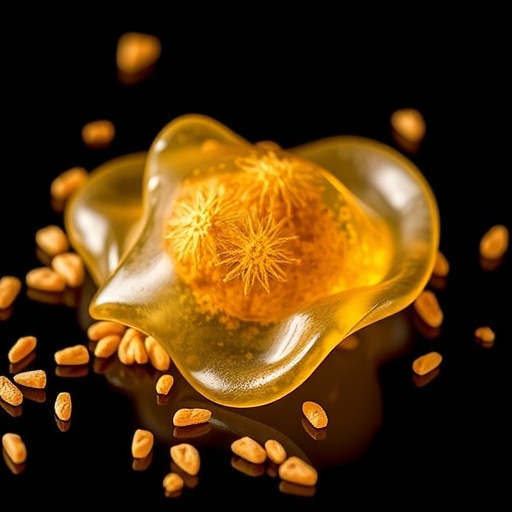
In a groundbreaking advancement at the intersection of food science and sustainable biotechnology, researchers at the KTH Royal Institute of Technology have unveiled a novel method to transform wheat bran—a widely available yet underutilized agricultural byproduct—into soft, jelly-like hydrogels. These innovative materials hold the potential to revolutionize the texture and nutritional profile of many plant-based food products, addressing longstanding challenges in incorporating dietary fibers into consumer-friendly formats.
Wheat bran, the coarse outer layer of the grain left behind after milling flour, is typically relegated to animal feed despite its richness in dietary fiber and antioxidants. The fibrous texture of bran has universally precluded its enjoyment in everyday foods, owing to an unpleasant mouthfeel. However, the team led by Professor Francisco Vilaplana at KTH’s PLENTY research center has developed a process where arabinoxylan (AX), a soluble fiber extracted from wheat bran, can be enzymatically crosslinked to form stable hydrogels. These hydrogels retain the nutritional benefits of the original fiber while delivering a smooth, gel-like consistency far more palatable for human consumption.
Central to this breakthrough is the enzymatic action of laccase, an oxidase enzyme that catalyzes the formation of covalent bonds between fiber molecules rich in ferulic acid groups. This results in a robust, interconnected polymer network capable of entrapping other food constituents. What sets this study apart is the successful incorporation of wheat gluten protein into these arabinoxylan gels—a feat not previously achieved. The gluten protein, when added, becomes physically embedded within the fiber matrix, enhancing the functional properties of both components.
The inclusion of wheat gluten inside the fiber-based hydrogel addresses a significant issue seen when plant proteins form gels independently. Such gels are often brittle, uneven, and highly sensitive to environmental factors such as salt concentration, pH variations, and temperature changes. This sensitivity complicates the use of plant proteins in formulating consistent-texture food products. By contrast, gluten proteins restrained within the arabinoxylan network contribute to a more stable texture, opening up new pathways for food scientists to design plant-based meat alternatives, dairy substitutes, and high-fiber snack foods with appealing mouthfeel and enhanced stability.
Further highlighting the versatility of this technology, early experimental results indicate that the enzymatic gelation process is potentially applicable not only to wheat gluten but also to other plant-derived proteins like pea or soy. This adaptability is particularly relevant given the global push towards sustainable, plant-based diets and the increased demand for functional, nutritionally enriched food ingredients.
The researchers’ extraction and gel-forming methods can be seen as a step toward valorizing agricultural side streams—parts of crops often discarded or underutilized. By converting wheat bran, which is produced globally in vast quantities, into valuable food ingredients, this approach aligns with circular economy principles aimed at reducing food waste and improving resource efficiency in the agrifood sector.
The enzymatic crosslinking also leverages the natural antioxidant properties inherent in the ferulic acid content of arabinoxylan, potentially conferring additional health benefits and functional longevity to the gels. This intrinsic antioxidant quality may enhance the shelf life and oxidative stability of food products incorporating these hydrogels, a major advantage in food processing and storage.
From a food technology perspective, the ability to fine-tune the rheological (flow and deformation) properties of these hydrogels through controlled enzymatic oxidation and protein loading represents a powerful toolkit for product developers. By adjusting parameters such as enzyme concentration and protein type, manufacturers could customize gel textures to meet specific application needs—from creamy sauces and smooth yogurts to fibrous meat analogs with bite.
This research was propelled by the efforts of postdoctoral researcher Niklas Wahlström and colleagues within a project funded by the Lantmännen Research Foundation, reflecting a broader commitment within the scientific community to integrate biotechnology tools to enhance the functionality and sustainability of food ingredients. The work is further embedded in the goals of the PLENTY research center at KTH, which focuses on optimizing resource utilization and reducing losses in food supply chains through innovative circular approaches.
Published under the title “Arabinoxylan-gluten hydrogels with tunable rheological properties via enzymatic oxidation and regeneration” in the peer-reviewed journal Food Hydrocolloids, the study offers a detailed account of these hydrogel systems and their physicochemical behaviors. The research team includes notable scientists Marjorie Ladd Parada, Secil Yilmaz-Turan, Pramod Sivan, Mikael S. Hedenqvist, alongside Professor Vilaplana and Wahlström.
The implications of this work extend well beyond laboratory innovation; they could transform how plant fiber components are integrated into commercial food products, making high-fiber diets more appealing and accessible. Additionally, this approach points toward a future where agricultural residues are not discarded but rather serve as valuable inputs in creating sustainable, nutritious food items that meet the demands of a growing global population.
As consumers increasingly prioritize plant-based and health-conscious options, technologies like these hydrogels provide critical solutions to longstanding formulation challenges. They pave the way for next-generation food products that do not compromise on texture or nutritional quality, while simultaneously contributing to environmental sustainability by valorizing side streams otherwise destined for animal feed or waste.
Looking ahead, ongoing efforts within PLENTY and affiliated centers continue to expand biotechnological approaches like these to harness agri-food side streams. Such initiatives are crucial in developing resilient, circular food systems that optimize resource use, minimize losses, and integrate advanced scientific knowledge into everyday nutrition.
This research exemplifies how interdisciplinary cooperation between food science, enzymology, and polymer chemistry can unlock the hidden potential in agricultural byproducts, ushering in new paradigms for sustainable and functional food ingredients. The findings serve as a blueprint for similar endeavors aiming to bridge health, sustainability, and technology in the evolution of global food landscapes.
Subject of Research: Development of wheat bran arabinoxylan and wheat gluten protein-based hydrogels for functional food applications.
Article Title: Arabinoxylan-gluten hydrogels with tunable rheological properties via enzymatic oxidation and regeneration
News Publication Date: 1-Mar-2026
Web References: http://dx.doi.org/10.1016/j.foodhyd.2025.111930
References: Published in the scientific journal Food Hydrocolloids by Wahlström, M. L. Parada, S. Yilmaz-Turan, P. Sivan, M. S. Hedenqvist, and F. Vilaplana
Image Credits: Not provided
Keywords: Wheat bran, arabinoxylan, gluten protein, hydrogels, enzymatic oxidation, laccase, food hydrocolloids, plant-based protein, functional food ingredients, biotechnological valorization, circular food systems, sustainable food innovation


