

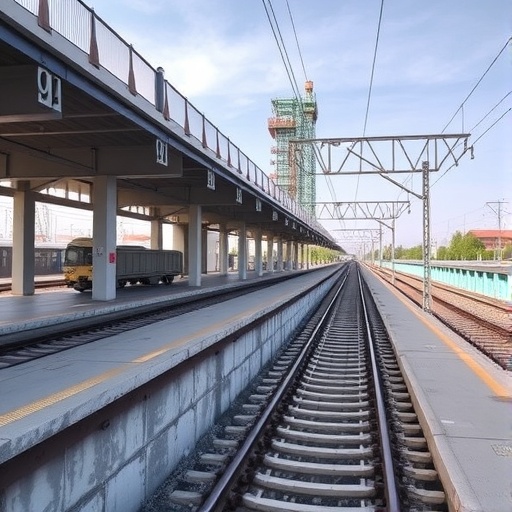
In the realm of civil engineering and disaster management, the aftermath of an earthquake poses tremendous challenges, particularly for infrastructure systems like railway stations. A recent study conducted by an esteemed team of researchers has introduced an innovative approach aimed at enhancing the recovery processes post-earthquake. This study asserts the significance of implementing a structured repair methodology alongside a comprehensive analysis to promote functional recovery in railway stations.
The researchers, headed by Song, J., and supported by Gao, H. and Pan, Y., have developed what they term the “4 stages-6 sequences” repair method. This method revolves around the idea that the restoration of a railway station’s operational capabilities needs a systematically organized framework that takes into consideration various stages of damage assessment, repair strategy formulation, execution, and subsequent operational evaluation. The introduction of this repair method marks a pivotal advancement in the field, striving for not just quick repairs but robust and future-ready infrastructure.
During an earthquake, railway stations often sustain extensive damage ranging from structural disintegration to utility failures, significantly hindering their serviceability. The traditional repair methods that rely on generic practices fall short in terms of efficiency and efficacy in addressing the unique challenges that arise from seismic events. This innovative “4 stages-6 sequences” method aims to fill those gaps by tailoring solutions that are customizable depending on the specific damages observed in the aftermath of an earthquake.
The research notably outlines the four distinct stages involved in the repair process. Each stage is key to guaranteeing that repairs are not only executed but also validated for effectiveness. The initial stage focuses on damage assessment, where the degree and type of damage are meticulously cataloged to inform repair decisions. This stage employs cutting-edge technologies and methodologies such as drone surveys and real-time data analytics, paving the way for a more accurate representation of the structural condition.
Following the assessment, the second stage is dedicated to strategizing repair operations. Here, engineers leverage the findings from the first stage to devise targeted repair plans that employ the most effective materials and techniques tailored to the unique structural context of the station. This stage is crucial for preventing future vulnerabilities, as the methods chosen are reflective of both current needs and future resilience.
Execution, the third stage, involves the actual repair work being conducted on-site. The research emphasizes the importance of collaboration among various disciplines, including civil engineering, material science, and project management. By facilitating this multidisciplinary approach during the execution phase, the integrity of the repair process is enhanced, ensuring that repairs not only restore functionality but also enhance long-term resilience against potential seismic threats.
The final stage concerns operational evaluation post-repair. This is where the effectiveness of the interventions is monitored over time to ensure that the railway station can reliably serve its intended purpose. The comprehensive nature of this stage is vital for providing stakeholders with the necessary data to make informed decisions regarding future infrastructural investments and modifications as necessary.
The “6 sequences” aspect of this method integrates well with the defined stages, offering more granular steps that complement each broader phase. For example, within the damage assessment stage, the sequences might involve preliminary visual inspections, advanced structural analysis, foundational integrity tests, and utility functionality checks among others. Each sequence presents focused actions that cohesively contribute to the success of the overarching repair strategy.
The significance of this research cannot be understated, particularly in the context of increasing global seismic activity and the imperative need for resilient infrastructure systems. By implementing this bespoke repair methodology, railway stations—vital arteries of urban mobility—stand to greatly benefit, facilitating quicker recoveries and minimizing service disruptions that reverberate throughout society.
Moreover, quantification analysis plays a critical role in the implementation of the “4 stages-6 sequences” repair method. This aspect pertains to the systematic evaluation of repair effectiveness and its impact on functionality. By employing quantitative metrics, the research delivers not only qualitative insights but also empirical data to reinforce the approach’s credibility. Stakeholders in the transportation and civil engineering sectors can utilize this data to support decision-making processes and allocate resources more efficiently during disaster recovery efforts.
As cities around the world continue to modernize their infrastructure in response to urbanization and climatic challenges, adopting such innovative approaches is essential. The railway sector, with its intertwined networks and dependencies, must champion advancements that marry engineering technology with practical recovery strategies to withstand the rigors of natural disasters.
Emerging from this research is a broader implication for global practices regarding urban resilience. The methodologies forged from this study advocate for comprehensive disaster preparedness, suggesting that the integration of advanced analytical tools and innovative repair strategies can result in exceptionally robust infrastructure capable of rebounding from seismic occurrences.
The commitment to cultivating infrastructure resilience has far-reaching effects not only for transportation sectors but also for communities at large. The successful implementation of such repair methods ultimately shapes societal trust in public transportation systems, ensuring that citizens can safely rely on them even amidst the unknowns of a natural disaster.
As we look towards the future of infrastructure repair and recovery, the contributions of this research standout as influential and necessary. The “4 stages-6 sequences” repair method represents a shift towards a more sophisticated approach to post-earthquake recovery, ensuring that as the ground shakes, our infrastructure stands resilient and steadfast, ready to serve its purpose for generations to come.
This research highlights the importance of continual improvement and adaptation in the face of evolving challenges brought about by climate change and urbanization. As cities grow and become more complex, the repair protocols and methodologies need to evolve alongside them, ensuring that with each new advancement, our infrastructure systems become better equipped to handle the events of tomorrow.
The groundwork laid by Song, J., Gao, H., and Pan, Y. sets a new benchmark for industry standards and highlights the critical nature of research in informing practical applications and frameworks within civil engineering. As the world continues to face the inevitabilities of earthquake occurrences, it is these proactive measures that will ensure the safety, functionality, and efficiency of critical transport infrastructures in the years ahead.
In conclusion, the establishment of the “4 stages-6 sequences” repair method serves as a clarion call for the entire engineering community to embrace innovation driven by empirical research. The researchers invite further collaboration and sharing of knowledge within the field to amplify the impact of their findings, ultimately redefining how infrastructure is constructed, maintained, and restored in earthquake-prone regions.
With a focus on not just surviving but thriving through future quakes, this research encapsulates the spirit of resilience and adaptability necessary to meet the challenges of our dynamic world.
Subject of Research: Post-earthquake recovery strategies for railway stations
Article Title: Establishment of the “4 stages-6 sequences” repair method and quantification analysis on post-earthquake functional recovery of railway station
Article References:
Song, J., Gao, H., Pan, Y. et al. Establishment of the “4 stages-6 sequences” repair method and quantification analysis on post-earthquake functional recovery of railway station.
Earthq. Eng. Eng. Vib. 24, 827–842 (2025). https://doi.org/10.1007/s11803-025-2339-z
Image Credits: AI Generated
DOI: https://doi.org/10.1007/s11803-025-2339-z
Keywords: earthquake recovery, railway stations, infrastructure resilience, civil engineering, disaster management, repair method


