


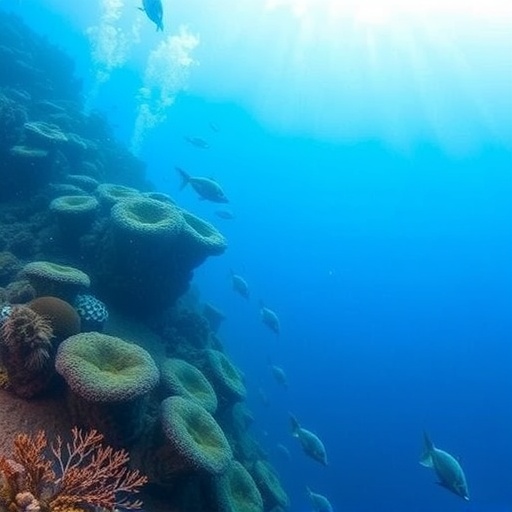
In an era where climate change dominates discussions surrounding environmental degradation, recent findings from a groundbreaking study challenge prevailing notions about the principal threats to coral reef ecosystems. The research, led by Xu, H., Li, Y., Liu, T., and colleagues, published in Nature Communications in 2026, presents compelling evidence that localized anthropogenic stressors inflict more immediate and devastating harm on coral reefs in the northern South China Sea than global climate factors. This revelation compels environmental scientists, policymakers, and conservationists to rethink management strategies and prioritize local action alongside global efforts to combat climate change.
Coral reefs, often called the rainforests of the sea, are among the most diverse and productive ecosystems on Earth. They provide vital services including coastal protection, fisheries, and tourism revenue. Yet, these ecosystems are extraordinarily sensitive to environmental conditions, responding vulnerably to temperature shifts, water quality, and physical disturbances. Historically, shifts in ocean temperature linked to global warming have been cited as the primary driver of coral bleaching and mortality worldwide, eclipsing concerns about localized human activities. However, the meticulous research conducted in the northern South China Sea paints a contrasting picture, wherein local human-induced stressors collectively overshadow the impacts of rising ocean temperatures.
The northern South China Sea serves as a vital biogeographic region hosting an array of coral species that support local economies and biodiversity hotspots. The research team undertook extensive field observations combined with advanced modeling approaches to discern the relative impacts of climate variability versus anthropogenic influences. Their data showed that nutrient runoff, sedimentation due to coastal development, overfishing, and direct physical damage exert far more significant pressure on coral reef health than fluctuations in seawater temperature and ocean acidification within this region.
To elucidate these dynamics, researchers integrated satellite monitoring, underwater surveys, and water quality assessments over multiple years. Their analyses revealed that excessive nutrient input from agricultural runoff stimulated algal blooms that smother corals and disrupt symbiotic relationships critical for coral vitality. Sediment accumulation from deforestation and urban expansion effectively blocked sunlight necessary for photosynthesis. Meanwhile, unsustainable fishing practices removed keystone species, undermining reef resilience and allowing invasive organisms to proliferate. These localized stressors, operating in synergy, accelerated reef degradation at a pace that outstripped the direct consequences of warming seas.
One striking finding was the spatial heterogeneity observed across reefs in the northern South China Sea. Areas near densely populated coastal zones exhibited pronounced coral mortality and reduced reef complexity, while remote reefs with minimal human footprint showcased relative stability despite experiencing the same regional climate trends. This spatial gradient underscores how local stewardship considerably influences reef health outcomes and points to the tangible benefits of targeted intervention in human-impacted regions.
Furthermore, the research emphasized the limited capacity of coral reefs to adapt or recover under compounded stress conditions. Even small increases in water temperature became lethal when corals were concurrently stressed by pollution and habitat destruction. This synergistic effect suggests that climate change and anthropogenic stressors do not operate in isolation but instead interact to exacerbate vulnerability. It highlights that mitigating local stressors can be a critical lever to enhance coral resilience in a warming world.
Technological innovations, such as high-resolution environmental DNA sampling and 3D reef mapping, played a pivotal role in disentangling these complex interactions. These advanced methodologies allowed the research team to assess coral health, species diversity, and ecological connectivity with unprecedented precision. Such tools foster better predictive capacity for reef futures under various management scenarios, enabling policymakers to devise more informed conservation strategies.
The implications for marine conservation are profound. While international climate accords remain vital, the study urges a parallel focus on curbing nutrient pollution, enforcing sustainable fisheries management, regulating coastal development, and engaging local communities in reef stewardship. Implementation of marine protected areas, stricter pollution controls, and restoration projects could mitigate many local stressors and provide immediate benefits, buying time for coral ecosystems to weather the longer-term impacts of climate change.
This research complements a growing body of evidence emphasizing the multifaceted nature of coral reef decline globally. While rising ocean temperatures and acidification alter fundamental chemical and biological processes, localized human activities represent more tractable intervention points with near-term ecological payoffs. The urgency to address these stressors cannot be overstated, as coral reefs continue to face unprecedented threats from both global and regional pressures.
Notably, this study serves as a clarion call for integrated ocean governance that marries local actions with international climate mitigation efforts. Strengthening collaborations between scientists, governments, industry stakeholders, and indigenous populations is essential to foster stewardship and ensure sustainable use of marine resources. The complexity and diversity of coral reef systems demand nuanced, place-based responses tailored to specific environmental and social contexts.
Moreover, the findings challenge the perception that climate change alone dictates reef futures. Recognizing that reef collapse can be offset or delayed by alleviating local stressors enriches the conservation narrative, enhancing optimism and mobilizing support for localized solutions. The study indicates that reef managers and policymakers possess tangible tools to halt or reverse damage by tackling human impacts at the source.
In conclusion, the study by Xu et al. galvanizes the scientific and conservation communities around a pivotal insight: the resilience and survival of coral reefs hinge on confronting the immediate and pervasive threats generated by human activity at the local scale. While climate change remains an overarching challenge, it is the daily footprint of human presence—pollution, overexploitation, habitat modification—that primarily undermines reef health in the northern South China Sea. This knowledge redefines priorities in marine conservation, advocating an integrated approach that combines global commitments with vigorous local action to safeguard these irreplaceable ecosystems for future generations.
Cite Scienmag News
Margaret Porter. (March 19, 2026). Local Human Stressors Trump Climate in Coral Collapse. Scienmag. https://scienmag.com/local-human-stressors-trump-climate-in-coral-collapse/
Margaret Porter. "Local Human Stressors Trump Climate in Coral Collapse." Scienmag, 19 March 2026, https://scienmag.com/local-human-stressors-trump-climate-in-coral-collapse/. Accessed 5 September 2026.
Margaret Porter. "Local Human Stressors Trump Climate in Coral Collapse." Scienmag. March 19, 2026. https://scienmag.com/local-human-stressors-trump-climate-in-coral-collapse/


