


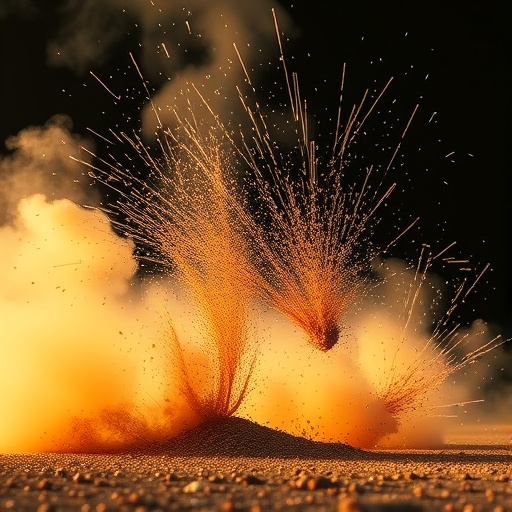
In a groundbreaking study that may reshape our understanding of contact electrification and static electricity, physicists from the Institute of Science and Technology Austria (ISTA) have identified a surprising environmental agent responsible for the directional flow of charge between identical insulating oxide materials. By employing a novel experimental technique utilizing acoustic levitation, this research elucidates how adventitious carbon molecules adsorbed from the environment to oxide surfaces break the symmetry in charge transfer, a puzzle that has mystified scientists for decades.
Contact electrification — the phenomenon where materials become electrically charged upon contact and separation — has been a subject of intense scientific curiosity for centuries. While it is well known that when two different materials come into contact, charges exchange and lead to an electrostatic imbalance, the deeper question arises when two materials of the same composition interact. How does the charge decide which direction to flow? Researchers have long grappled with theories suggesting that random variations in surface properties or the influence of adsorbed water molecules dictated this, but definitive experimental proof remained elusive.
To tackle this conundrum, the ISTA team, led by assistant professor Scott Waitukaitis, turned their focus toward silica—one of the most omnipresent and fundamental solid materials in the universe. The problem, however, was that even the slightest unintended contact with laboratory instruments introduced uncontrolled charge exchange. To circumvent this, first author Galien Grosjean developed an ingenious setup leveraging acoustic levitation, enabling a single silica grain to be manipulated and contacted without physical handling, thereby eliminating unwanted influence from external contacts.
This levitated grain was systematically brought into contact with a plate made of the same silica material. Precise measurements of the charge transferred after these controlled contacts revealed a striking and reproducible pattern: identical materials charged either positively or negatively depending on their environmental conditioning, rather than exhibiting a random or zero net charge as earlier models predicted. This discovery raised a pivotal question — if composition is identical, what breaks the charge symmetry?
Early hypotheses focused on surface heterogeneity modeled as a “mosaic” of patches with randomly distributed charge affinities — colloquially dubbed the “dairy cow pattern.” Such models anticipated fluctuating charge directions that would average out over repeated contacts. Additionally, water adsorption on surfaces, long considered crucial in surface chemistry, was extensively investigated. Yet, these classical assumptions failed to encompass the consistent charge polarity observed in the experiments.
A turning point came when the researchers subjected samples to heat treatment and plasma cleaning. These treatments removed a thin surface layer—later identified as a coating of environmental carbon species ubiquitously adsorbed from ambient air—without altering the underlying silica structure itself. Post-treatment, the samples exhibited an inversion in their charging behavior, now consistently presenting negative charge after contact. This change was linked directly to the removal of the carbonaceous surface layer, rather than any intrinsic material property.
Subsequent verification by collaborating surface science groups confirmed that these environmental carbon species form a monolayer on oxide surfaces and their presence or absence governs the direction of charge transfer. Importantly, the re-adsorption of carbon molecules over time correlated precisely with the gradual return of the original charging behavior, cementing carbon as the symmetry-breaking agent in oxide contact electrification.
Expanding their scope, the ISTA team explored other insulating oxides such as alumina, spinel, and zirconia. These materials traditionally fit into a known triboelectric series — a ranking that orders materials by their tendency to gain or lose electrons upon contact. Strikingly, targeted removal of the carbon layer from samples reversed their natural position in this series. This demonstrated that the adventitious carbon coating’s influence could override the inherent surface tendencies, rewriting the fundamental assumptions held about triboelectric charging.
This revelation has significant implications beyond the laboratory. Static electricity generated by the contact of fine oxide particles — prevalent in natural phenomena such as Saharan dust storms, volcanic lightning, and even the dust disks in young planetary systems — could owe their electric behavior to this carbon coating effect. Such insights might unlock a better understanding of how primordial energy sources, such as volcanic lightning, contributed to molecular complexity on early Earth and, consequently, the origins of life.
The acoustic levitation technique employed in these experiments not only sidestepped the contamination issues associated with conventional handling but also achieved remarkable measurement sensitivity capable of detecting changes as minute as 500 electrons. This level of precision allowed the researchers to unravel subtle electrostatic effects previously masked by environmental variables.
Moreover, this work distinguishes oxide contact electrification from previously studied polymer-based systems. While contact history governs charge polarity in soft, silicon-based materials, the ISTA team’s findings emphasize that oxide surfaces are dominated by surface chemistry—specifically the presence of adventitious carbon. This divergent behavior cautions researchers against extrapolating findings across fundamentally different material classes without careful consideration.
By unveiling the role of environmental carbon in breaking charge symmetry, this study marks a turning point in the quest to understand static electricity at the atomic scale. It opens new avenues for controlling electrostatic phenomena in material science, from industrial applications involving powders and coatings to natural processes shaping planetary evolution.
As research progresses, these insights may also contribute to refining models of protoplanetary disks where charged dust particle interactions influence aggregation and planet formation. The so-called sparks of creation — tiny electrostatic discharges at the interface of solid materials — could be fundamentally governed by the invisible cloak of carbon molecules coating their surfaces.
Ultimately, this breakthrough offers a vivid reminder of how seemingly insignificant environmental factors can intertwine with fundamental physical laws to produce profound effects on natural and technological systems alike. The subtle but decisive role of adventitious carbon reshapes our understanding of electrification, inviting scientists to reconsider classical paradigms and inspiring future explorations into the electrifying origins of matter.
Cite Scienmag News
Violet Maxwell. (March 18, 2026). Explosive Dust Collisions Ignite Sparks of Creation. Scienmag. https://scienmag.com/explosive-dust-collisions-ignite-sparks-of-creation/
Violet Maxwell. "Explosive Dust Collisions Ignite Sparks of Creation." Scienmag, 18 March 2026, https://scienmag.com/explosive-dust-collisions-ignite-sparks-of-creation/. Accessed 3 September 2026.
Violet Maxwell. "Explosive Dust Collisions Ignite Sparks of Creation." Scienmag. March 18, 2026. https://scienmag.com/explosive-dust-collisions-ignite-sparks-of-creation/


