


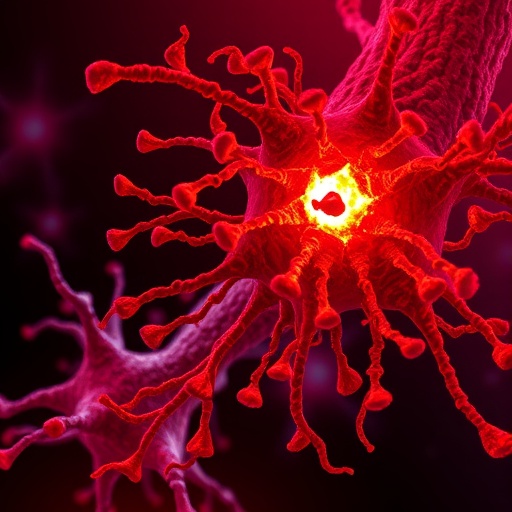
In a groundbreaking study recently published in Nature, researchers unveil a novel molecular axis that links mitochondrial dysfunction to T cell exhaustion, a phenomenon that has long hampered the efficacy of immunotherapies, particularly in cancer treatment. Exhausted CD8+ T cells, critical players in the immune response against tumors and chronic infections, display impaired function after prolonged activation. The new findings shed light on the intricate intracellular mechanisms that drive this exhaustion, pointing to a proteasome-guided haem signalling cascade influenced by mitochondrial health.
Mitochondria, the powerhouse organelles responsible for cellular energy production, play a pivotal role in immune cell functionality. Previous studies had demonstrated that T cells accumulating depolarized, dysfunctional mitochondria are prone to losing their effector capabilities and adopt an exhausted phenotype. However, the exact biochemical and molecular pathways connecting mitochondrial impairment to this exhaustion remained elusive. The latest data fills this gap by highlighting how damaged mitochondria lead to increased proteasomal activity within the T cells.
Through meticulous experiments, the researchers observed that accumulations of depolarized mitochondria significantly elevate proteasome activity. The proteasome—a cellular complex responsible for degrading damaged or unneeded proteins—selectively breaks down mitochondrial proteins as part of quality control mechanisms. This proteasome hyperactivity results in the liberation of haem, a critical prosthetic group found in many proteins, through the breakdown of haemoproteins. The presence and accumulation of this regulatory haem within the cell nucleus fundamentally alter transcriptional landscapes relevant to T cell functionality.
A key discovery is that the increased nuclear haem disrupts the function of BACH2, a transcription factor central to maintaining T cell stemness and preventing exhaustion. BACH2 normally acts as a repressive regulator, restraining genes that promote exhaustion. However, when haem levels surge, BACH2-mediated transcription is impaired, effectively exacerbating the exhaustion process. This revelation links mitochondrial health, proteasomal activity, and haem signalling in a previously unappreciated network that dictates T cell fate under chronic stimulation.
Delving deeper, the team demonstrated that inhibiting the nuclear import of regulatory haem preserves BACH2 integrity and its transcriptional control. This intervention notably reverses aspects of the exhaustion phenotype, enhancing T cell stemness and their ability to mount a vigorous immune response. The therapeutic implications are profound, especially concerning adoptive cellular therapies such as chimeric antigen receptor (CAR)-T cells, which often face challenges related to T cell exhaustion during manufacturing and clinical application.
Analyzing clinical data from patients treated with CD19+ CAR-T therapies for B cell acute lymphoblastic leukemia (B-ALL), the study identified a robust negative correlation between proteasome gene signatures in CAR-T cells and treatment efficacy. Essentially, T cells exhibiting elevated proteasome activity post-manufacturing were less effective anti-tumor warriors. This insight provides a direct biomarker that could predict and potentially improve CAR-T cell therapeutic outcomes.
The researchers exploited this mechanistic understanding by incorporating bortezomib, an FDA-approved proteasome inhibitor, into the CAR-T cell manufacturing process. Bortezomib-treated CAR-T cells exhibited decreased hallmarks of exhaustion, maintained superior functional capacity, and demonstrated enhanced anti-tumor efficacy in preclinical models. This repurposing of an established drug offers a promising strategy to optimize CAR-T therapies, potentially extending their benefits to a broader patient population.
Beyond its therapeutic promise, the study illuminates a general principle in immunometabolism and transcriptional regulation. It underscores how mitochondrial integrity is not just a metabolic checkpoint but also a molecular conductor orchestrating intracellular signalling cascades that impact T cell destiny. This foundational concept may have broader application across diverse immune cell types and disease contexts marked by chronic stimulation and cellular fatigue.
Importantly, this research bridges previously disconnected fields—mitochondrial biology, proteostasis, haem signalling, and immunology—into a coherent model that explains T cell exhaustion at a molecular level. The idea that mitochondrial damage triggers proteasome-mediated haem release which in turn sabotages a pivotal transcription factor is a paradigm shift with the potential to recalibrate approaches to immunotherapy.
While the findings shine a bright spotlight on the proteasome-haem-BACH2 axis, they also provoke new questions. How universal is this mechanism in other exhausted or dysfunctional immune cell subsets? Are there additional haem-regulated transcription factors influencing exhaustion? What are the long-term effects of proteasome inhibition during T cell expansion? These questions set the stage for future investigations that could refine and extend this therapeutic strategy.
The study also highlights the importance of intracellular haem as a regulatory molecule beyond its classical role in oxygen transport and electron transport chains. Its emerging role as a modulator of gene expression within immune cells might inspire new lines of research into haem-targeted therapies across autoimmune diseases, infections, and cancer.
In summary, this pioneering work identifies a previously uncharted proteasome-initiated haem signalling axis that fundamentally governs CD8+ T cell exhaustion by modulating transcription factor BACH2. It offers a compelling molecular explanation for how mitochondrial dysfunction translates into functional impairment in T cells. By revealing actionable targets such as proteasome activity and nuclear haem transport, this research paves the way for innovative interventions designed to bolster the immune system’s capacity to fight cancer and chronic diseases.
As immunotherapy continues to revolutionize medicine, understanding and manipulating T cell exhaustion will be crucial to maximize therapeutic potential. This study provides vital mechanistic insights and actionable strategies, potentially transforming current CAR-T cell manufacturing processes and improving patient outcomes. The integration of metabolic, proteolytic, and transcriptional pathways into a holistic model marks a significant advance in immunology and cellular therapy research.
With proteasome inhibitors already clinically approved, rapid translation of these insights into trials is feasible, heralding a new era in adoptive cell therapy optimization. This work not only enhances our understanding of T cell biology but also underscores the immense complexity and interconnectivity of cellular regulation mechanisms. The future of cancer immunotherapy may well hinge on modulating these intricate molecular circuits unveiled by this landmark study.
Cite Scienmag News
Nathaniel Bowman. (March 19, 2026). Proteasome-Haem Axis Drives T Cell Exhaustion. Scienmag. https://scienmag.com/proteasome-haem-axis-drives-t-cell-exhaustion/
Nathaniel Bowman. "Proteasome-Haem Axis Drives T Cell Exhaustion." Scienmag, 19 March 2026, https://scienmag.com/proteasome-haem-axis-drives-t-cell-exhaustion/. Accessed 3 September 2026.
Nathaniel Bowman. "Proteasome-Haem Axis Drives T Cell Exhaustion." Scienmag. March 19, 2026. https://scienmag.com/proteasome-haem-axis-drives-t-cell-exhaustion/


