

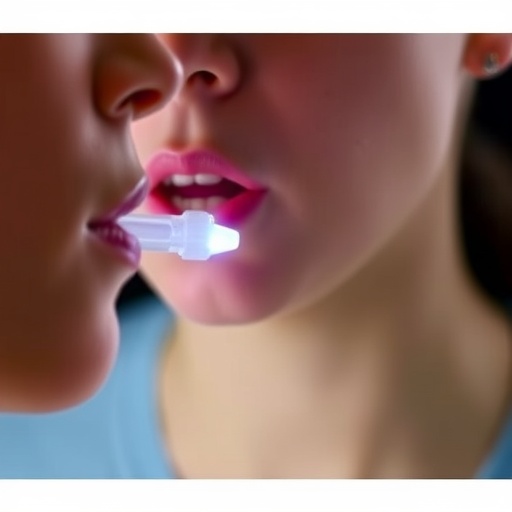
In the relentless battle against infectious diseases, rapid and accurate diagnosis of bacterial infections remains a formidable challenge for modern medicine. The rampant spread of antibiotic-resistant bacteria only intensifies the urgency for diagnostic techniques that are both swift and non-invasive. A groundbreaking study recently published in ACS Central Science promises to revolutionize how bacterial infections are detected—through the analysis of breath. This pioneering research demonstrates a method that can spot bacterial infections within minutes by detecting traceable metabolic byproducts in the breath, potentially transforming clinical diagnostics.
Traditional diagnostic methods for bacterial infections often rely on blood cultures, imaging approaches, and molecular assays. Although effective, these techniques suffer from significant limitations: they can be slow, often taking days to yield results; lack specificity in differentiating bacterial pathogens; or entail considerable expense and infrastructure, restricting their accessibility. These drawbacks compromise timely decision-making, which is critical for administering appropriate therapy, especially in emergency settings. Recognizing these gaps, the research team led by David Wilson developed a novel breath test approach inspired by existing diagnostics for Helicobacter pylori, a bacterium causing stomach infections.
The classic H. pylori breath test involves patients consuming a substrate labeled with a traceable isotope, which the bacteria metabolize into labeled carbon dioxide detectable in exhaled breath. Borrowing from this concept, Wilson and colleagues sought to broaden the scope by identifying compounds specifically metabolized by a wider array of bacteria while remaining largely inert to human metabolism. Their innovative strategy hinged on the use of sugars and sugar alcohols tagged with carbon-13, a stable, non-radioactive isotope. Because human cells metabolize these compounds less efficiently than bacteria, the presence of carbon-13-labeled carbon dioxide in breath would serve as a direct indicator of bacterial activity.
To validate their concept, the researchers conducted meticulous laboratory assays to screen various carbon-13-tagged substrates. They confirmed several candidates that are preferentially metabolized by clinically relevant bacteria, producing carbon-13-enriched carbon dioxide as a metabolic byproduct. For sensitive detection, the team employed nondispersive infrared spectroscopy—a cost-effective, portable analytical method capable of quantifying isotope-labeled gases in real time. This synergistic combination of isotope-labeled substrates and infrared detection formed the cornerstone of their breath testing prototype.
Animal models of infection provided compelling proof of concept. Mice infected with bacterial pathogens causing pneumonia, bloodstream infections, muscle infections, and osteomyelitis were intravenously administered the carbon-13-labeled compounds. Within minutes, breath samples from infected mice exhibited significantly elevated levels of carbon-13-labeled carbon dioxide compared to uninfected controls, whose breath signals remained near baseline. Intriguingly, results showed that the breath-based signal typically appeared within the first 10 minutes post substrate administration, highlighting the remarkable rapidity of this diagnostic approach.
Moreover, the team demonstrated the breath test’s potential utility as a real-time monitor of therapeutic efficacy. In one model of Escherichia coli infection, measurements of labeled carbon dioxide in breath decreased progressively as antibiotic treatment suppressed bacterial proliferation. This real-time feedback could enable clinicians not only to confirm bacterial infections rapidly but also to track treatment response non-invasively, potentially allowing for individualized therapy adjustments with unprecedented speed.
Beyond performance, safety and practicality were also at the forefront. The sugars and sugar alcohols chosen are generally recognized as safe for human use, with established pharmacokinetics and minimal toxicity. Coupled with compact, portable instruments for breath analysis, the envisioned diagnostic platform could be deployed in a variety of clinical environments—from emergency rooms to outpatient clinics—without requiring extensive laboratory infrastructure. This portability promises to drastically reduce turnaround times for infection diagnosis.
Despite the exciting results, the researchers underscore that their preliminary investigation has not yet optimized the breath test protocol. Future studies aim to fine-tune substrate selection and dosing, enhance breath sampling techniques, and validate the approach in humans. Their vision is for a non-invasive, rapid breath test that can provide immediate diagnostic clarity for bacterial infections, assisting clinicians in making prompt and appropriate treatment decisions in critical scenarios.
The implications of this study extend beyond diagnostic speed. By enabling point-of-care detection of bacterial infections, such breath-based tests could diminish unnecessary antibiotic prescriptions, thereby combating the global threat of antibiotic resistance. The capability to monitor treatment response in near real-time may foster judicious use of antimicrobials, improve patient outcomes, and reduce healthcare costs. Additionally, the non-invasive nature of breath sampling represents a significant patient comfort improvement compared to blood draws or invasive biopsies.
Supported by funding from the National Institutes of Health and the Cystic Fibrosis Foundation, this venture capitalizes on interdisciplinary collaboration, merging microbiology, analytical chemistry, and clinical medicine. The authors have taken steps to secure intellectual property related to this technology by filing a U.S. patent, underscoring the translational potential of their innovation.
The utilization of carbon isotopes for metabolic tracing in diagnostic applications is not new; however, tailoring this approach specifically to bacterial infection detection in breath signifies a vibrant leap forward. This research bridges fundamental chemical biology with practical healthcare solutions, charting a course for rapid, accurate, and patient-friendly diagnostics. As the global community grapples with emerging infectious threats and antimicrobial resistance, advances like these are crucial for reshaping the future of medicine.
Through this novel technology, scientists harness the metabolic footprints of bacteria to “sniff out” infections in a matter of minutes—a feat that could redefine emergency diagnostics and infectious disease management worldwide. While further clinical validation remains necessary, the vision of a simple breath test for bacterial infections draws closer to reality, promising to empower healthcare providers with faster, safer, and smarter tools to fight infection.
Subject of Research: Development of rapid, non-invasive breath tests for diagnosing bacterial infections using carbon-13-labeled substrates and infrared spectroscopy.
Article Title: Prototype breath tests spot bacterial infections in minutes
News Publication Date: 18-Mar-2026
Web References:
http://pubs.acs.org/doi/abs/10.1021/acscentsci.5c01995
Keywords:
Bacterial infections, breath test, carbon-13 isotope, nondispersive infrared spectroscopy, rapid diagnosis, pneumonia, bloodstream infection, antibiotic resistance, metabolic tracing, Escherichia coli, point-of-care diagnostics, non-invasive testing


