


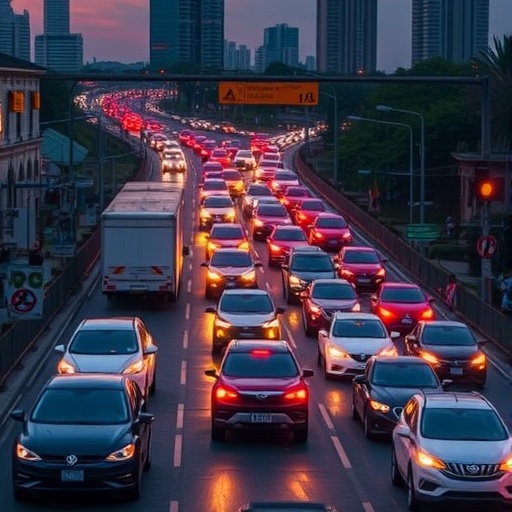
Scientists at The University of Manchester have pioneered an innovative approach to quantifying the impact of urban traffic on rising city temperatures, shedding new light on how everyday vehicle activities contribute to the urban heat landscape. This research marks a critical step forward in understanding the nuanced interactions between human transportation and climate dynamics, highlighting a previously underexplored source of urban warming.
Traditionally, urban heat research has emphasized the roles of infrastructure—such as buildings, pavements, and other heat-retaining surfaces—in driving temperature elevations in city environments. However, the direct heat output generated by vehicles—the cumulative energy emitted from engines, exhaust systems, and braking mechanisms—has often been overlooked in large-scale climate simulations. Addressing this gap, the Manchester team has developed a sophisticated physics-based module that integrates vehicular heat contributions directly into the Community Earth System Model (CESM), a leading global climate modeling platform widely used to forecast Earth’s climatic behavior under various scenarios.
By embedding urban traffic-related heat flux within CESM, the research allows a granular examination of how waste heat from vehicles affects the microclimate. This module captures complex thermodynamic exchanges that occur between urban surfaces and atmospheric layers, such as how heat emanated from busy roadways interacts with adjacent buildings and disperses into the surrounding air. Crucially, the model does not treat urban traffic heat as a mere background factor; instead, it simulates dynamic heat emissions that respond to real-time variations in traffic volume, vehicle types, and prevailing meteorological conditions.
The validation of this novel approach was performed using real-world datasets from two distinct metropolitan areas, Manchester in the United Kingdom and Toulouse in France. These sites were chosen for their contrasting climatic profiles and diverse traffic patterns, offering robust test beds for the model’s accuracy and adaptability. Data were supplied by Transport for Greater Manchester (TfGM) and complemented with publicly available datasets to refine the model’s calibration. The results compellingly demonstrated that vehicle heat production measurably elevates ambient urban air temperatures, with notable seasonal variability.
Quantitatively, simulations revealed that traffic-related heat increased air temperatures in Manchester by approximately 0.16 degrees Celsius during summer months and an even more pronounced 0.35 degrees Celsius in the heart of winter. While these increments may appear modest in isolation, their compounded effect during periods of extreme weather presents significant public health and infrastructure challenges. For instance, during the July 2022 United Kingdom heatwave, the modeled contribution of traffic heat was found to extend the duration and severity of dangerously high “feels like” temperatures, exacerbating human thermal stress and potentially increasing heat-related morbidity risks.
The model also illuminated how waste heat from vehicles is not confined to outdoors but penetrates indoor environments through conductive and convective processes involving building materials and air exchange. This transfer intensifies cooling demands in residential and commercial buildings, leading to higher energy consumption and environmental burden associated with air conditioning systems. As urban areas face intensifying heatwaves, understanding these interlinked pathways of heat transmission becomes essential for designing effective climate adaptation and mitigation strategies.
One of the model’s groundbreaking capabilities lies in its differentiation among various vehicle types, including petrol, diesel, hybrid, and electric vehicles. This feature permits an exploration of how evolving transportation technologies and policy changes might alter the urban heat signature. For example, while electric vehicles produce less direct engine heat, their electricity generation and battery thermal management introduce alternate thermal considerations that the model can dynamically capture. This flexibility enables policymakers to simulate the climate impacts of future transport scenarios, from widespread electric vehicle adoption to changes in traffic volume driven by urban planning measures.
This advancement has profound implications for urban planners and environmental scientists seeking to build cities resilient to climate change. By integrating traffic-related heat flux into large-scale Earth system models, stakeholders can simultaneously assess the effectiveness of transport policies aimed at reducing emissions and managing thermal environments. The method provides a vital scientific foundation for decisions that reconcile urban mobility demands with climate adaptation goals and public health needs.
Dr. Zhonghua Zheng, serving as Co-Lead for Environmental Data Science & AI at Manchester Environmental Research Institute and Lecturer in Data Science & Environmental Analytics at The University of Manchester, emphasized that this approach fills a significant void in urban climate modeling. He noted that previous research largely neglected the transient and localized nature of vehicular heat emissions, which are critical to understanding urban microclimates. This study opens avenues for more integrated environmental data science, blending computational rigor with real-world empirical insights.
PhD researcher Yuan Sun, the paper’s first author, underlined the broader relevance of incorporating transport systems into urban climate strategies. “Our findings stress that transport emissions are not only about greenhouse gases; the direct heat they release significantly influences urban thermal comfort and infrastructure performance. Planning for climate adaptation, cooling initiatives, and net-zero transitions must account for these heat fluxes to be truly effective,” Sun stated.
Published in the Journal of Advances in Modeling Earth Systems, this study demonstrates the power of computational simulation and modeling to reveal hidden dimensions of urban heat dynamics. The research exemplifies a multidisciplinary fusion of environmental analytics, atmospheric physics, and data science, heralding a shift toward more comprehensive climate models that factor in city-level anthropogenic activities with unprecedented specificity.
As cities worldwide grapple with increasing temperatures and climatic extremes, this research underscores a critical yet modifiable urban heat driver—traffic heat emissions. Future investigations expanding the model to more cities and integrating real-time traffic sensor networks could further refine predictions and inform adaptive urban designs. By illuminating the thermal footprints of transport, scientists, policymakers, and urban stakeholders are better equipped to navigate the complex path toward sustainable and resilient urban futures.
News Publication Date: 8-Apr-2026
Web References:
https://doi.org/10.1029/2025MS005435
References:
Journal of Advances in Modeling Earth Systems, 2026, DOI: 10.1029/2025MS005435
Cite Scienmag News
Courtney Benton. (April 8, 2026). Traffic Heat Linked to Rising City Temperatures, New Study Reveals. Scienmag. https://scienmag.com/traffic-heat-linked-to-rising-city-temperatures-new-study-reveals/
Courtney Benton. "Traffic Heat Linked to Rising City Temperatures, New Study Reveals." Scienmag, 8 April 2026, https://scienmag.com/traffic-heat-linked-to-rising-city-temperatures-new-study-reveals/. Accessed 3 September 2026.
Courtney Benton. "Traffic Heat Linked to Rising City Temperatures, New Study Reveals." Scienmag. April 8, 2026. https://scienmag.com/traffic-heat-linked-to-rising-city-temperatures-new-study-reveals/


