


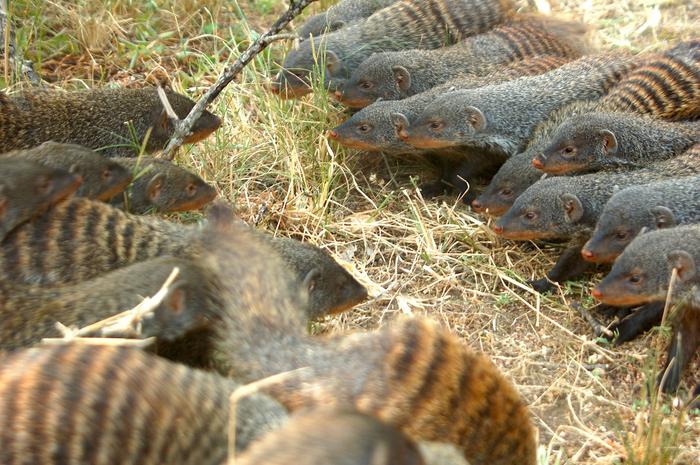
A major new research project will investigate how and why groups of animals from the same species fight one another.

Credit: Harry Marshall
A major new research project will investigate how and why groups of animals from the same species fight one another.
By focussing on warlike species – mongooses and termites – researchers aim to understand how evolution can lead to extreme aggression between groups, the consequences of this and the factors that can lead to peace.
The results will help to explain why violence between rival groups evolves in some species but not others, or between some groups and not others – with implications for our understanding of human evolution.
The research team, led by Professor Michael Cant at the University of Exeter, includes the universities of Cambridge, York, Swansea and Bielefeld, Germany, and a field team based in Uganda.
Professor Cant and his team have been awarded a €3 million Advanced Grant by the European Research Council (ERC).
“An outstanding problem in evolutionary biology is to explain how cooperative groups evolve by natural selection,” said Professor Cant, from the Centre for Ecology and Conservation on Exeter’s Penryn Campus in Cornwall.
“Classic research on this question has shown that factors that operate within the group, such as kinship and reciprocity, can select for altruism.
“Yet there is now substantial evidence from humans and other social animals that conflict between groups – or warfare – can also exert a profound influence on social behaviour.
“Intergroup conflict could in principle act as a fundamental moulding force in the evolution of animal societies, shaping not just behaviour but also life history and social organisation, but this idea has not been tested.
“We will test this hypothesis through an integrated theory, field and lab study using two animal societies as model systems.
“The outcome will be a significant advance in our understanding of how social life forms and societies evolve.”
The researchers will study a wild population of banded mongooses in Uganda and a lab population of dampwood termites in Cornwall.
This project, entitled “Intergroup conflict and the evolution of animal societies”, is one of 255 included in new grants awarded by the ERC to outstanding researchers across Europe.
Iliana Ivanova, Commissioner for Innovation, Research, Culture, Education and Youth, said: “These grants will not only support leading researchers in pushing the boundaries of knowledge, but also create some 2,500 jobs for postdoctoral fellows, PhD students and other research staff across Europe.
“This investment nurtures the next generation of brilliant minds.
“I look forward to seeing the resulting breakthroughs and fresh advancements in the years ahead.”
Cite Scienmag News
Drew Townsend. (April 11, 2024). New project explores warfare in animal societies. Scienmag. https://scienmag.com/new-project-explores-warfare-in-animal-societies/
Drew Townsend. "New project explores warfare in animal societies." Scienmag, 11 April 2024, https://scienmag.com/new-project-explores-warfare-in-animal-societies/. Accessed 4 September 2026.
Drew Townsend. "New project explores warfare in animal societies." Scienmag. April 11, 2024. https://scienmag.com/new-project-explores-warfare-in-animal-societies/

