


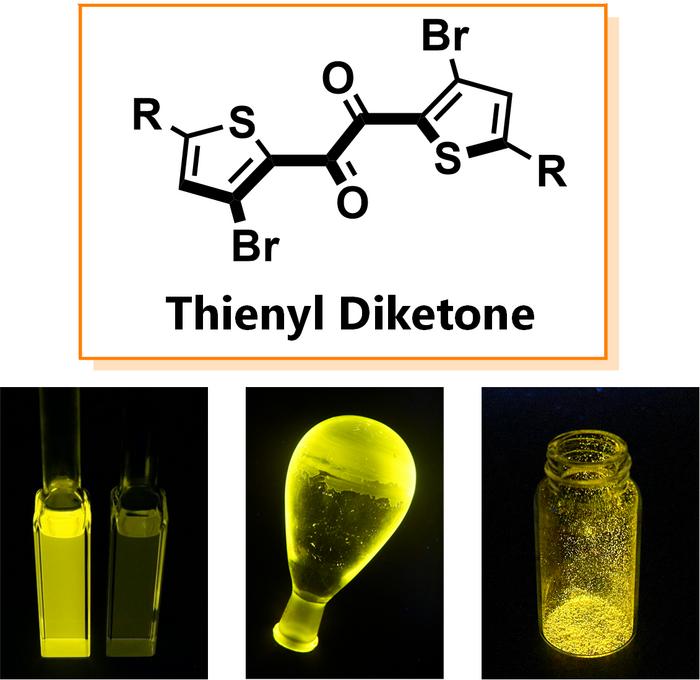
A research team led by Osaka University discovered that the new organic molecule thienyl diketone shows high-efficiency phosphorescence. It achieved phosphorescence that is more than ten times faster than traditional materials, allowing the team to elucidate this mechanism.
Osaka, Japan – Phosphorescence is a valuable optical function used in applications such as organic EL displays (OLEDs) and cancer diagnostics. Until now, achieving high-efficiency phosphorescence without using rare metals such as iridium and platinum has been a significant challenge. Phosphorescence, which occurs when a molecule transitions from a high-energy state to a low-energy state, often competes with non-radiative processes where the molecule loses energy as heat.

Credit: Osaka University
A research team led by Osaka University discovered that the new organic molecule thienyl diketone shows high-efficiency phosphorescence. It achieved phosphorescence that is more than ten times faster than traditional materials, allowing the team to elucidate this mechanism.
Osaka, Japan – Phosphorescence is a valuable optical function used in applications such as organic EL displays (OLEDs) and cancer diagnostics. Until now, achieving high-efficiency phosphorescence without using rare metals such as iridium and platinum has been a significant challenge. Phosphorescence, which occurs when a molecule transitions from a high-energy state to a low-energy state, often competes with non-radiative processes where the molecule loses energy as heat.
This competition can lead to slow phosphorescence and lower efficiency. While previous research indicated that incorporating certain structural elements into organic molecules could speed up phosphorescence, these efforts have not matched the speed and efficiency of rare metal-based materials.
The research team’s breakthrough with the new organic molecule thienyl diketone represents a significant advancement in the field. Yosuke Tani, senior author of the study, remarked, “We discovered this molecule by chance and initially did not understand why it demonstrated such superior performance. However, as our research progressed, we began to connect the pieces and deepen our understanding.”
“Our research has led to a clearer understanding of the mechanism behind this molecule’s performance than any previous organic phosphorescent material,” explains Dr. Tani. “Nonetheless, we believe there is still much to explore, and we are excited about its potential applications.”
This research provides new design guidelines for developing organic phosphorescent materials that do not rely on rare metals, offering the potential to surpass and replace these materials in various applications. The findings promise significant advancements in the fields of OLEDs, lighting, and medical diagnostics, among others.
###
The article, “Fast, efficient, narrowband room-temperature phosphorescence from metal-free 1,2-diketones: rational design and mechanism,” was published in Chemical Science at DOI:
About Osaka University
Osaka University was founded in 1931 as one of the seven imperial universities of Japan and is now one of Japan’s leading comprehensive universities with a broad disciplinary spectrum. This strength is coupled with a singular drive for innovation that extends throughout the scientific process, from fundamental research to the creation of applied technology with positive economic impacts. Its commitment to innovation has been recognized in Japan and around the world. Now, Osaka University is leveraging its role as a Designated National University Corporation selected by the Ministry of Education, Culture, Sports, Science and Technology to contribute to innovation for human welfare, sustainable development of society, and social transformation.
Website:
Journal
Chemical Science
Method of Research
Experimental study
Subject of Research
Not applicable
Article Title
Fast, efficient, narrowband room-temperature phosphorescence from metal-free 1,2-diketones: rational design and mechanism
Article Publication Date
4-Jul-2024
Cite Scienmag News
Bethany Barker. (July 4, 2024). New organic molecule shatters phosphorescence efficiency records and paves way for rare metal-free applications. Scienmag. https://scienmag.com/new-organic-molecule-shatters-phosphorescence-efficiency-records-and-paves-way-for-rare-metal-free-applications/
Bethany Barker. "New organic molecule shatters phosphorescence efficiency records and paves way for rare metal-free applications." Scienmag, 4 July 2024, https://scienmag.com/new-organic-molecule-shatters-phosphorescence-efficiency-records-and-paves-way-for-rare-metal-free-applications/. Accessed 9 September 2026.
Bethany Barker. "New organic molecule shatters phosphorescence efficiency records and paves way for rare metal-free applications." Scienmag. July 4, 2024. https://scienmag.com/new-organic-molecule-shatters-phosphorescence-efficiency-records-and-paves-way-for-rare-metal-free-applications/

