


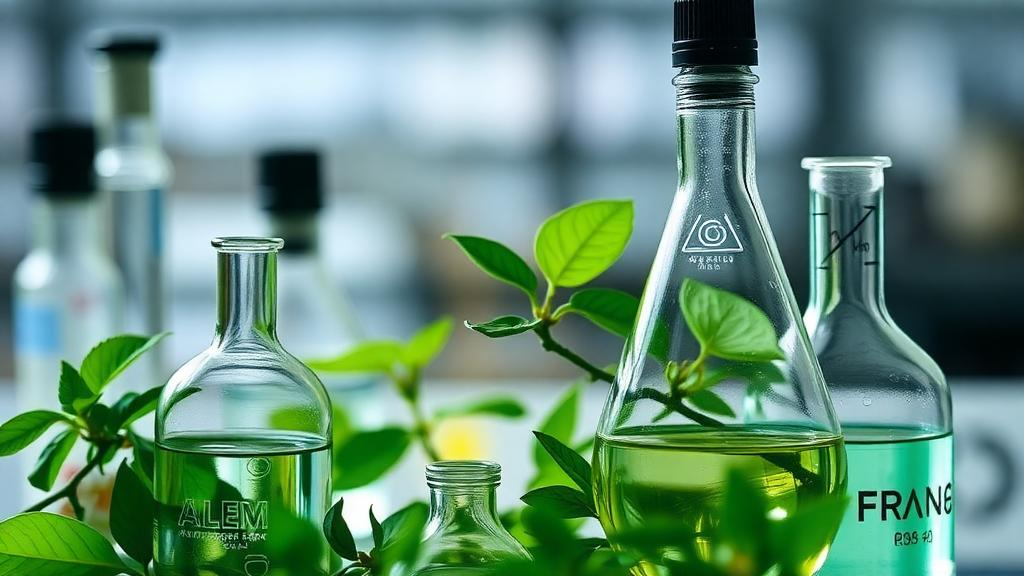
A new scientific journal dedicated entirely to green chemistry has launched with a bold ambition: to make safer, cleaner, and more resource-efficient chemistry the baseline expectation rather than the exception. Discover Green Chemistry, a fully open access journal in Springer Nature’s Discover series, published its inaugural editorial on 2 March 2026, setting out a sweeping vision for a field that has evolved from a countercultural warning about chemical pollution into a quantitative, predictive, and design-driven discipline. The editorial, written by Manjiri A. Mahadadalkar of Springer Nature Technology and Publishing Solutions in Pune, Venkata Surya Kumar Choutipalli of Temple University’s Institute for Computational Molecular Science in Philadelphia, and Ruchi Bharti of Chandigarh University in Mohali, frames the journal as both a scientific venue and a meeting point for industry, policy, and society.
The intellectual roots of green chemistry stretch back further than many readers might expect. The editorial traces the discipline’s origins to Rachel Carson’s 1962 book Silent Spring, which alerted the public to the unintended consequences of widespread chemical use, particularly pesticides accumulating in food chains and ecosystems. That early cautionary tale gradually matured into a constructive engineering philosophy. In 1998, Paul Anastas and John Warner codified the field’s practical framework in their Twelve Principles of Green Chemistry, a set of design guidelines covering everything from waste prevention and atom economy to the use of safer solvents and renewable feedstocks. What began as a set of aspirational rules has, over the past decades, become a toolkit that academia and industry apply daily, yielding safer reagents and solvents, reduced emissions, effective catalysis, renewable raw materials, circular strategies for chemicals and materials, cleaner energy and water, and contributions to global climate change mitigation.
Perhaps the most striking theme in the inaugural editorial is the discipline’s pivot from reactive cleanup to predictive design. Green chemistry, the authors argue, is increasingly embracing computational and quantitative approaches that embed sustainability at the earliest stages of research and development, long before a single gram of material is synthesized. Modelling tools and thermodynamic insight can now guide the selection of safer solvents, including emerging classes such as deep eutectic systems, and inform the rational design of catalytic and reaction pathways before extensive experimental screening begins. This represents a fundamental shift in how chemists work: instead of testing dozens of solvent systems in the laboratory and discarding the failures, researchers can screen candidates in silico and advance only the most promising, least hazardous options to the bench.
Computer-aided process design takes this logic to the scale of entire manufacturing routes. These frameworks integrate environmental metrics such as the E-factor, the ratio of waste generated to product obtained, and energy consumption directly into synthetic planning, allowing chemists and chemical engineers to optimize routes for reduced waste and improved efficiency. In parallel, in silico toxicology, quantitative structure-activity relationship modeling, and machine learning approaches enable early-stage screening of hazards and exposure risks, aligning chemical innovation with regulatory requirements and societal expectations before products reach the market. The editorial describes this convergence as a movement from reactive mitigation toward predictive, design-oriented strategies for sustainability, a reframing that could reshape how the chemical industry approaches everything from pharmaceutical synthesis to commodity materials.
The journal’s declared scope is remarkably broad, reflecting green chemistry’s position as an interdisciplinary crossroads. Among the priority topics are chemical degradation, including the breakdown of antibiotics, fertilizers, dyes, and chemical residues using advanced oxidation methods and controlled degradation under specific environmental conditions. Chemical recycling receives its own emphasis, spanning molecular-level processing, the recovery of precious metals from electronic waste, and technologies such as pyrolysis, gasification, depolymerization, and solvolysis. Waste prevention and management covers source reduction, on-site treatments like neutralization, filtration, precipitation, and detoxification, responsible disposal, and even digital inventory systems designed to prevent chemical stockpiling and wastage in laboratories and storerooms.
Circular economy principles feature prominently throughout the scope. The journal invites work on atom economy, waste valorisation, and the design of biodegradable materials, alongside energy efficiency in chemical manufacturing and application. That last category includes process optimization, energy-efficient manufacturing techniques such as microwave-assisted, photochemical, and flow chemistry reactions, and the integration of computational modeling to reduce carbon footprints and manufacturing costs. Green catalysis forms another pillar, encompassing biocatalytic, enzyme-assisted, nanocatalytic, photocatalytic, and organocatalytic reactions, as well as energy-efficient and highly selective heterogeneous catalysts and the emerging field of predictive catalysis. Green synthesis topics include single-step reactions, the use of bio-based materials, plant extracts, natural products, and microorganisms, and cost-effective, environmentally friendly manufacturing processes that minimize energy consumption.
Renewable resources and safer chemicals round out the scientific agenda. The journal seeks research on biomass and agricultural waste as feedstocks, non-depletable raw materials, bioplastics, biofuels, and alternatives to fossil fuels. On the safety side, it calls for computational approaches to designing safer chemicals, the substitution of traditional toxic solvents with safer alternatives, and strategies to avoid bioaccumulation and environmental persistence. Sustainable chemistry topics extend to reducing greenhouse gas emissions, data-driven sustainability metrics, and life-cycle management that follows materials from raw material extraction through manufacturing, usage, and disposal. The editorial also emphasizes systemic thinking, integrating environmental, economic, and social factors into chemical manufacturing, and highlights sustainable materials and products designed to be benign by design, including reclaimed materials, compostable packaging, plant-based fibres, and eco-friendly consumer goods.
Notably, the journal’s scope extends beyond the laboratory bench into policy, education, and innovation. The editorial lists safer workplaces, accident prevention, and real-time analysis for pollution prevention among its interests, acknowledging that green chemistry’s impact depends as much on how chemicals are handled and regulated as on how they are synthesized. The editorial board, which brings together researchers and practitioners from across the breadth of the field, will handle manuscripts, recommend expert reviewers, advocate rigorous and constructive peer review, identify emerging directions for guest-edited Topical Collections, and promote the journal within professional communities. The board is expected to expand, and the journal welcomes new members who wish to contribute to its development.
The journal’s stance on what counts as publishable science is deliberately inclusive. The editors state that Discover Green Chemistry welcomes both breakthrough advances and well-validated incremental improvements, arguing that each contribution plays a pivotal role in the sustainable progress of the field. This is a meaningful position in a publishing landscape that often privileges novelty over reliability. Incremental improvements, such as a modestly greener solvent swap or a slightly more efficient catalyst, may lack headline appeal, but they are precisely the changes that accumulate into industrial transformation. The journal accepts full-length research articles, brief communications, comprehensive reviews, perspectives, and case studies, and it commits to publishing work that is not only innovative but also credible, scalable, and measurable in its sustainability impact.
The launch also carries a broader significance for open science. As a fully open access journal, Discover Green Chemistry makes its content freely available to researchers, industry practitioners, policymakers, and educators worldwide, removing paywalls that can slow the diffusion of sustainable technologies, particularly in developing economies where green chemistry solutions may be most urgently needed. The journal explicitly encourages submissions that address the United Nations Sustainable Development Goals, tying chemical research to global targets on clean water, affordable energy, climate action, and responsible production. Whether the new journal can help accelerate the transition from green chemistry as principle to green chemistry as default practice will depend on the community it attracts, but its inaugural editorial makes clear that the ambition is nothing less than a redesign of how molecules, materials, and processes are conceived from the very first sketch on the drawing board.
Subject of Research: The launch and scope of the open access journal Discover Green Chemistry
Article Title: Inaugural editorial for Discover Green Chemistry
Article References: Mahadadalkar, M. A., Choutipalli, V. S. K., & Bharti, R. (2026). Inaugural editorial for Discover Green Chemistry. Discover Green Chemistry, 1(1), Article 1. https://doi.org/10.1007/s44509-026-00005-3
Image Credits: AI Generated
DOI: 10.1007/s44509-026-00005-3
Keywords: green chemistry, Discover Green Chemistry, open access publishing, sustainability, Twelve Principles of Green Chemistry, chemical recycling, green catalysis, computational chemistry, renewable feedstocks, circular economy, safer solvents, Sustainable Development Goals
Cite Scienmag News
Bethany Barker. (October 1, 2026). New Open Access Journal Puts Green Chemistry at the Heart of Sustainable Science. Scienmag. https://scienmag.com/new-open-access-journal-puts-green-chemistry-at-the-heart-of-sustainable-science/
Bethany Barker. "New Open Access Journal Puts Green Chemistry at the Heart of Sustainable Science." Scienmag, 1 October 2026, https://scienmag.com/new-open-access-journal-puts-green-chemistry-at-the-heart-of-sustainable-science/. Accessed 4 October 2026.
Bethany Barker. "New Open Access Journal Puts Green Chemistry at the Heart of Sustainable Science." Scienmag. October 1, 2026. https://scienmag.com/new-open-access-journal-puts-green-chemistry-at-the-heart-of-sustainable-science/


