


Deep in the sun-baked karst hills above the Croatian village of Zaostrog, a moth barely larger than a grain of rice has been quietly hiding one of the most surprising secrets in European lepidopterology. Researchers describing Elachista dimorphella sp. nov. in the journal Nota Lepidopterologica have unveiled the first known sexually dimorphic species of Aphelosetia, a large subgenus of the grass-miner moth genus Elachista. The discovery is remarkable not because the species is large or flashy, but because it overturns a long-standing assumption about a genus of roughly 700 described species: that males and females of Aphelosetia moths always look essentially alike.
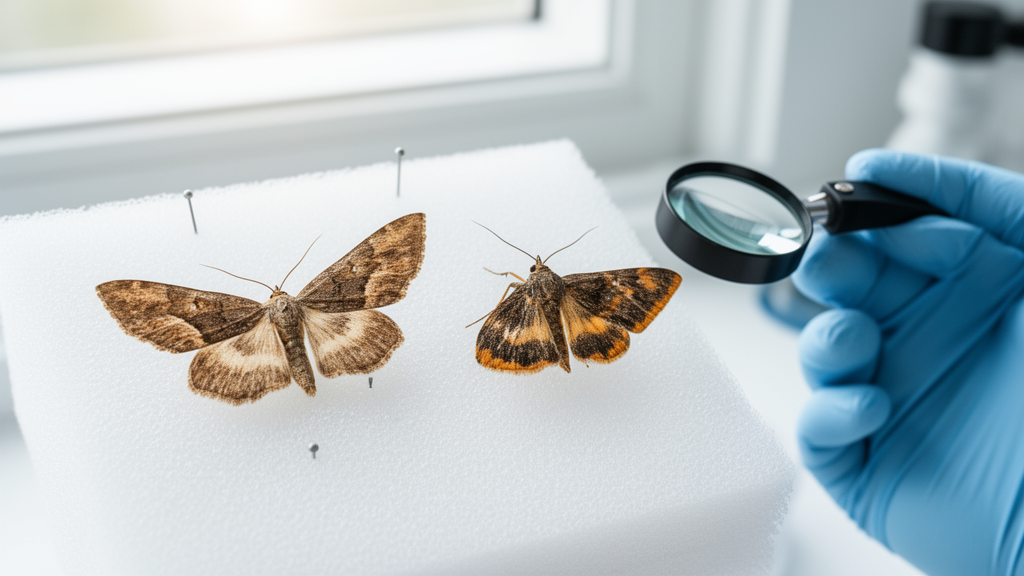
The contrast between the sexes of the new species is striking for such a small insect. Males, with wingspans of 6.5 to 7.7 millimetres, are dark grey with an indistinct, irregular forewing pattern, a unicolorous grey and unusually thick antennal flagellum, and dark grey hindwings. Females, spanning 7.5 to 8.5 millimetres, are yellowish white, variably adorned with a yellow to honey-yellow pattern and sparsely scattered light brown scales, especially along the apex of the fringe on the termen. To the naked eye, and even to an experienced lepidopterist, the two sexes would hardly be suspected of belonging to the same species. Indeed, the species name dimorphella was chosen precisely to reflect this dramatically different external appearance.
For decades, wing colouration in Elachista has been considered largely uniform between the sexes in the subgenus Aphelosetia. Sexual dimorphism in wing pattern was known elsewhere in the genus, particularly in the subgenera Elachista and Atachia, but never in Aphelosetia. The new species belongs to the bedellella species group, which is confined to the Palaearctic region and currently contains about 50 named species, with many more undescribed. The finding suggests that the diversity of this group, and the evolutionary forces shaping it, may be far greater than previously appreciated.
Crucially, the association between the dark males and pale females was not made on morphology alone. The researchers turned to DNA barcoding, sequencing tissue samples from eleven specimens at the Canadian Centre for DNA Barcoding in Guelph. The sequences form a unique Barcode Index Number, BOLD:ABA4184, and cluster together with nearly no variation within the cluster. Without this molecular evidence, the authors note, it would hardly have been possible to associate males and females of this species at all. The barcode data thus served as the decisive bridge between two morphs that external appearance alone could never unite.
The specimens were collected across a handful of localities hugging the Adriatic Sea: from Caorle on the Italian coast, through Petrinjski kras and Brestovica in Slovenia, to Istrian sites near Pula and Rovinj, and Dalmatian localities including Bilišane, Zaton Obrovački and Zaostrog in Croatia. The distribution ranges from near sea level to approximately 450 metres. Adults were collected from early May to early July, mostly in light-traps, though some were disturbed from low undergrowth before sunset in Pula. The immature stages and host plants remain unknown, leaving a substantial gap in our understanding of the species’ biology.
The description relied on meticulous classical techniques alongside molecular work. Genitalia were dissected following standard procedures for small Lepidoptera and embedded in Euparal on glass slides or stored in glycerol-filled vials. Male genitalia were stained with eosin, while abdominal pelts and female genitalia were gently stained with chlorazol black E. Photographs of adults were taken with macro equipment and edited digitally, while drawings of male genitalia were rendered in Indian ink on transparent drawing paper. The genitalia of the new species show distinctive characters: in the female, a paired band of small spines in the corpus bursae; in the male, relatively long, tapered uncus lobes and a phallus 0.6 to 0.75 times as long as the valva, with no cornuti present.
Beyond the new species itself, the study untangled a web of confusion among its closest relatives. The male of E. constitella Frey, 1859, previously unknown, is now characterised for the first time, based on material from Trieste. The female of E. maculata Parenti, 1978 is likewise described. Perhaps most significantly, the male of E. maculata has widely but erroneously been considered to be E. constitella, a misidentification that the new work corrects. A specimen previously stated to be the unknown male of E. constitella is shown to represent E. maculata instead. The male of E. amseli Rebel, 1933, a species with unclear status, is also characterised from a paralectotype preserved in Karlsruhe.
The genus Elachista is among the largest lepidopteran genera, divided into five subgenera, and many more species are known but awaiting formal description. The taxonomy of the genus is poorly known worldwide, and even supposedly well-explored regions have repeatedly proved poorly known with respect to smaller moths. Europe, especially the Mediterranean area, is particularly underexplored. The Balkan peninsula presents extraordinary challenges in how species morphology and DNA barcodes coincide, with evidence that even distant barcode clusters can show seemingly non-differentiated morphology, complicating the establishment of a firm basis for formal taxonomy.
The case of E. dimorphella illustrates how molecular tools have transformed the study of small moths. DNA barcoding has added considerably to the understanding of diversity in nearly all groups of Lepidoptera, in particular the smaller-sized ones. For a genus like Elachista, where external appearance offers few reliable clues and genitalia dissection is essential, the ability to match sexes and species through barcode clusters has proven decisive. The new species’ barcode data are publicly accessible through the Barcode of Life Data Systems, allowing future researchers to build on the work.
For now, Elachista dimorphella stands as a reminder that even in well-trodden European landscapes, tiny organisms can harbour evolutionary surprises of the first order. A moth that would otherwise be dismissed as two separate, unremarkable species has been revealed as one, thanks to a combination of patient fieldwork across Adriatic coastlines, careful morphological study of type material spanning nearly a century, and the molecular fingerprints that finally linked dark grey males to honey-yellow females. The discovery opens the door to searching for further dimorphic species in a group where none were thought to exist.
Subject of Research: Taxonomy
Article Title: Elachista dimorphella sp. nov., the first known sexually dimorphic species of Aphelosetia , a subgenus of Elachista ( Elachistidae , Elachistinae )
Article References: Kaila, L., & Tokár, Z. (2026). Elachista dimorphella sp. nov., the first known sexually dimorphic species of Aphelosetia, a subgenus of Elachista (Elachistidae, Elachistinae). Nota Lepidopterologica, 49, 1-15. https://doi.org/10.3897/nl.49.174091
Image Credits: AI Generated
DOI: 10.3897/nl.49.174091
Keywords: Elachista dimorphella, Lepidoptera, sexual dimorphism, DNA barcoding, new species, taxonomy, Elachistidae, Adriatic coast, Elachista, dimorphella, first, known
Cite Scienmag News
Gavin Prescott. (October 16, 2026). New moth species stuns scientists with dramatically different males and females. Scienmag. https://scienmag.com/new-moth-species-stuns-scientists-with-dramatically-different-males-and-females/
Gavin Prescott. "New moth species stuns scientists with dramatically different males and females." Scienmag, 16 October 2026, https://scienmag.com/new-moth-species-stuns-scientists-with-dramatically-different-males-and-females/. Accessed 16 October 2026.
Gavin Prescott. "New moth species stuns scientists with dramatically different males and females." Scienmag. October 16, 2026. https://scienmag.com/new-moth-species-stuns-scientists-with-dramatically-different-males-and-females/


