


When Johns Hopkins Hospital opened the RISE Restorative Space in January 2024, nobody knew whether busy clinicians, nurses, lab scientists, and administrators would actually take time out of grueling shifts to sit in a room with bubble lights and a massage chair. Four months later, the answer was a resounding yes. Badge swipe data published in Frontiers in Organizational Psychology show that the cluster of five rooms was accessed 4,271 times by 823 unique employees between January 1 and April 30, 2024, and 71 percent of those users came back at least once. Individual usage ranged from a single visit to a striking 98 visits, and traffic grew every month, with the steepest climb in the Sensory Room.
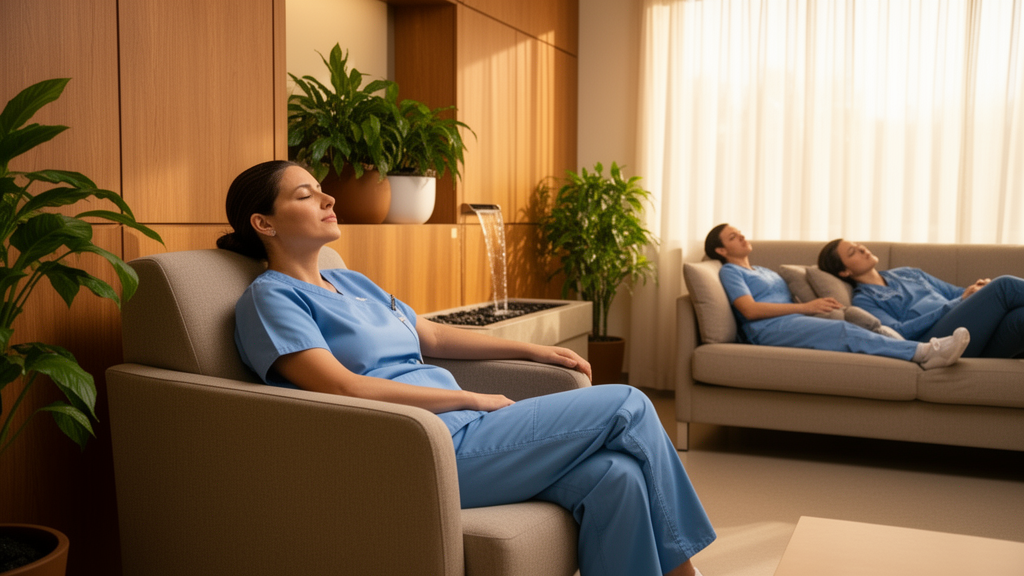
The RISE Restorative Space is an extension of the hospital’s Resilience in Stressful Events program, a peer-support initiative that proved its worth during the COVID-19 pandemic. Rather than a single quiet room, the design team built a multimodal environment: two shared spaces, an Art Activity Room stocked with painting supplies and vision-board tools, and a Gathering Room with comfortable seating, natural light, biophilic elements, books, puzzles, and musical instruments. Three private rooms round out the offering: a reservable Private Consultation Room for confidential counseling and peer support, a Sensory Room with a massage chair, color-shifting bubble lights, aromatherapy, and Bluetooth speakers, and a Tune Room housing a vibro-acoustic, medical-grade bed designed to engage the parasympathetic nervous system.
The engineering behind the space draws on neuroaesthetic design principles, developed with input from the International Arts + Mind Lab, Studio Elsewhere, and the architecture firm Reddymade. Each room carries its own color palette, with more vibrant hues reserved for the Art Activity Room, and a coordinated lighting plan emphasizing softer color temperatures, adjustable illumination, and windows for natural light. The intent is to reduce sensory overload, promote calm, and give workers a sense of personal control, features that environmental psychology research links to improvements in perceived stress, emotional regulation, cognitive functioning, and even physiological stress markers. Curved architectural elements were not feasible within the budget, so designers relied on visual softness and sensory modulation within existing constraints.
To measure whether the concept actually worked outside a crisis, the research team, led by Annelise Brochier of the Johns Hopkins Bloomberg School of Public Health, combined three data streams. Badge swipes at each room’s entrance provided objective utilization metrics, including visit frequency, room preferences, and time-of-day patterns. In May 2024, the team emailed an anonymous web-based survey to everyone who had swiped in, collecting usage details, perceived benefits and challenges, and burnout scores on the Mini Z General assessment. A cost analysis divided total program expenditures by employees, users, and visits. The project was run as a quality improvement assessment and did not require institutional review board review.
The survey results, from 296 respondents who confirmed they had used the space, reveal what workers were actually seeking. Nearly half, 47.7 percent, said they first visited seeking relaxation, while 38.4 percent cited simple curiosity, 28.4 percent sought rejuvenation, and 27.8 percent pointed to fatigue. Asked what they achieved, 58 percent reported a sense of comfort and 42.9 percent a positive distraction. The Sensory Room and Tune Room were the most visited spaces, used by 57.4 and 45.6 percent of respondents respectively, far outpacing the Art Activity Room at 16.6 percent, the Gathering Room at 14.5 percent, and the Private Consultation Room at 2.7 percent. Word of mouth, hospital email, and the communications newsletter each introduced roughly a third of users to the space.
The timing data tell a particularly compelling story. Use peaked during standard daytime working hours between 9 a.m. and 5 p.m., but a second surge appeared between 1 a.m. and 4 a.m., suggesting that overnight staff, often overlooked in wellbeing programming, were also finding their way to the rooms. Because the shared spaces are unscheduled and accessible at any time, employees can drop in alone or with colleagues, supporting both informal restoration and spontaneous social connection. The authors argue that a continuously accessible restorative space can serve employees across a wide range of schedules and meet different needs throughout the day and night.
The burnout findings underscore why such a resource matters. Using the Mini Z General assessment, the team found that only 4.1 percent of respondents scored high enough to classify their workplace as highly supportive, and not a single respondent reached the threshold for perceiving their workload as manageable. Just 3.4 percent scored high enough to describe their workplace as joyful, and 34.1 percent reported experiencing burnout. Against that backdrop, the enthusiasm for the space is striking: 93 percent of respondents said they would recommend it to a friend or colleague, with 74.4 percent calling themselves extremely likely to do so. Nearly half, 48 percent, wanted to see more spaces like it at their institution, and 43.2 percent desired more fitness facilities.
The economics look promising as well. Total program costs for the first four months came to 168,000 dollars, combining 153,000 dollars in facility-related expenses with a 15,000 dollar contribution from the Johns Hopkins Office of WellBeing. Spread across the roughly 15,000 employees eligible to access the space, that works out to 11.20 dollars per employee. Per unique user, the cost was 204 dollars, and per visit, 39.33 dollars. The authors emphasize that these figures reflect only the initial implementation period, when awareness was still building; as utilization increases, the cost per user should fall, though ongoing staffing, maintenance, and programming costs will also accrue and must be weighed in future cost-effectiveness analyses.
The model appears transferable. A second hospital within the same health system launched its own RISE Restorative Space in May 2024, and within four months it drew 945 unique employees along with overwhelmingly positive feedback. One of the most beloved features there was a blessing jar where visitors could leave and read encouraging messages, a detail the original space lacked but which highlights how institutions can tailor restorative environments to their own staff culture. The authors also note practical implementation lessons: although the space functions largely as a self-directed resource, survey responses pointed to the importance of a dedicated individual responsible for oversight, coordination, maintenance, and outreach, and of aligning the space with institutional strategic priorities.
The findings come with caveats. Badge swipe data can blur individual usage, since group visits may register as multiple swipes, some employees may swipe in for others, and congestion at peak times may produce missed or duplicate swipes. The survey sample may be skewed by selection bias, with employees more positively disposed toward the space more likely to respond, and the experience questions were developed specifically for this assessment and have not been formally validated. The burnout measure captures a snapshot rather than changes caused directly by space use. Still, the authors argue that thoughtfully designed, institutionally supported restorative environments can meaningfully engage healthcare employees and complement broader organizational efforts to reduce burnout. A planned follow-up evaluation will track longitudinal changes in wellbeing, compare usage trajectories, and probe whether private and communal rooms address distinct needs, offering the first rigorous test of whether a few quiet rooms can genuinely bend the curve on clinician burnout.
Subject of Research: Stress, resilience, and recovery: assessing a physical restorative space within a multimodal support program for hospital workers
Article Title: Stress, resilience, and recovery: assessing a physical restorative space within a multimodal support program for hospital workers
Article References: Brochier, A., Davis, S., Kulkarni, S., Miller, J., Malik, M., Norvell, M., Connors, C., & Wu, A. W. (2026). Stress, resilience, and recovery: assessing a physical restorative space within a multimodal support program for hospital workers. Frontiers in Organizational Psychology, 4, Article 1944537. https://doi.org/10.3389/forgp.2026.1944537
Image Credits: AI Generated
DOI: 10.3389/forgp.2026.1944537
Keywords: Stress, resilience, recovery, assessing, physical, restorative, space, within, multimodal, support, program, hospital
Cite Scienmag News
Glenn Wilkins. (October 16, 2026). Hospital’s Restorative Rooms Draw Thousands of Stressed Workers in First Months. Scienmag. https://scienmag.com/hospitals-restorative-rooms-draw-thousands-of-stressed-workers-in-first-months/
Glenn Wilkins. "Hospital’s Restorative Rooms Draw Thousands of Stressed Workers in First Months." Scienmag, 16 October 2026, https://scienmag.com/hospitals-restorative-rooms-draw-thousands-of-stressed-workers-in-first-months/. Accessed 16 October 2026.
Glenn Wilkins. "Hospital’s Restorative Rooms Draw Thousands of Stressed Workers in First Months." Scienmag. October 16, 2026. https://scienmag.com/hospitals-restorative-rooms-draw-thousands-of-stressed-workers-in-first-months/


