


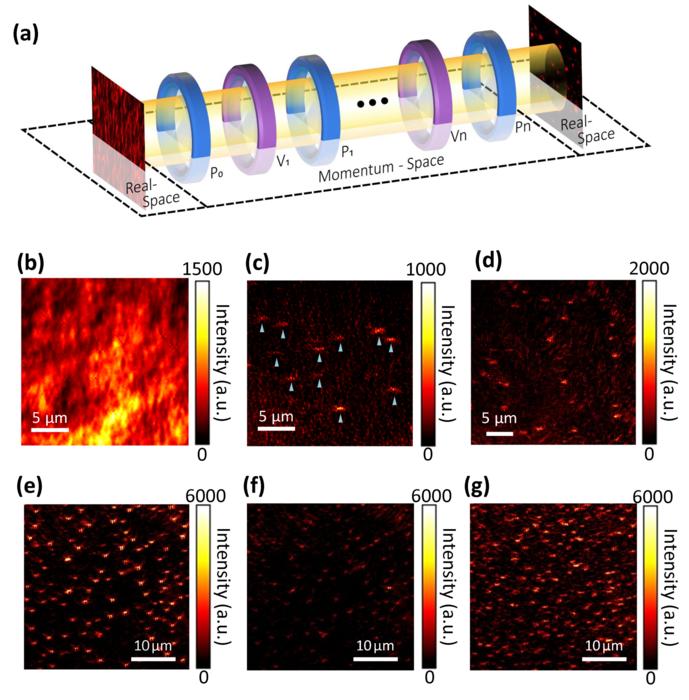
A research team led by Prof. ZHANG Dongguo from the University of Science and Technology of China (USTC) of the Chinese Academy of Sciences (CAS) developed an optical module consists of cascaded momentum-space polarization filters based on vector light field modulation. It can efficiently suppress background noise and capture high signal-to-noise ratio (SNR) optical microscopy images of individual nano-objects. This study was published in Proceedings of the National Academy of Sciences.

Credit: Image by Prof. ZHANG’s team
A research team led by Prof. ZHANG Dongguo from the University of Science and Technology of China (USTC) of the Chinese Academy of Sciences (CAS) developed an optical module consists of cascaded momentum-space polarization filters based on vector light field modulation. It can efficiently suppress background noise and capture high signal-to-noise ratio (SNR) optical microscopy images of individual nano-objects. This study was published in Proceedings of the National Academy of Sciences.
Precise imaging of the evolution and motion behavior of individual nano-objects, such as ultrafine atmospheric particles, is crucial for understanding their properties and functionalities. Label-free optical microscopy has been widely used in imaging and sensing of nanoparticles due to its unique non-destructive, non-invasive and fast detection characteristics.
However, for individual nanoparticles in air, their light scattering intensity decreases sharply with their particle size to the sixth power. As a result, the scattered light intensity is much weaker than the background noise, making it challenging for conventional label-free optical microscopes to achieve high SNR imaging of individual nanoparticles.
To tackle this problem, Prof. ZHANG’ team designed a momentum-space polarization filter, which can be used to modulate the vector field polarization. Only scattering light from single nano-objects can pass through the filter and be captured by the detector, while various background noise is substantially filtered and suppressed, therefore achieving high contrast, high SNR imaging of nano-objects.
To demonstrate the filter’s application, it was installed at the exit end of a total internal reflection microscopy (TIRM). After installing the filter, TIRM was converted into a black-field microscopy, which has lower (blacker) background noise and higher detection sensitivity compared to conventional label-free black-field microscopy. The black-field microscopy can capture high SNR and high contrast optical microscopy images of single protein molecules, gold nanoparticles and perovskite nanocrystals in real-time.
Furthermore, by successively introducing HCl and HI vapor, single perovskite nanocrystals undergo anion-exchange reactions, which cause changes in the morphology and refractive index of the nanocrystals, resulting in variations in the scattered light signals of the individual nanocrystals. The black-field microscopy can record this process in real time, providing a new photonic technology for the real-time detection of the physical and chemical reactions occurring during the evolution of properties in individual nano-objects.
The standout feature of the momentum-space polarization filter device is its ability to provide conventional label-free optical microscopy, such as surface plasmon resonance microscopy (SPRM), TIRM, and other near-field optical microscopy, with black-field imaging capability without changing the internal structure of the microscopes, thus significantly enhancing their sensitivity in detecting single nano-objects.
The team developed a black-field microscopy that provides a new platform for the analysis of individual nanoparticles, which have promising application prospects in biology, physics, environmental science and materials science.
Journal
Proceedings of the National Academy of Sciences
Article Title
Cascaded momentum-space polarization filters enabled label-free black-field microscopy for single nanoparticles analysis
Article Publication Date
18-Mar-2024
Cite Scienmag News
Grant Pearson. (June 3, 2024). New momentum-space polarization filters enables high sensitivity nano imaging. Scienmag. https://scienmag.com/new-momentum-space-polarization-filters-enables-high-sensitivity-nano-imaging/
Grant Pearson. "New momentum-space polarization filters enables high sensitivity nano imaging." Scienmag, 3 June 2024, https://scienmag.com/new-momentum-space-polarization-filters-enables-high-sensitivity-nano-imaging/. Accessed 5 September 2026.
Grant Pearson. "New momentum-space polarization filters enables high sensitivity nano imaging." Scienmag. June 3, 2024. https://scienmag.com/new-momentum-space-polarization-filters-enables-high-sensitivity-nano-imaging/

