


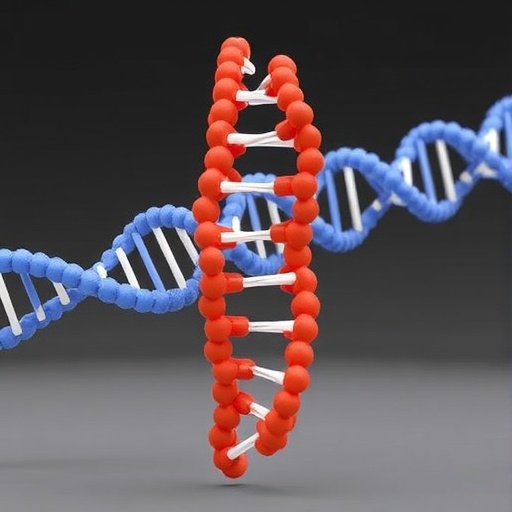
In the intricate ballet of cellular division, the faithful duplication of a cell’s inner contents, especially its prized genetic material, is paramount. The process of mitosis demands a remarkable transformation in the structure of chromosomes — the DNA packaged into compact, manageable forms. This shift from a symmetrical “ball” shape into a cylindrical form facilitates the precise distribution of chromosomes into daughter cells. Rice University Professor Peter Wolynes and his team have delved deeply into this morphological metamorphosis, uncovering critical mechanistic insights by revisiting the roles played by molecular motors during chromosome replication.
Chromosomes are not static structures; during the cell’s life cycle, they predominantly exist as tangled balls of DNA, festooned with microscopic loops that resemble yarn unwound just enough for a curious cat’s playful paws. These loops are not mere structural quirks but functional sites that interact dynamically with protein machines capable of exerting mechanical forces. Wolynes and colleagues proposed that two distinct classes of motor proteins tug on these loops, applying directional forces that sequentially reshape the chromosome from a rounded ball into an elongated cylinder optimized for segregation during mitosis.
This recent work builds upon their earlier findings by adding nuance to the motor activity: the researchers distinguish between “processive” and “nonprocessive” motor proteins based on how persistently these proteins pull on the DNA loops. The processive motors anchor themselves for extended durations and continuously reel in the DNA, while the nonprocessive ones give short, intermittent tugs before detaching and starting anew at different sites. This fine-tuned interplay between motors with differing behaviors is central to breaking the chromosome’s initial spherical symmetry.
Through sophisticated computational modeling, the team demonstrated that when the nonprocessive motors act in tandem with processive ones, their simulated chromosome shapes closely mirror those observed experimentally. The processive motor’s prolonged anchoring creates localized asymmetries—critical “hot spots” that initiate the global deformation of the chromosome architecture. Thus, symmetry breaking emerges not from a uniform force but through spatially and temporally differentiated motor activities.
Zhiyu Cao, a postdoctoral researcher and primary author of the study, elaborated on this phenomenon, emphasizing that local symmetry-breaking forces propagate to shape the overall chromosome. Analogous to a cat’s claws working differently on a yarn ball, the processive motors act like front claws gripping and pulling persistently, whereas the nonprocessive motors, akin to back claws, make quick pinches and release operations at different points. Over time, this dynamic tension field transforms the chromosome’s structure, a concept that intertwines molecular biology with principles of physics.
An intriguing consequence the team uncovered relates to the “chromosomal jet” phenomenon—a distinct structural pattern previously observed but poorly understood. When motor binding affinities vary along the chromosome—particularly where active DNA regions border inactive domains—the processive motors concentrate preferentially on active regions. This uneven distribution exacerbates local asymmetries, generating the jet-like architectural features in the chromosome’s cylindrical form, thus offering a mechanistic explanation grounded in motor dynamics.
Importantly, the nature of the cylindrical chromosome’s internal organization is also markedly impacted by motor processivity. When both motors are nonprocessive, the chromosome adopts a soft crystalline lattice, with subunits periodically aligned but relatively flexible. In contrast, a mix of processive and nonprocessive motors leads to a smectic liquid crystalline structure reminiscent of layer-like soap films. This looser, layered arrangement might imbue chromosomes with enhanced pliability, facilitating their manipulation and transport within the mitotic apparatus.
Wolynes points out the broader biological significance of this structural transition: the broken spherical symmetry and resulting cylindrical form appear specific to eukaryotic chromosomes, such as those in human cells. Bacterial chromosomes, which lack similar packaging complexities, do not exhibit the same requirement for symmetry breaking or intricate motor-driven remodeling. This raises fundamental questions about the evolutionary pressures shaping chromosome architecture in diverse life forms.
Beyond cell biology, the study touches on deep theoretical concepts, such as broken symmetry—a cornerstone topic linking cellular biophysics with physical laws governing systems from condensed matter to cosmology. Unraveling the molecular underpinnings of symmetry breaking in chromosomes promises not only advances in genetics and molecular biology but also fresh perspectives for physics and systems theory.
This multidisciplinary investigation marries experimental data with computational simulations, providing a predictive framework for future studies. By pinpointing how differential motor activities translate into large-scale chromosome structural changes, the study lays a foundation for devising novel experiments aimed at manipulating chromosome behavior, with potential ramifications in genetics, cancer biology, and regenerative medicine.
The work was supported by the Bullard-Welch Chair at Rice University and funding from the National Science Foundation, reflecting notable institutional commitment to elucidating the mysteries of chromosome dynamics. As molecular motors continue to unfold their secrets, the boundary between physics and biology blurs, illuminating the elegant mechanisms that enable life’s most fundamental process: copying itself with breathtaking precision.
- DOI:10.1073/pnas.2609796123
- Peter Wolynes profile, Rice University
References: - Wolynes et al., Proceedings of the National Academy of Sciences, 2026
- Previous related study: Nature Communications (DOI:10.1038/s41467-025-66025-y)
Image Credits: Not provided
Keywords
DNA replication, Chromosome dynamics, Molecular motors, Processive motor proteins, Nonprocessive motor proteins, Symmetry breaking, Mitotic chromosome structure, Loop extrusion, Liquid crystals, Theoretical biophysics
Cite Scienmag News
Bethany Barker. (May 28, 2026). New Model Reveals DNA Packaging Dynamics During Replication. Scienmag. https://scienmag.com/new-model-reveals-dna-packaging-dynamics-during-replication/
Bethany Barker. "New Model Reveals DNA Packaging Dynamics During Replication." Scienmag, 28 May 2026, https://scienmag.com/new-model-reveals-dna-packaging-dynamics-during-replication/. Accessed 3 September 2026.
Bethany Barker. "New Model Reveals DNA Packaging Dynamics During Replication." Scienmag. May 28, 2026. https://scienmag.com/new-model-reveals-dna-packaging-dynamics-during-replication/


