


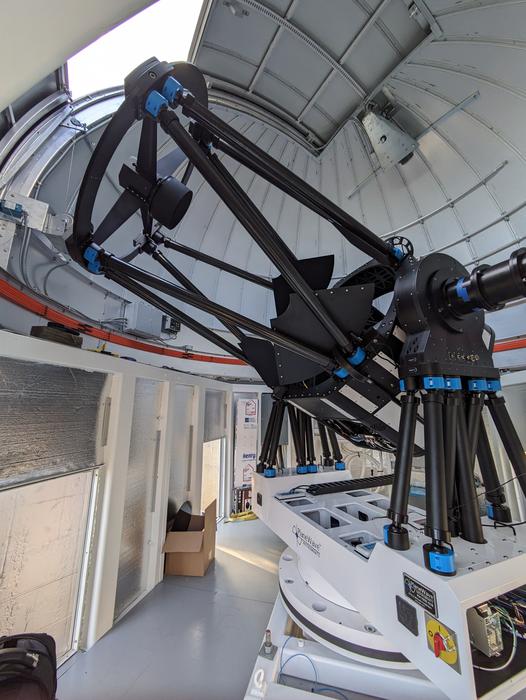
ATLANTA — Scientists from around the world will have new opportunities to study the stars thanks to a newly installed mobile telescope at Georgia State’s Center for High Angular Resolution Astronomy, known as the CHARA Array.

Credit: Georgia State University
ATLANTA — Scientists from around the world will have new opportunities to study the stars thanks to a newly installed mobile telescope at Georgia State’s Center for High Angular Resolution Astronomy, known as the CHARA Array.
The new — and seventh — telescope is mounted on a trailer that can be moved between locations near the other telescopes with fixed locations.
Douglas Gies, director of the CHARA Array and Regents’ Professor of Physics and Astronomy, said the new addition will allow astronomers to obtain better images of stars both large and small.
“The astronomers who come to the CHARA Array always ask about extending its abilities in new ways for scientific investigations,” Gies said. “There are several dozen red supergiant stars that are actually too large for CHARA to measure, and there are thousands of distant stars of great interest that are too small to see.
“The new telescope will help us to see these remarkable stars by moving between a location close to existing telescopes for images of big stars, and a far southern location for measurements of small stars. The new largest baseline, or telescope separation, will increase from 330 meters to 550 meters at the southern site. Thus, the CHARA Array is now beating its own world’s largest record through this expansion.”
The CHARA Array is positioned atop Mount Wilson in California, and acts as a single, massive telescope. This means that even with extremely tiny angular dimensions, astronomers can measure the sizes of individual stars and the separations of stars in pairs.
The new telescope will work with the existing CHARA telescopes by relaying star light through fiber optic cables. The CHARA Array staff are working with scientists at the University of Limoges in France in the design and control of the fiber optics.
The CHARA Array is one of the most potent instruments in the world for studying stars and stellar systems at resolutions never before possible, since it offers the best resolution of any telescope at visible and near-infrared wavelengths.
Part of future expansion of the array includes a plan to connect other new telescopes using fiber optics to transport the starlight to the central beam-combining laboratory. The project with the new mobile telescope is named the CHARA Michelson Array Pathfinder (CMAP), as it is establishing how fiber optics will enable a much larger interferometric array in the future.
“The CHARA Array is making exciting strides to the benefit of scientists conducting important research from around the world,” said Donald Hamelberg, interim vice president for Research and Economic Development at Georgia State. “We’re excited to see this expansion to this one-of-a-kind research center that inspires knowledge about our world and the cosmos.”
Gies said the project is being led by CHARA staff member Robert Ligon, who is an expert in optics and interferometry, with a team that has designed and led every aspect of the new telescope and its equipment.
“There are many new discoveries on the horizon that will be made with the newly enlarged CHARA Array, and observations should begin before the end of the year,” Gies said.
Scientists from around the world have the opportunity to use the facilities at the CHARA Array to conduct astronomy and physics research through an application system.
The CHARA Array is supported by funding from the National Science Foundation and Georgia State University through the College of Arts and Sciences and the Office of the Vice President for Research and Economic Development. For more information about Georgia State University research and its impact, visit research.gsu.edu.
Cite Scienmag News
Grant Pearson. (April 9, 2024). New mobile telescope installed at Georgia State’s CHARA Array. Scienmag. https://scienmag.com/new-mobile-telescope-installed-at-georgia-states-chara-array/
Grant Pearson. "New mobile telescope installed at Georgia State’s CHARA Array." Scienmag, 9 April 2024, https://scienmag.com/new-mobile-telescope-installed-at-georgia-states-chara-array/. Accessed 3 September 2026.
Grant Pearson. "New mobile telescope installed at Georgia State’s CHARA Array." Scienmag. April 9, 2024. https://scienmag.com/new-mobile-telescope-installed-at-georgia-states-chara-array/

