


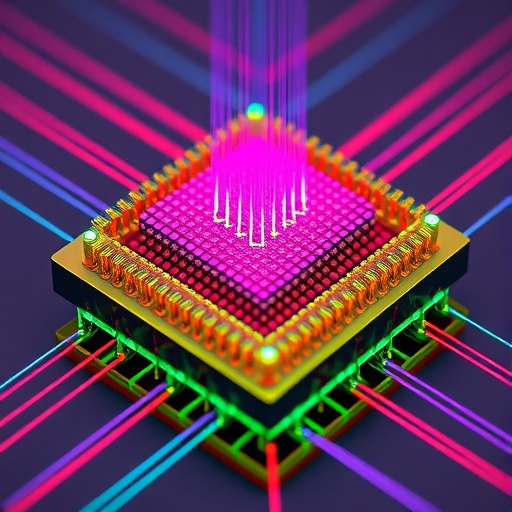
In a groundbreaking advancement for optical technologies, researchers have unveiled an integrated photonic device capable of both synthesizing and analyzing light polarization. This innovation, detailed in a recent publication in Light: Science & Applications, promises to revolutionize fields ranging from telecommunications to quantum computing by enabling precise polarization control on a chip-scale platform.
Polarization—the orientation of light’s electric field—is a fundamental property exploited in numerous applications, including data transmission, sensing, and imaging. Traditionally, controlling and measuring polarization has relied on bulky, discrete optical components, limiting integration and miniaturization. The newly developed device overcomes these challenges by leveraging integrated photonics, where light manipulation occurs within compact waveguide circuits etched onto semiconductor chips.
At the heart of this technology lies a sophisticated interference architecture, which synthesizes any desired state of polarization from multiple input signals. By engineering the optical paths and phase relationships within the chip, the system can dynamically produce complex polarization states with high precision. This capability is complemented by an embedded analyzer capable of decomposing incoming light into its constituent polarization components and assessing their strengths, all within the same integrated framework.
Such dual functionality on a single photonic chip marks a significant leap forward. By consolidating the roles of polarization synthesis and analysis, the device drastically reduces footprint and power consumption compared to conventional setups. Moreover, its compatibility with established semiconductor fabrication processes paves the way for scalable production and integration into existing photonic circuits.
The implications extend beyond traditional optics. In quantum information science, for instance, controlling photon polarization states is essential for encoding and manipulating quantum bits. This integrated solution could enable more robust and compact quantum devices. Similarly, in optical communications, dynamically tunable polarization states can enhance channel capacity and security through multiplexing and polarization-based encryption.
Another remarkable aspect of the device is its potential for high-speed operation. Integrated photonic platforms are inherently faster than mechanical or bulk-optical manipulation methods, facilitating rapid polarization switching and real-time analysis. This opens new possibilities for adaptive optical systems that respond swiftly to environmental changes or signal variations.
While the prototype demonstrates impressive performance, further refinements in design and materials may unlock even greater capabilities. For instance, integrating active components like modulators or detectors on the same chip could yield fully autonomous polarization management units. Additionally, exploring different wavelength regimes may broaden the device’s applicability to infrared and visible light applications.
This research exemplifies the transformative power of integrated photonics in reshaping how light is controlled and utilized. By embedding complex polarization functions into a compact, scalable platform, these scientists have laid the groundwork for a new generation of optical technologies that are faster, smaller, and more efficient.
As this technology matures, it is poised to impact diverse sectors, from enhancing fiber-optic networks to advancing precision metrology and beyond—heralding a future where the full manipulation of light’s polarization state is as accessible as the light itself.
Cite Scienmag News
Katie Riggs. (July 10, 2026). New Integrated Device Synthesizes and Analyzes Photonic Polarization. Scienmag. https://scienmag.com/new-integrated-device-synthesizes-and-analyzes-photonic-polarization/
Katie Riggs. "New Integrated Device Synthesizes and Analyzes Photonic Polarization." Scienmag, 10 July 2026, https://scienmag.com/new-integrated-device-synthesizes-and-analyzes-photonic-polarization/. Accessed 3 September 2026.
Katie Riggs. "New Integrated Device Synthesizes and Analyzes Photonic Polarization." Scienmag. July 10, 2026. https://scienmag.com/new-integrated-device-synthesizes-and-analyzes-photonic-polarization/


