


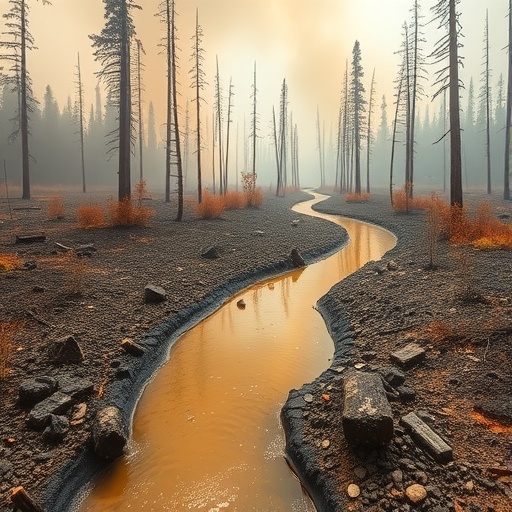
Wildfires are increasingly being recognized not only as threats to forests, homes and public health, but also as potential triggers for long-lasting contamination of drinking-water supplies. A new scoping review in PLOS Water suggests that arsenic concentrations in water resources frequently rise after wildfires, particularly when fires pass through areas shaped by mining, agriculture or urban development. The review, titled “Wildfire mobilization of arsenic into water resources: A scoping review of current literature,” examined existing scientific evidence on how fire can transform arsenic stored in soils, rocks, infrastructure and human-modified landscapes into a mobile pollutant capable of reaching streams, reservoirs and groundwater.
Arsenic is a naturally occurring element, but its presence in the environment is often intensified by human activity. Mining can expose arsenic-bearing minerals, agricultural chemicals may leave residues in soil, and older industrial or urban materials can contain arsenic compounds. Under normal conditions, much of this arsenic may remain attached to soil particles or locked within mineral structures. Wildfire can alter that balance through extreme heating, the combustion of organic matter and the destruction of vegetation that normally stabilizes soil. Once the protective plant cover is gone, rainfall can rapidly transport ash, sediment and dissolved contaminants into waterways.
The review’s central concern is arsenic mobilization: the process by which arsenic shifts from relatively immobile forms into dissolved or particle-bound forms that can travel through the water cycle. Fire can change soil chemistry by removing carbon-rich material, modifying mineral surfaces and producing ash with a different pH and chemical composition from the original soil. These changes may affect how strongly arsenic binds to iron and aluminum minerals. When those minerals are altered, dissolved arsenic can be released into runoff. The result is a potentially complex mixture in which arsenic moves both as a dissolved chemical species and attached to eroded particles washed downstream during storms.
The evidence summarized by the researchers indicates that post-wildfire arsenic concentrations can exceed pre-fire levels, although the size and duration of the increase vary widely between locations. The strongest concerns appear in landscapes where fire overlaps with historical mining, intensive agriculture or dense urban development, because these environments may already contain elevated arsenic inventories. In such settings, a wildfire does not necessarily create arsenic from nothing. Instead, it can act as a disturbance that unlocks contaminants accumulated over decades or centuries and transfers them into drinking-water sources at a time when communities may already be struggling with damaged infrastructure and disrupted water treatment.
A forest plot included with the review compares arsenic concentrations measured before and after wildfire in studies that reported suitable data. The figure displays pre-fire values in blue and post-fire values in orange, along with the reported percentage changes. Most points represent maximum concentrations, while two studies report means. The comparison is intended to show the direction and scale of change rather than establish a single universal wildfire effect. Some measurements were below individual studies’ detection limits, and these are marked with an “X.” This distinction is scientifically important because a result below detection does not prove that arsenic was absent; it means only that its concentration could not be reliably quantified using the method and reporting threshold applied.
The review also places the findings in the context of drinking-water regulation. The U.S. Environmental Protection Agency’s drinking-water limit for arsenic is 10 micrograms per liter, equivalent to 0.010 milligrams per liter. Although that threshold is small, arsenic exposure is a major public-health concern because long-term intake has been associated with increased risks of cancer and other chronic effects. Arsenic can occur in different chemical forms, and its toxicity, mobility and treatment requirements depend on factors including oxidation state, pH, dissolved organic matter and the presence of competing ions. A water source that appears clear after a fire may therefore still require laboratory testing before it can be considered safe.
Wildfire-related contamination can also challenge conventional water-management systems. Intense rain following a fire may produce sudden pulses of ash and sediment, creating short-lived but extreme contaminant loads. Treatment plants designed for ordinary seasonal variation may face rapidly changing water chemistry, clogged filters or increased demand for coagulants and other treatment chemicals. In addition, arsenic does not always behave like visible sediment. Some of it may remain dissolved and pass through processes designed mainly to remove particles. Effective treatment may require oxidation followed by adsorption or co-precipitation, often using iron-based media, as well as continuous monitoring of source-water chemistry.
The authors’ scoping approach highlights both what is known and what remains uncertain. Studies differ in their sampling locations, analytical methods, timing and definitions of “post-fire” conditions. One investigation may collect water days after a burn, while another may sample months or years later. Fire severity, rainfall intensity, soil type, watershed geology and the history of land use can all influence the outcome. These differences make direct comparisons difficult and prevent researchers from predicting a single standard arsenic increase after every wildfire. The review therefore points to the need for harmonized sampling protocols, longer-term monitoring and studies that track arsenic through connected soil, sediment, surface-water and groundwater systems.
The findings carry an urgent message for communities living downstream of burned watersheds. Water utilities and emergency planners may need to treat wildfire as a potential drinking-water contamination event, not simply a vegetation or erosion problem. Pre-fire testing can establish baseline arsenic concentrations, while rapid sampling after a fire can identify changes before contaminated water reaches treatment facilities or household taps. Protecting reservoirs, restricting the use of ash-impacted water and providing clear public guidance may reduce exposure during the most vulnerable period. Because wildfire seasons are expanding in many regions and extreme rainfall can follow severe burns, understanding the chemical aftermath of fire is becoming a critical part of climate and public-health preparedness.
The review does not suggest that every wildfire will contaminate drinking water with dangerous levels of arsenic. Instead, it shows that the risk is plausible, documented and especially important where burned landscapes contain natural or human-generated arsenic sources. By bringing together scattered studies, the researchers argue that wildfire response should include chemical surveillance alongside smoke forecasting, evacuation planning and erosion control. The most effective warning may come before the flames arrive: mapping arsenic-rich geology, abandoned mines, agricultural soils and vulnerable water supplies could help authorities identify communities at greatest risk. As fire reshapes watersheds, the question is no longer only what burns, but what pollution the burning can set in motion.
News Publication Date: 19-Aug-2026
Web References: https://doi.org/10.1371/journal.pwat.0000549
References: Willeford et al., 2026, PLOS Water, DOI: 10.1371/journal.pwat.0000549
Keywords
Wildfires, arsenic, drinking water, water contamination, wildfire pollution, environmental health, water resources, mining, agriculture, urbanization, climate risk, PLOS Water
Cite Scienmag News
Denise Maddox. (August 20, 2026). Scoping review suggests wildfires often leave drinking water contaminated with arsenic. Scienmag. https://scienmag.com/scoping-review-suggests-wildfires-often-leave-drinking-water-contaminated-with-arsenic/
Denise Maddox. "Scoping review suggests wildfires often leave drinking water contaminated with arsenic." Scienmag, 20 August 2026, https://scienmag.com/scoping-review-suggests-wildfires-often-leave-drinking-water-contaminated-with-arsenic/. Accessed 5 September 2026.
Denise Maddox. "Scoping review suggests wildfires often leave drinking water contaminated with arsenic." Scienmag. August 20, 2026. https://scienmag.com/scoping-review-suggests-wildfires-often-leave-drinking-water-contaminated-with-arsenic/


