


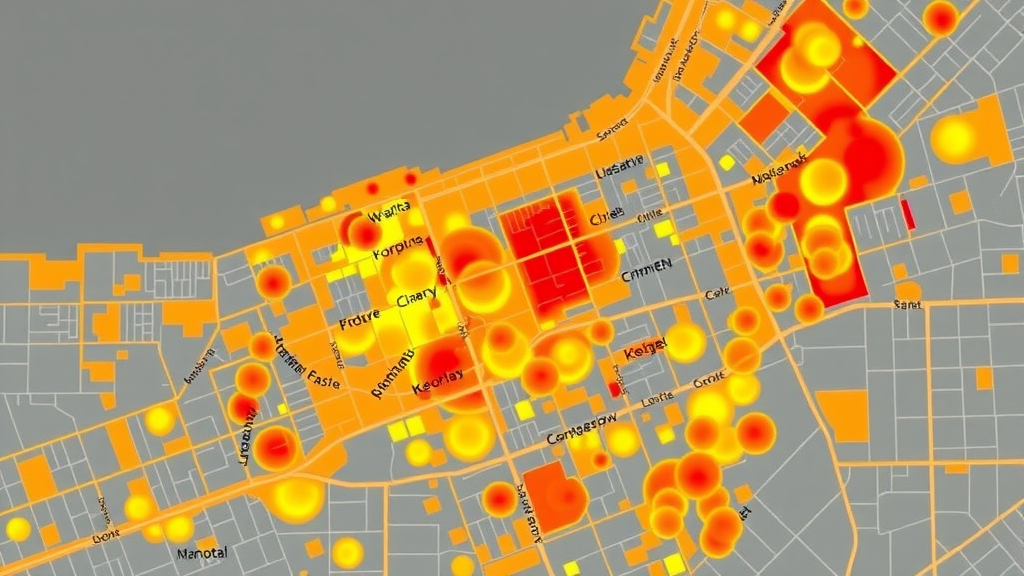
Heat stress quietly kills more people each year than nearly any other weather hazard, and in cities the danger is amplified by a phenomenon that most residents never see: the urban heat island, a manmade pocket of elevated temperatures created when concrete, asphalt and brick absorb sunlight by day and release it slowly by night. Now scientists at the U.S. National Science Foundation National Center for Atmospheric Research, working with colleagues at Emory University and the University of North Carolina at Chapel Hill, have unveiled a dataset designed to capture not just how hot a city gets, but how its residents actually experience that heat. The product, called the High-resolution Urban Meteorology for Impacts Dataset for Atlanta Metropolitan Region, or HUMID-Atlanta, is described in the journal Scientific Data and is already being used by health researchers to trace the fingerprints of extreme heat on human disease.
The central insight behind the project is deceptively simple: temperature alone is a poor measure of human heat exposure. Whether an afternoon feels oppressive or merely warm depends on wind, humidity, shade and radiation, all of which are shaped by the fine-grained structure of a city. A pedestrian walking between tall buildings may be shielded from the sun but also deprived of cooling breezes, while someone in a leafy suburb faces a different microclimate entirely. Tzu-Shun Lin, an NSF NCAR scientist and lead author of the new paper, said the dataset is a useful tool for quantifying how human beings experience heat in an urban environment and how factors like wind or humidity influence the impacts. He described HUMID-Atlanta as the first dataset of its kind and noted that the team is already talking with other major cities and exploring a version covering the entire conterminous United States.
To appreciate why the new dataset matters, it helps to understand its lineage. Lin and his colleagues began with an earlier NSF NCAR product, the original HUMID dataset, which was built by combining a relatively simple offline urban model with long-term measurements of temperature and humidity spanning 1980 to 2018. That dataset marked an important research advancement, giving climatologists and epidemiologists a consistent record of urban heat conditions over nearly four decades. But it had a fundamental limitation: it treated the city essentially as a static surface, without simulating how the living, breathing atmosphere interacts with buildings, streets and vegetation. It could not capture, for example, how a canyon of high-rise towers channels wind around corners and alters the rate at which sweat evaporates from human skin.
The breakthrough came from coupling the original HUMID framework with NSF NCAR’s Weather Research and Forecasting model, a widely used numerical weather prediction system known simply as WRF. By piloting the method on the Atlanta metropolitan area and drawing on the WRF-Urban extension, the team fed detailed urban characteristics, including building height, directly into the atmospheric simulation. This allows HUMID-Atlanta to resolve interactions that simpler datasets miss, such as how wind moves around buildings and influences cooling, a factor that can change how humans are affected by heat. The result is a high-resolution picture of the urban atmosphere that reflects the true physics of heat stress rather than a thermometer reading alone.
The enhanced dataset covers the years 2010 through 2023, a window deliberately chosen to overlap with modern health and administrative records. That overlap is the key to its practical value. Researchers can cross-reference hospitalization records, emergency department visits and other public health data against detailed heat data from the same time period, searching for the specific combinations of weather and urban infrastructure that precede spikes in heat stress. Because heat-related illness often results from an accumulation of factors, including consecutive hot nights, high humidity and limited access to shade or air conditioning, identifying the precise mixture of conditions that drives harm is a problem tailor-made for a dataset of this resolution.
The implications for city planning are substantial. Once researchers can identify when and where dangerous conditions are most likely to occur, governments gain the evidence base needed for targeted interventions, from cooling centers and tree-planting programs to building codes that promote ventilation and reflective surfaces. Lin and his NSF NCAR colleagues are continuing to refine the method and have already extended HUMID-Atlanta through the year 2025, and the dataset is publicly available to any researcher or agency that wants to use it. Plans are underway to apply the approach to other large cities, to the entire United States, and possibly even globally. Lin believes the method could eventually be developed to forecast future meteorological changes, positioning it as a potential backbone for early warning systems that trigger extreme heat action days before the most dangerous conditions arrive.
The most immediate application, however, is in human health. Andrew Newman, an NSF NCAR senior scientist and co-author of the paper, is working with colleagues at Emory University to use the dataset to better understand how heat waves influence human diseases, with a particular focus on acute kidney injury, a condition in which kidney function declines rapidly. The connection between heat and kidney damage is well established in occupational medicine, where agricultural workers exposed to high temperatures have shown elevated rates of renal disease, but earlier studies linking kidney disease to heat exposure failed to capture the crucial differences in how people experience heat depending on whether they live in dense city centers, surrounding suburbs, or rural areas. HUMID-Atlanta is helping researchers narrow in on exactly where the risks are highest and what can be done to mitigate harm.
Newman emphasized that the stakes extend beyond individual suffering. Acute kidney injury is a serious health concern in its own right, he noted, but the economic burden of treating patients who develop it is also substantial, straining hospitals, dialysis capacity and public health budgets. In his view, HUMID-Atlanta and subsequent versions of the dataset have the ability to fill major gaps in heat health research. The work will ultimately support targeted outreach and education activities, guide improvements in clinical case management, and provide inputs for risk assessment and economic evaluation of heat-health impacts. In other words, a meteorological dataset built on atmospheric physics may end up influencing how doctors manage patients and how health departments allocate resources during the hottest weeks of the year.
The research was funded by a grant from the National Institute of Diabetes and Digestive and Kidney Diseases, an assignment that reflects the project’s dual identity as both atmospheric science and public health research. That fusion is arguably what makes HUMID-Atlanta a template for the future. Cities are where most of humanity now lives, and they are warming faster than their surroundings because of the very materials used to build them. As climate change raises baseline temperatures, the difference between a survivable summer and a deadly one may hinge on precise, street-by-street knowledge of how heat behaves. A dataset that can quantify the lived experience of urban heat, from wind-flow shadows between towers to humidity trapped over parking lots, gives scientists, clinicians and city officials a shared language for a hazard that has long been underestimated, and it offers a glimpse of how next-generation climate data could power everything from emergency alerts to neighborhood-scale urban design.
Subject of Research: A high-resolution urban meteorology dataset for studying heat stress and human health in cities
Article Title: Hot new dataset focuses on human health
Article References: Hot new dataset focuses on human health. (n.d.). Original publication
Image Credits: AI Generated
DOI: Not provided
Keywords: urban heat island, heat stress, HUMID-Atlanta, NSF NCAR, WRF model, Atlanta, acute kidney injury, public health, Scientific Data, extreme heat, urban meteorology, heat-health research
Cite Scienmag News
Russell Cooper. (September 20, 2026). New High-Resolution Heat Dataset Maps How City Residents Actually Feel Extreme Heat. Scienmag. https://scienmag.com/new-high-resolution-heat-dataset-maps-how-city-residents-actually-feel-extreme-heat/
Russell Cooper. "New High-Resolution Heat Dataset Maps How City Residents Actually Feel Extreme Heat." Scienmag, 20 September 2026, https://scienmag.com/new-high-resolution-heat-dataset-maps-how-city-residents-actually-feel-extreme-heat/. Accessed 4 October 2026.
Russell Cooper. "New High-Resolution Heat Dataset Maps How City Residents Actually Feel Extreme Heat." Scienmag. September 20, 2026. https://scienmag.com/new-high-resolution-heat-dataset-maps-how-city-residents-actually-feel-extreme-heat/


