

FAYETTEVILLE, Ark. — Two “new” herbicide options could soon be available for blackberry growers during the 2025 growing season.

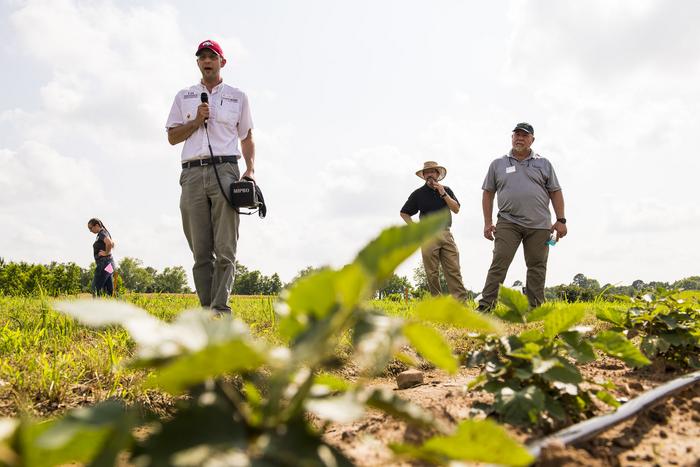
Credit: (UA System Division of Agriculture photo by Fred Miller)
FAYETTEVILLE, Ark. — Two “new” herbicide options could soon be available for blackberry growers during the 2025 growing season.
Recent research by weed scientist Matt Bertucci, assistant professor of horticulture for the Arkansas Agricultural Experiment Station, shows that the herbicides 2,4-D choline and glufosinate are safe and effective in blackberry production. That research is now in the hands of the U.S. Department of Agriculture and the U.S. Environmental Protection Agency awaiting final approval before recommendations can be released to growers.
While these herbicides are not new to agriculture, their use in blackberry cultivation is a novel approach.
“We’re excited about these results because they offer growers new tools for better weed control,” said Bertucci, who discussed this research in an episode of the Food, Farms and Forests podcast. Food, Farms and Forests is produced by the experiment station, the research arm of the University of Arkansas System Division of Agriculture.
Blackberry growers face some challenges in weed control due to the crop’s sensitivity to many commonly used herbicides. Additionally, the financial incentives for developing new herbicides specifically for blackberries are low compared to major row crops. This is where the USDA’s IR-4 Project comes into play, supporting the registration of pesticides for specialty crops like blackberries and ensuring that smaller but economically valuable crops receive resources needed for continued research.
“This support is crucial because it helps growers without the chemical companies bearing the full cost and logistical challenges of registration,” Bertucci said.
The research team conducted trials over two years to evaluate the safety and effectiveness of 2,4-D choline and glufosinate on blackberries. These chemicals are commonly used in crops such as rice, corn and soybeans, but this was the first study to test them extensively in blackberry fields.
Bertucci and his team found that established blackberry plants showed minimal, temporary damage symptoms from 2,4-D choline, while glufosinate, when carefully applied, managed to control weeds without harming young blackberry plants.
2,4-D choline, a synthetic herbicide known for its broadleaf weed control, was tested on established blackberry plants. The trials involved applications before the plants broke dormancy, during active growth, and post-harvest. Results showed comparable yields and only minor, short-lived damage to the plants, indicating that 2,4-D choline can be a safe option for established blackberries, Bertucci said.
Glufosinate, a non-selective herbicide, was tested on newly planted blackberry plugs. The researchers used wax cartons to shield the young plants during herbicide application to avoid direct contact, which could harm the plants. While glufosinate did cause some minor leaf burning, it was restricted to the lower parts of the plants and did not affect overall plant health, Bertucci said. It also helped control new blackberry shoots, reducing the need for manual pruning, he added.
“Currently registered products for post-emergence application in blackberries only control grassy weeds,” Bertucci said. “2,4-D choline and glufosinate will give us some broader activity and let us go after a different set of species that really can cause fits for our growers.”
EPA approval pending
EPA approval is required before growers can legally use the herbicides on blackberries, Bertucci said. While the registration process can be lengthy, he remains hopeful that growers will be able to use these herbicides by the 2025 growing season.
“I’m very excited to do this type of work that growers are excited about implementing and using on their farms,” Bertucci said. “It’s very promising because I know that I have good news to deliver. I had a good discovery, and I’m just waiting to tell people, ‘Go forth and spray.’”
This research was supported by the IR-4 Project under the direction of principal biologist and weed scientist Roger Batts. Collaborators included Wayne Mitchem, Southern Region Small Fruit Consortium coordinator at North Carolina State University, and Marcelo Moretti, associate professor at Oregon State University. Moretti investigated the herbicides on raspberries.
To learn more about the Division of Agriculture research, visit the Arkansas Agricultural Experiment Station website. Follow on X at @ArkAgResearch. To learn more about the Division of Agriculture, visit uada.edu. Follow us on X at @AgInArk. To learn about extension programs in Arkansas, contact your local Cooperative Extension Service agent or visit uaex.uada.edu.
About the Division of Agriculture
The University of Arkansas System Division of Agriculture’s mission is to strengthen agriculture, communities, and families by connecting trusted research to the adoption of best practices. Through the Agricultural Experiment Station and the Cooperative Extension Service, the Division of Agriculture conducts research and extension work within the nation’s historic land grant education system.
The Division of Agriculture is one of 20 entities within the University of Arkansas System. It has offices in all 75 counties in Arkansas and faculty on five system campuses.
The University of Arkansas System Division of Agriculture offers all its Extension and Research programs and services without regard to race, color, sex, gender identity, sexual orientation, national origin, religion, age, disability, marital or veteran status, genetic information, or any other legally protected status, and is an Affirmative Action/Equal Opportunity Employer.

