


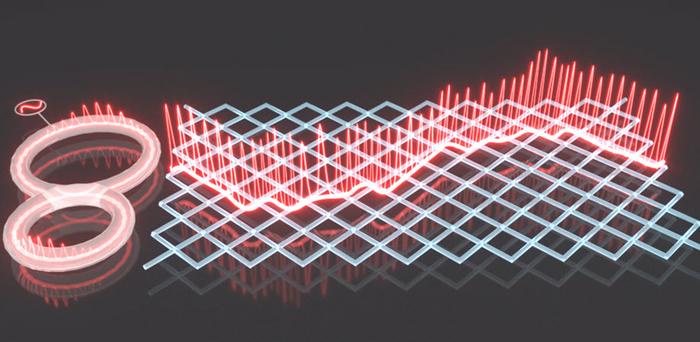
Full coherent control of wave transport and localization is a long-sought goal in wave physics research, which encompasses many different areas from solid-state to matter-wave physics and photonics. One among the most important and fascinating coherent transport effects is Bloch oscillation (BO), which refers to the periodic oscillatory motion of electrons in solids under a direct current (DC)-driving electric field. Super-Bloch oscillations (SBOs) are giant oscillatory motions achieved by applying simultaneously detuned DC- and AC-driving electrical fields. Considered amplified versions of BOs, SBOs receive less attention than ordinary BOs mainly because their experimental observations are more challenging and require a much longer particle coherence time.

Credit: Image courtesy of Xinyuan Hu (Huazhong University of Science and Technology).
Full coherent control of wave transport and localization is a long-sought goal in wave physics research, which encompasses many different areas from solid-state to matter-wave physics and photonics. One among the most important and fascinating coherent transport effects is Bloch oscillation (BO), which refers to the periodic oscillatory motion of electrons in solids under a direct current (DC)-driving electric field. Super-Bloch oscillations (SBOs) are giant oscillatory motions achieved by applying simultaneously detuned DC- and AC-driving electrical fields. Considered amplified versions of BOs, SBOs receive less attention than ordinary BOs mainly because their experimental observations are more challenging and require a much longer particle coherence time.
One unique feature of SBOs is the existence of coherent oscillation inhibition through an AC-driving renormalization effect, which manifests as the localization of an oscillation pattern with a vanishing oscillation amplitude. Dubbed the “collapse” of SBO, this interesting phenomenon typically occurs in the strong AC-driving regime, which hasn’t been reached in previous experiments of SBOs based on electronic and other systems. All present theoretical and experimental studies on SBOs have been limited to the simplest sinusoidal AC-driving cases, so the SBO collapse under more general AC-driving formats, and the ability to harness SBOs for flexible coherent wave manipulation, also remain unexplored.
In a recent study, researchers from Wuhan National Laboratory for Optoelectronics and School of Physics, Huazhong University of Science and Technology (HUST), and Polytechnic University of Milan set out to tackle these problems. As reported in Advanced Photonics, by combining both a DC-driving and a nearly detuned AC-driving electric field in the synthetic temporal lattice, the researchers successfully achieved SBOs up to the strong-driving regime. For the first time, they observed the SBO collapse effect and extended SBOs into arbitrary-wave driving situations.
With the flexible controllability from tailoring the synthetic DC and AC electric fields, the researchers observe the features of vanishing oscillation amplitude and flip of initial oscillation direction at specific driving amplitudes, showing the clear signatures of SBO collapse. For a sinusoidal AC-driving, they show that as the amplitude-to-frequency ratio of the AC-driving field takes the root of the first-order Bessel function, the SBO collapse occurs, manifesting as a complete inhibition of oscillation with a vanishing oscillation amplitude as well as the flip of the initial oscillation direction by crossing the collapse point.
The characteristic rapid swing features of SBOs and the collapse of SBOs have also been analyzed from the Fourier spectrum of oscillation patterns. By generalizing SBOs from the sinusoidal-driving to an arbitrary-wave driving format, the researchers also observed the generalized SBOs with tunable collapse conditions. Finally, the report exploits the oscillation direction flip feature to design tunable temporal beam routers and splitters.
According to corresponding author Stefano Longhi, professor at the Polytechnic Institute of Milan, “This work realizes periodic oscillations and transportation for optical pulses, which may also find wide applications in versatile temporal-beam control in light routing, splitting, and localization for next-generation optical communications and signal processing.”
For details, see the original Gold Open Access article by X. Hu et al., “Observing the collapse of super-Bloch oscillations in strong-driving photonic temporal lattices,” Adv. Photon. 4(6), 046001 (2024), doi 10.1117/1.AP.6.4.046001.
Journal
Advanced Photonics
Article Title
Observing the collapse of super-Bloch oscillations in strong-driving photonic temporal lattices
Article Publication Date
2-Aug-2024
Cite Scienmag News
Bethany Barker. (August 6, 2024). Strong driving to realize super-Bloch oscillations. Scienmag. https://scienmag.com/strong-driving-to-realize-super-bloch-oscillations/
Bethany Barker. "Strong driving to realize super-Bloch oscillations." Scienmag, 6 August 2024, https://scienmag.com/strong-driving-to-realize-super-bloch-oscillations/. Accessed 4 September 2026.
Bethany Barker. "Strong driving to realize super-Bloch oscillations." Scienmag. August 6, 2024. https://scienmag.com/strong-driving-to-realize-super-bloch-oscillations/

