


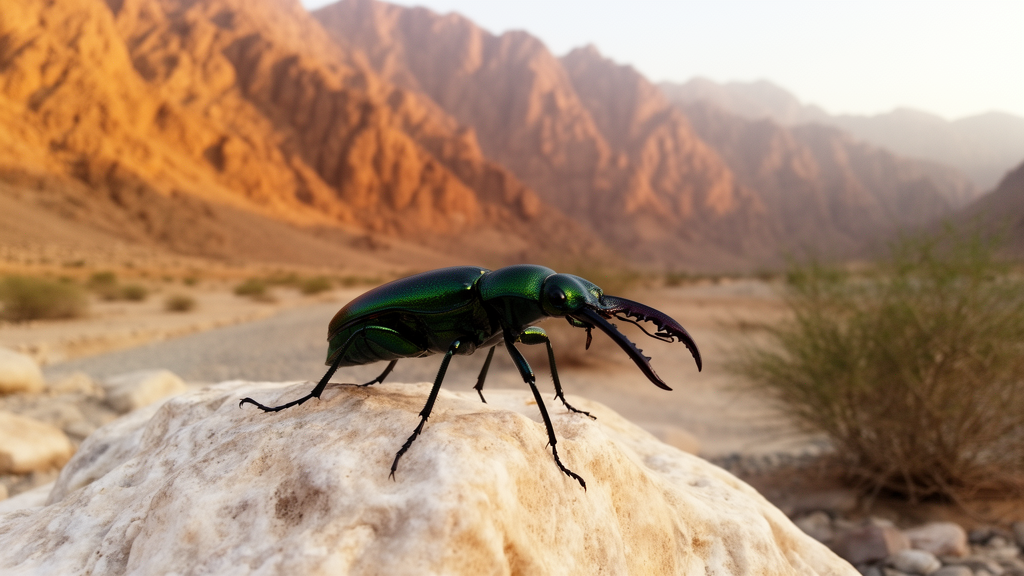
Deep in the western Hajar Mountains of Oman, on the north side of a ridge some 1,000 meters above sea level, a small light-brown beetle scurried across arid woodland floor after sunset in March 2024. That single female specimen, collected near the village of Balad Sayt, has now been formally described as Microdaccus birgitae, a brand-new species of lebiine ground beetle. The discovery, published in the Biodiversity Data Journal, not only adds an eleventh-plus-one species to a little-known genus of desert-adapted predators but also pushes the known geographic range of the entire genus southward into the Arabian Peninsula for the first time.
The new beetle was found by Thorsten Assmann and his wife Birgit Assmann, an enthusiastic amateur biologist and conservationist after whom the species is named. Working with Ali Abdullah Al-Jahdhami and Swantje Grabener, the team described the holotype, a female measuring just 5.15 millimeters from the tips of its mandibles to the apex of its elytra. Despite its small size, the insect carries a suite of diagnostic features that immediately set it apart from its relatives: a slender pronotum whose lateral margins barely widen toward the hind angles, strongly rounded elytra with a sinuously curved apex, and a small basal tooth on each mandible.
Under the microscope, the beetle reveals an architecture finely tuned to life in semi-arid terrain. Its entire upper surface is covered in strong isodiametric microsculpture that renders the animal opaque, an adaptation common among desert insects where matte surfaces may reduce reflectivity and aid camouflage against stony substrates. The head is remarkably small, less than half the width of the elytra, with protruding eyes that cover roughly half of the head’s width. The antennae are long, about 1.13 times the length of the elytra, and the legs are slender and elongated, consistent with an agile, fast-moving lifestyle on open ground.
The type locality sits within a vegetation community dominated by Euphorbia larica and Moringa peregrina, a mix of open xeromorphic woodlands and semi-evergreen shrubland characteristic of the arid to semi-arid submontane zone of northern Oman. When the holotype was captured, the ambient temperature was around 24 degrees Celsius and the beetle was extremely active after dark, suggesting a nocturnal foraging strategy. Intriguingly, several days of intensive searching in December 2024 and March 2025, including flight-interception traps fitted with UV light, failed to turn up a second specimen, leaving the species known from a single individual and its true abundance an open question.
The closest relative of the new species appears to be Microdaccus bushehricus, described from Iran in 2019. Both species share light brown coloration, evenly rounded elytra with rounded humeri, fine hairs on the underside of the onychium, and a triangular terminal labial palpomere. Yet the Omani beetle differs in several consistent details: its mandibles are less markedly bent, it carries three pre-apical setae on the elytra rather than a different configuration, its apical elytral margin is sinuate, and, most distinctively, the lateral sides of its pronotum are almost rectilinear in the basal half, whereas those of M. bushehricus are deeply sinuate. These characters, the authors argue, justify full species status.
Beyond describing the new species, the study delivers a significant taxonomic correction. The genus Psammodromius, erected by Peyerimhoff in 1927 for an Egyptian species, has long been treated as a separate genus closely allied to Microdaccius. The two taxa were distinguished almost exclusively by male genitalia: in Psammodromius, the median lobe of the aedeagus bears a long, flagellum-like copulatory piece unknown in Microdaccus. The authors argue that such genital differences should not be the sole basis for separating genera in ground beetles, noting that strong genital divergence occurs within many carabid genera and that genera founded mainly on genital characters have sometimes proven paraphyletic. Complicating matters, no male genitalia are available for the three most recently described Microdaccus species, including the female holotype of the new species, making formal assignment to either genus impossible. Accordingly, Psammodromius is now reclassified as a subgenus of Microdaccus, a change formally designated stat. nov.
To bring order to this restructured genus, the team examined material from major European collections, including the Natural History Museum Basel, the Natural History Museum in London, the Muséum national d’Histoire naturelle in Paris, the Steinhardt Museum in Tel Aviv, and the Natural History Museum in Vienna. From this survey they compiled an illustrated identification key covering all known species, distinguishing them by mandibular dentition, elytral coloration, pronotal shape, scutellum color, and the proportions of the copulatory pieces in the male genitalia. The key runs from the dark-winged M. opacus of Greece and western Turkey through the bicolored species of the Levant and Iran to the pale desert species of Egypt, Central Asia, and now Oman.
The taxonomic audit also resolved long-standing confusion in the eastern Mediterranean. Microdaccus assingi, split from M. opacus in 2009, appears to be the only representative of the genus on Cyprus, where specimens previously labeled as M. opacus were in fact the smaller species. The authors located the poorly preserved holotype of M. opacicolor in the Frey Collection in Basel and traced its type locality to what is now southern Turkey near the Syrian border. Several subspecies described under M. opacicolor show pronounced variation in pronotal shape, and the authors note that a final resolution, including possible synonymies, will require fresh material from the type localities to characterize intraspecific variability.
For the Arabian Peninsula, the discovery carries broader biogeographic weight. The genus was previously known from the southern Balkan Peninsula across Turkey and the Levant to Kazakhstan, Afghanistan, and Iran, so the Hajar Mountains record extends its range roughly a thousand kilometers south. The region’s beetle fauna has been increasingly recognized as a hotspot of endemism, shaped by the isolated mountain ranges that rise abruptly from the desert. The recognition of Microdaccus birgitae underscores how much of this fauna remains undocumented, particularly among small, cryptically colored ground beetles that rarely attract attention.
The study also highlights a practical tension in modern taxonomy: how to classify species when the anatomical structures traditionally used to define genera are missing from the very specimens that matter most. By downgrading Psammodromius to subgenus rank and relying instead on external morphology, the authors have produced a framework that can accommodate new discoveries even when only females or incomplete type series are available. Whether future finds in the Hajar Mountains, or in the intervening deserts between Oman and Iran, reveal populations bridging the two known rounded-elytrum species remains to be seen. For now, a single beetle from a mountain village in Oman stands as the southernmost sentinel of an ancient lineage of desert predators, and a reminder that even well-studied insect orders still yield surprises on a single night’s walk.
Subject of Research: Taxonomic description of a new ground beetle species and revision of the genus Microdaccus
Article Title: Microdaccus Schaum, 1864: a new species from Oman, taxonomic notes and an identification key to the species of the genus ( Coleoptera , Carabidae , Lebiinae )
Article References: Assmann, T., Abduallah Al-Jahdhami, A., & Grabener, S. (2026). Microdaccus Schaum, 1864: a new species from Oman, taxonomic notes and an identification key to the species of the genus (Coleoptera, Carabidae, Lebiinae). Biodiversity Data Journal, 14, Article e185048. https://doi.org/10.3897/bdj.14.e185048
Image Credits: AI Generated
Keywords: Microdaccus, ground beetles, Carabidae, Oman, Hajar Mountains, new species, taxonomy, Psammodromius, Arabian Peninsula, entomology, biodiversity, Lebiinae
Cite Scienmag News
Gavin Prescott. (October 18, 2026). New Ground Beetle Species Discovered in Oman’s Hajar Mountains. Scienmag. https://scienmag.com/new-ground-beetle-species-discovered-in-omans-hajar-mountains/
Gavin Prescott. "New Ground Beetle Species Discovered in Oman’s Hajar Mountains." Scienmag, 18 October 2026, https://scienmag.com/new-ground-beetle-species-discovered-in-omans-hajar-mountains/. Accessed 18 October 2026.
Gavin Prescott. "New Ground Beetle Species Discovered in Oman’s Hajar Mountains." Scienmag. October 18, 2026. https://scienmag.com/new-ground-beetle-species-discovered-in-omans-hajar-mountains/


