


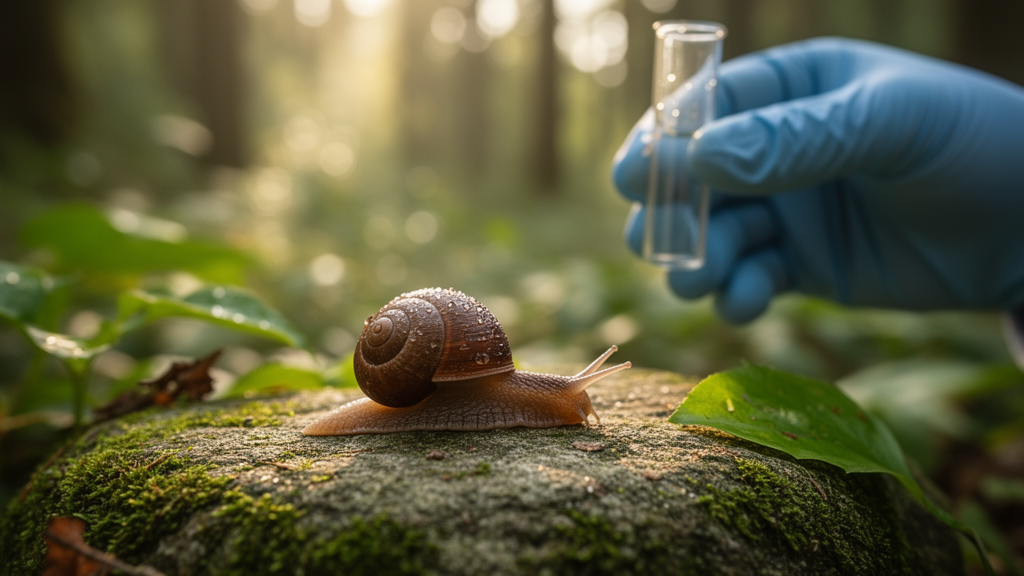
For centuries, taxonomists have argued about where one species ends and another begins. Nowhere is that struggle more visible than in land snails, whose shells often vary so wildly within a single population that a dozen forms can be mistaken for a dozen species, while genuinely distinct species may look almost identical. A new study published in Frontiers in Zoology offers a practical way out of this maze. A team led by Jeffrey C. Nekola of Masaryk University in Brno, together with colleagues at the University of New Mexico, has developed and validated a strategy for finding single-copy nuclear DNA markers that can be amplified cheaply and reliably to tell closely related species apart. Their proof-of-concentrate group was the eupulmonate gastropods, an extraordinarily diverse lineage of snails and slugs that includes roughly 35,000 described species.
The central problem the researchers set out to solve is one that anyone who has tried to build a species-scale phylogeny knows well. The standard workhorse markers used in molecular taxonomy, such as the mitochondrial cytochrome oxidase 1 gene (CO1), the 16S ribosomal RNA gene, and the nuclear ribosomal cassette regions 18S, 28S, ITS1 and ITS2, either lack enough informative variation to discriminate recently diverged species or suffer from problems such as paralogy, introgression or poor amplification across broad taxonomic spans. Restriction-site associated sequencing, or RADseq, and whole-genome approaches generate far more data, but they scale poorly when a study needs to sample hundreds or thousands of specimens, as is often required for testing species hypotheses across geography and morphology.
The solution proposed by Nekola and his colleagues bridges these extremes. Their workflow begins with next-generation sequencing: they assembled partial nuclear genomes for a strategically chosen set of taxa whose genomes span the eupulmonate phylogeny, combining newly generated Illumina assemblies, including those of the genera Rumina and Vertigo produced with support from the Center for Evolutionary and Theoretical Immunology at the University of New Mexico, with publicly available genome assemblies. From these assemblies they searched for ultraconserved elements, or UCEs, regions of the genome that have remained nearly unchanged across millions of years of evolution and across vast evolutionary distances.
Ultraconserved elements are attractive starting points because their conserved cores allow universal primers to bind in almost any organism, while the DNA flanking those cores often accumulates variation at just the right pace to distinguish species-level clades. Across the 14 de novo and public genome assemblies used in the study, the team identified approximately 24,000 ultraconserved elements. That enormous catalog then had to be filtered down to a workable set of markers, and the filtering criteria were demanding. A candidate region needed to be present as a single copy in the genome, to be flanked by DNA suitable for designing universal PCR primers, to contain enough variable sites in its flanking sequence to discriminate species, and to produce a clean, readable amplicon in a standard polymerase chain reaction.
Single copy status matters enormously. Many nuclear genes occur in multi-gene families, and amplifying the wrong family member or several paralogs at once can produce mixed sequences that mislead phylogenetic inference. By targeting regions anchored in ultraconserved elements that are demonstrably single-copy across the genomes examined, the researchers reduce the risk of paralogous amplification and ensure that sequence differences between specimens reflect true evolutionary history rather than gene duplication artifacts. The approach therefore combines the universality and reliability of conserved primer sites with the discriminatory power of variable, independently inherited nuclear loci.
After computational screening and experimental validation, the pipeline yielded 61 informative universal PCR targets. Each of these loci can be amplified by standard PCR and read by conventional Sanger sequencing, the oldest and most affordable sequencing technology, which remains the workhorse of most taxonomy laboratories around the world. This is the crucial practical point of the study: instead of requiring expensive genome-scale sequencing for every specimen, researchers can now recover targeted sequence data from loci known in advance to contain useful phylogenetic signal, at a fraction of the cost and with far greater throughput than genomic methods.
The design of the PCR strategy also reflects careful attention to laboratory efficiency. The authors even credit a clever protocol refinement to Veronika Horsáková, who suggested running all outer PCR reactions within a given marker panel in a single combined reaction, streamlining the workflow further. Such details may seem minor, but in a method intended to be scaled to large sample sizes, every saving in hands-on time multiplies across hundreds of reactions. The team also notes support from colleagues who contributed specimens and helped generate multiple sequence alignments for the target regions, underscoring the collaborative and iterative nature of marker development.
Why does this matter beyond malacology? Species demarcation is the foundation of integrative taxonomy, conservation policy, and biodiversity assessment. When species limits are ambiguous, conservation resources are misallocated, ecological studies become irreproducible, and legal protections may be impossible to enforce. The eupulmonate gastropods are an ideal test case precisely because they are so species-rich and so morphologically plastic: solving their species boundaries with molecular markers demonstrates that the approach can handle some of the most taxonomically intractable animal groups on Earth. The same pipeline, built on genome assemblies and ultraconserved elements, should in principle be transferable to any clade for which even a handful of genomes are available.
The study also highlights a broader shift in how evolutionary biologists think about data. Whole-genome sequencing has made enormous catalogs of conserved elements and other markers available for almost any organism, but translating that genomic wealth into tools usable by the wider community of field biologists and museum taxonomists requires exactly the kind of translational work described here. By publishing the marker list and protocol in an open access paper, with supplementary materials including spreadsheets and data files, the authors have effectively handed the research community a ready-made toolkit. Every one of the 61 targets has been experimentally validated, meaning laboratories can adopt them without repeating the developmental pipeline from scratch.
The work was funded by the Czech Science Foundation under Grant 22-23005 S, with additional support for the pilot genome assemblies from the Center for Evolutionary and Theoretical Immunology at the University of New Mexico. The paper, published open access on 15 October 2026 under a Creative Commons Attribution 4.0 license, was received on 28 February 2026 and accepted on 9 October of the same year. The authors, including Coen M. Adema, Eva Mikulášková, Farshad Nejat, Markéta Nováková, Marijan Posavi, Takumi Saito and Michal Horsák, report no competing interests. In an era when biodiversity is vanishing faster than it can be cataloged, tools that make species-level resolution affordable and scalable may prove to be among the most consequential contributions to taxonomy in a generation.
Subject of Research: Development of single-copy nuclear PCR markers from ultraconserved elements to resolve species-level clades in eupulmonate gastropods
Article Title: Identification of single-copy nuclear PCR targets for resolution of species-scale clades: a proof-of-concept using eupulmonate gastropods
Article References: Identification of single-copy nuclear PCR targets for resolution of species-scale clades: a proof-of-concept using eupulmonate gastropods. (n.d.). https://doi.org/10.1186/s12983-026-00637-y
Image Credits: AI Generated
DOI: 10.1186/s12983-026-00637-y
Keywords: ultraconserved elements, PCR, Sanger sequencing, species demarcation, eupulmonate gastropods, nuclear genome, integrative taxonomy, next-generation sequencing, phylogenetics, land snails, molecular markers, biodiversity
Cite Scienmag News
Juliet Wilcox. (October 15, 2026). New Genetic Toolkit Promises to untangle Species Boundaries in Land Snails and Beyond. Scienmag. https://scienmag.com/new-genetic-toolkit-promises-to-untangle-species-boundaries-in-land-snails-and-beyond/
Juliet Wilcox. "New Genetic Toolkit Promises to untangle Species Boundaries in Land Snails and Beyond." Scienmag, 15 October 2026, https://scienmag.com/new-genetic-toolkit-promises-to-untangle-species-boundaries-in-land-snails-and-beyond/. Accessed 15 October 2026.
Juliet Wilcox. "New Genetic Toolkit Promises to untangle Species Boundaries in Land Snails and Beyond." Scienmag. October 15, 2026. https://scienmag.com/new-genetic-toolkit-promises-to-untangle-species-boundaries-in-land-snails-and-beyond/


